
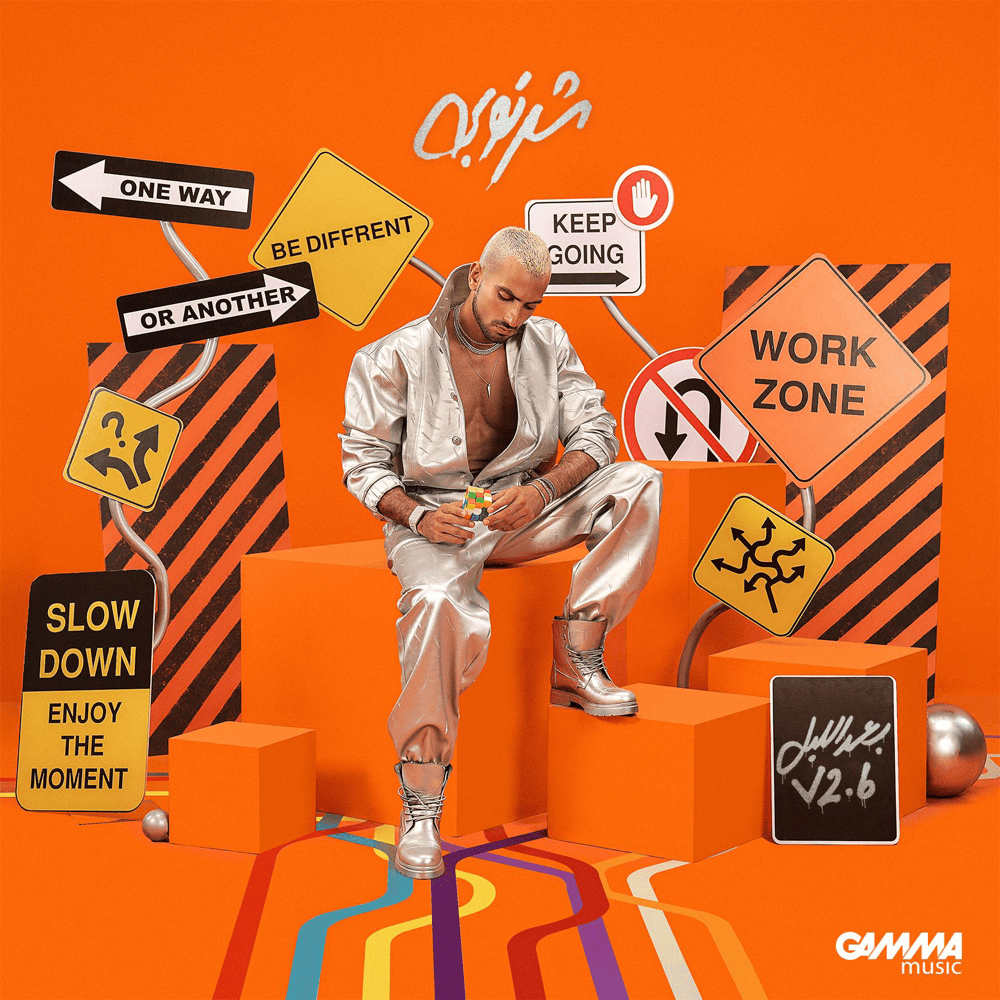
My journey of discovering Sharnouby started backwards. While the singer and actor has held a steady place in Egyptian pop culture, he existed in one of my many blind spots. I encountered him first when his latest album Ba3d El Leil V2.6 appeared on my Spotify Discover. My wife, an Egyptian pop culture head, instantly gave me the 101: how his career started early as an actor, his affection for tarab and classical Arabic singing, and what quickly became one of my favorite gems on YouTube: his tarab renditions of mahraganat classics like “El3ab Yala” during a talk show appearance.
Up until that point, Sharnouby’s career was moving in a single, predictable, and comfortable direction, before something happened in his life that forced a reckoning. A divorce. In 2022, his marriage to Randa Riad, business manager to the singer Angham, came to an abrupt end only a year and a half in, and while the separation stayed largely out of the public eye, what came next paints a clearer picture of its emotional impact.
In a recent TV interview, Sharnouby reflects on the past four years, and tells a story of self-discovery, or rather re-discovery, following his divorce. It started with a feeling that he, personally and artistically, was lost and immature, that he needed to find himself, and to grow. He brought his music career to a screeching halt, built a small studio, and started taking stock of his creative process. He taught himself production, held workshops and creative camps with some of the most exciting voices in today’s Egyptian music. He even tried his hand at writing lyrics. He wanted to put out a “born again” album, and it took him upwards of four years to get to a place where he felt he earned releasing such an album.
In a year when we saw several indie darlings begin to outsource increasing parts of their creative process, from composition to lyrics and production, Sharnouby’s Ba3d El Leil (Arabic for After the Night) swims against that current, and sees him transitioning from a singer into nearly an all-in-one musician. The album still teems with collaborators, including recognized hit-makers, but hardly a single aspect of the album is untouched by Sharnouby’s contribution.
The focused eight-track record, sitting at just 23 minutes, starts with its best foot forward, the gypsy-inspired electro-pop cut “Zai El Ghagar,” composed, mixed, and co-produced by Sharnouby, with production credits to electronic producer and DJ Amr El Banna, and lyrics credit to hit-maker Flipeno, whose name appears on massive hits like Ahmed Saad and Ruby’s “Ya Layali.”
It’s hard to resist comparing the song with Amr Diab’s “Baba” from last year, as both share vivid, bright electronic production weaving samples from Upper Egypt soundscapes. Another accomplishment of the track is sounding distinctively fresh and of its time, a weird thing to say about a song, true, but it’s 2026, a year that will go down as the Year of Interpolation, and listening to a complete pop record that’s unbothered with regurgitating old hits is bliss.
I’ve been recently joking that Egypt might have produced more flamenco tracks than Spain this year, and my joke finds another piece of evidence in Sharnouby’s album with the second track, “Habeet.” Written by Mostafa Nasser, while composed and arranged entirely by Sharnouby, the song contributes another breezy, acoustic love song to a year that has already had one too many.
The album returns to electro-pop bangers territory with “Ana Ha3mel.” Written by Flipeno, composed by an Amr Diab go-to, Ehab Abdelwahed, and produced by indie pop majesty Ismail Nosrat, the song delivers a dynamic Sahel road-trip soundtrack, but most importantly, it begins to tease, in shy amounts, Sharnouby’s honed and skillful vocal capabilities, executing the type of intricate intonations that are becoming more and more scarce amongst Arab pop’s new generation.
On “Ghorba,” one of the album’s standouts, Sharnouby teams up with another indie producer, this time shaabi-pop aficionado El Waili, taking the record to a darker, sadder, and more lyrically sophisticated corner of Arab pop. The core theme around alienation in romantic relationships gives Mostafa Nasser a specific emotional register to work within, as compared to the generic heartbreak song.
Songs like “Fein Ma Trouh,” entirely composed and arranged by Sharnouby, paint a clear picture of his evolving production style. His sounds are familiar but tastefully curated and lush, with a strong preference for instrumental samples, lending the record a cheeky hybrid edge between acoustic and electronic. He leans towards packed, fully exploited soundscapes, using as many samples and virtual instruments as he can and stopping just before things get excessive. While nothing across the record is radical or, for lack of a better term, far out, for a first self-produced release, it delivers enough and promises more.
Then we arrive at the album’s titular track, the track around which the album was built. Here, Sharnouby takes all the credits, composing, arranging, and penning the lyrics, turning only to sound engineer Ammar Khater for mixing and mastering.
The track is ambitiously composed and arranged, almost to a fault, mixing broad influences from Arab pop, global electro-pop, and rock, featuring oud alongside electric guitar, and boasting a complex melodic structure. Yet, the song’s best feature is its lyrics. Now this is a real breakup song. It’s not single-mindedly angry, blaming, or apologetic; it’s all of that at once, circling around an emotional axis familiar to anyone who has experienced the end of a high-stakes relationship: Grief.
Sharnouby ends the record on a happier note with “Khamsa,” a cheerful, big pop song that arrived two months late for the World Cup, where it could have organically turned into an anthem for the Egyptian team, as the lyrics can be interpreted as talking to a lover or to Egypt, particularly due to its use of the word “Tahya (Long Live),” commonly used in addressing Egypt, most famously in the ubiquitous slogan “Tahya Masr (Long Live Egypt).”
It’s been a while since we got a pop record with an honest-to-god emotional arc behind it. Across each of its eight tracks, Ba3d El Leil resists some of the worst impulses of this year’s Arab pop, while it serves as a diary of growth and self-discovery for an artist who, four years ago, decided he could make better music. He was right.





Abdi Declares the SDF Integration Into the Syrian State Complete
The SDF has completed its integration into Syria’s state institutions, a major step toward a unified Syria.