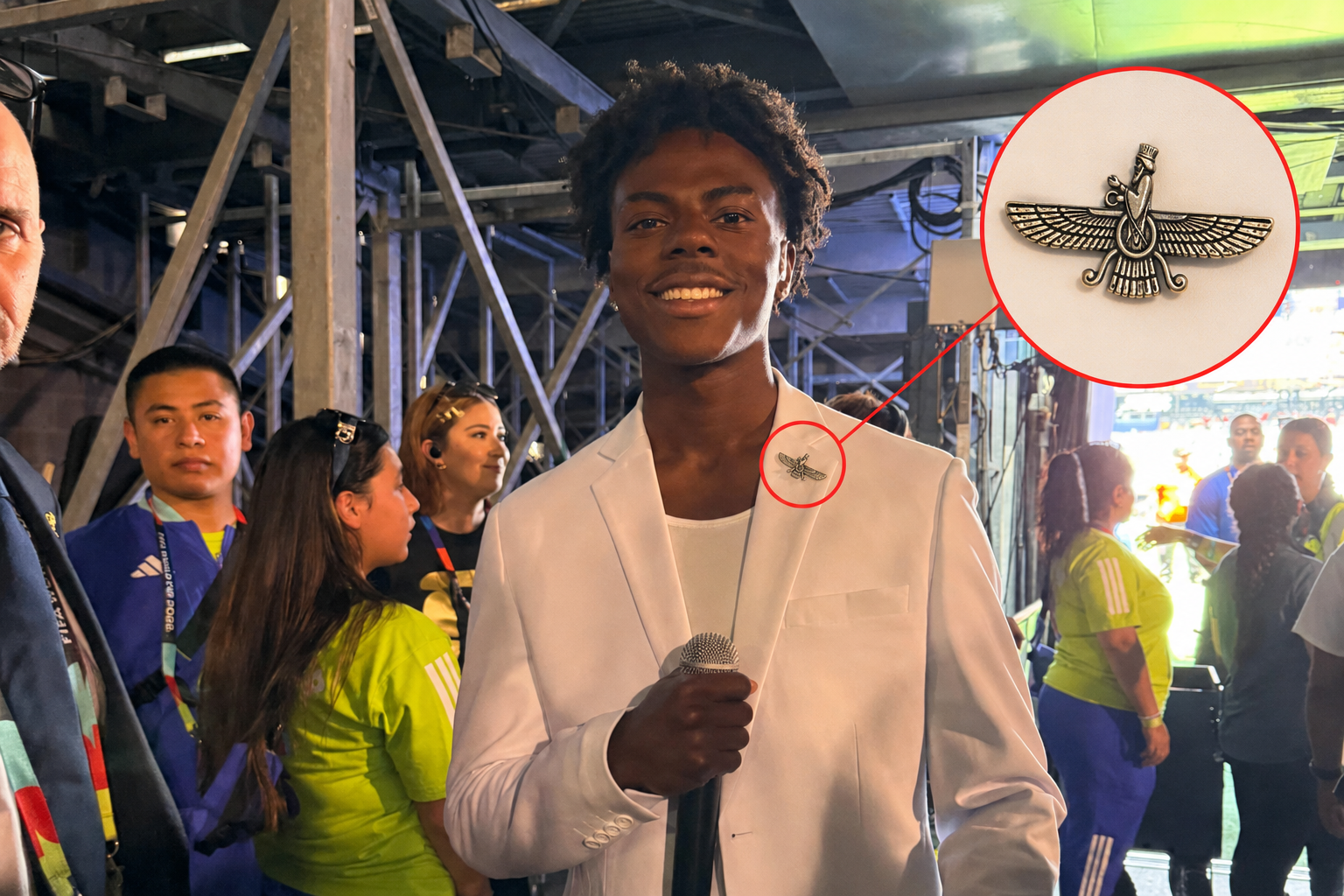
To most, it likely passed unnoticed; but, once we caught a glimpse of the farvahar pin glittering away on IShowSpeed’s white blazer during his 2026 World Cup Final halftime performance, we Iranians couldn’t stop looking at it. Nor, evidently, have some of us been able to stop talking about it.
I mean, it’s not every day you see a non-Iranian celebrity sporting a symbol representative of ancient Iran and Zoroastrianism, especially at such a high-profile event as the World Cup. That said, IShowSpeed isn’t the only American star with a penchant for the farvahar. Johnny Depp was spotted wearing a farvahar ring throughout his 2022 defamation trial, and there’s of course Snoop Dogg and Amitis’ Persian-themed ‘King’ music video from 2015, in which the former rapped on a throne beneath a giant farvahar.
How do we feel about this? Divided, in true Iranian fashion. Some of us have taken offence at such adoptions of this national and religious symbol, regarding them as instances of cultural appropriation.
While aspects of Iranian culture, like our architecture and Persian poetry, certainly have been appropriated — and I feel Zendaya showed sheer disrespect and insensitivity in wearing likely-looted or shamelessly-sold 3,000-year-old Iranian earrings to the Odyssey premiere — it doesn’t bother me (or others with a similar perspective) in the slightest that the likes of IShowSpeed are wearing farvahars.
Especially in the age of social media, I, as a Zoroastrian Iranian, think far more non-Iranian celebrities are welcome to follow suit, as they can bring attention to a culture and philosophy that have been struggling to survive for millennia and are at serious risk in, of all places, Iran.
A Traveling Myth
With aesthetic antecedents in Assyrian and Egyptian iconography, the Iranian farvahar depicts a bearded man clutching a ring in the centre of a winged disc. It’s a symbol that can be prominently seen at ancient sites like Persepolis (the capital of the first Persian empire) and on the tombs of the Achaemenid Persian emperors at Naghsh-e Rostam; and, while Iranians of diverse beliefs and backgrounds inside and outside the country proudly wear the farvahar as a national symbol in the form of pendants, pins, and tattoos, it has also come to represent the ancient and indigenous Iranian religion of Zoroastrianism.
As popular as it is, though, even many Iranians aren’t aware of the farvahar’s meaning — which is understandable, as there isn’t one brief answer.

Some scholars suggest it’s a symbol of the glory of Ahura Mazda (God), which gives kings legitimacy when bestowed upon them (and vice-versa). In Iranian art, this ‘glory’ (or, farr) can also be seen in the form of a halo.
Others say that Darius the Great used the farvahar to represent both Ahura Mazda (in the form of the bearded man) and his own divine legitimacy (via the winged disc). On the other hand, some Zoroastrians view the farvahar as a depiction of a fravashi, a sort of guardian angel each person has and is spiritually linked to.
But what is Zoroastrianism, anyway? In brief, it’s a monotheistic religion centred around the philosophy of the Iranian prophet Zarathustra (or, Zoroaster), who is said to have lived sometime around 1,000 BCE (though some scholars have suggested much earlier dates). Zarathustra reformed the Iranian branch of the Aryan religion, worshipping Ahura Mazda (the ‘Wise Lord’) as the sole source of life and goodness and urging humanity to choose goodness over evil — for example, by practising virtuous deeds instead of appeasing the wrath of the dastardly daevas through animal sacrifices — in what he, in his Gathas (hymns), viewed as a cosmic battle between the two; and, while the idea of fate is antithetical to Zoroastrianism, which has free will and human agency at its centre, Zoroastrians are adamant about the occurrence of one future event (and happenings related to it): the ultimate triumph of goodness over evil.
Between Iraq and a Hard Place
Given the way he depicted it, Mr Dogg was most likely aware of the farvahar’s associations. I’m not sure if IShowSpeed and Johnny Depp were. Even if such celebrities simply find the farvahar fashionable, their wearing it brings much-needed attention to indigenous Iranian culture, which includes Zoroastrianism, and which has been struggling to simply exist for thousands of years.
Ever since the fall of the Sassanian Persian Empire, whose state religion was Zoroastrianism, indigenous Iranian culture has been under threat. We Iranians have had to fight tooth and nail to preserve the Persian language (and other Iranic languages, like Kurdish and Gilaki), traditions like the Iranian New Year (Norooz), our history, and our very identity.

This is especially true today. From 1979 until now, the Islamic Republic has been steadfastly trying to eradicate indigenous Iranian culture. Shortly after it came to power, for example, it tried to raze down Persepolis. It has striven to do away with the Iranian New Year, shows a disdain for the Persian language and Iran’s most celebrated poets (like Omar Khayyam and Ferdowsi, whose monumental tomb in eastern Iran is now missing its farvahars), and is actively muffling any and all echoes of ancient Iran in the consciousness of the masses.
Looking at some discussions on social media, I can see that the farvahar’s presence in American pop culture is achieving this, to some degree. ‘Today I learned about Zoroastrianism, thank you!’ wrote one Redditor in reference to Depp’s ring. Another brought to light the persecution Zoroastrians — Freddie Mercury’s ancestors amongst them — have long faced: ‘A lot of Zoroastrians fled to India to escape persecution… My friend has been watching the trial and pointed this out as she too wears a [farvahar] charm necklace. Made her so happy!’ And, there’s the Redditor who, commenting on IShowSpeed’s pin, wrote, ‘[It] doesn’t matter in this instance [what he supports]. He’s the world’s most popular streamer, on the biggest stage. Our history is constantly being forgotten and rewritten. Any attention helps.’
As mentioned, however, IShowSpeed has ruffled a few feathers. ‘Cultural and religious appropriation at its finest’, opined one Redditor. ‘The good faith being represented by foul people is unacceptable’, wrote another, with yet another Redditor adding, ‘It is… disrespectful because, in my opinion, he might be unaware of the [farvahar’s] significance…’
Thus [Never] Spake Zarathustra
Such negative comments about the inappropriateness of these celebrities donning the farvahar prompt a few questions.
The first question has to do with the non-exclusivity of Zoroastrianism. Zoroastrianism isn’t reserved for a particular people or nation, and in none of Zarathustra’s Gathas (hymns) is there anything about exclusivity, initiation ceremonies, or even the farvahar. What if the Zoroastrian motto, ‘good thoughts, good words, good deeds’, simply resonates with Depp (who apparently identifies as agnostic), IShowSpeed (who, as some point out, seems to be spiritually confused), and Dogg (who would likely add, ‘and good weed’)?

Second, given that the farvahar is also a national symbol, why can’t others wear it to show appreciation for Iran? Can I not, for example, play Noel Gallagher’s Union Jack guitar because I’m not British? Similarly, from a national and religious standpoint, does my not being Christian preclude me from wearing a nation’s football jersey with a crucifix on it, as in Norway’s case?
There’s also the fact that, as mentioned, the farvahar as a symbol derives from the iconography of non-Iranian cultures. If we ourselves appropriated, in a way, the aesthetics of the farvahar, why can’t IShowSpeed wear one? Surely, Darius the Great (during whose reign it first appeared in Iran) must have also thought it looked cool, amongst other things.
Indigenous Iranian culture is experiencing one of its darkest moments in history. Even if they simply find it appealing (although who am I to say if there’s more beneath the surface?), such celebrities can, whether wearing the farvahar as a chic accessory or sitting pretty on an ancient Persian throne beneath one, shine a welcome light on a culture and worldview that are at risk of being snuffed out — not from abroad, but at home. Now, if only Zendaya could put those earrings back where they belong…