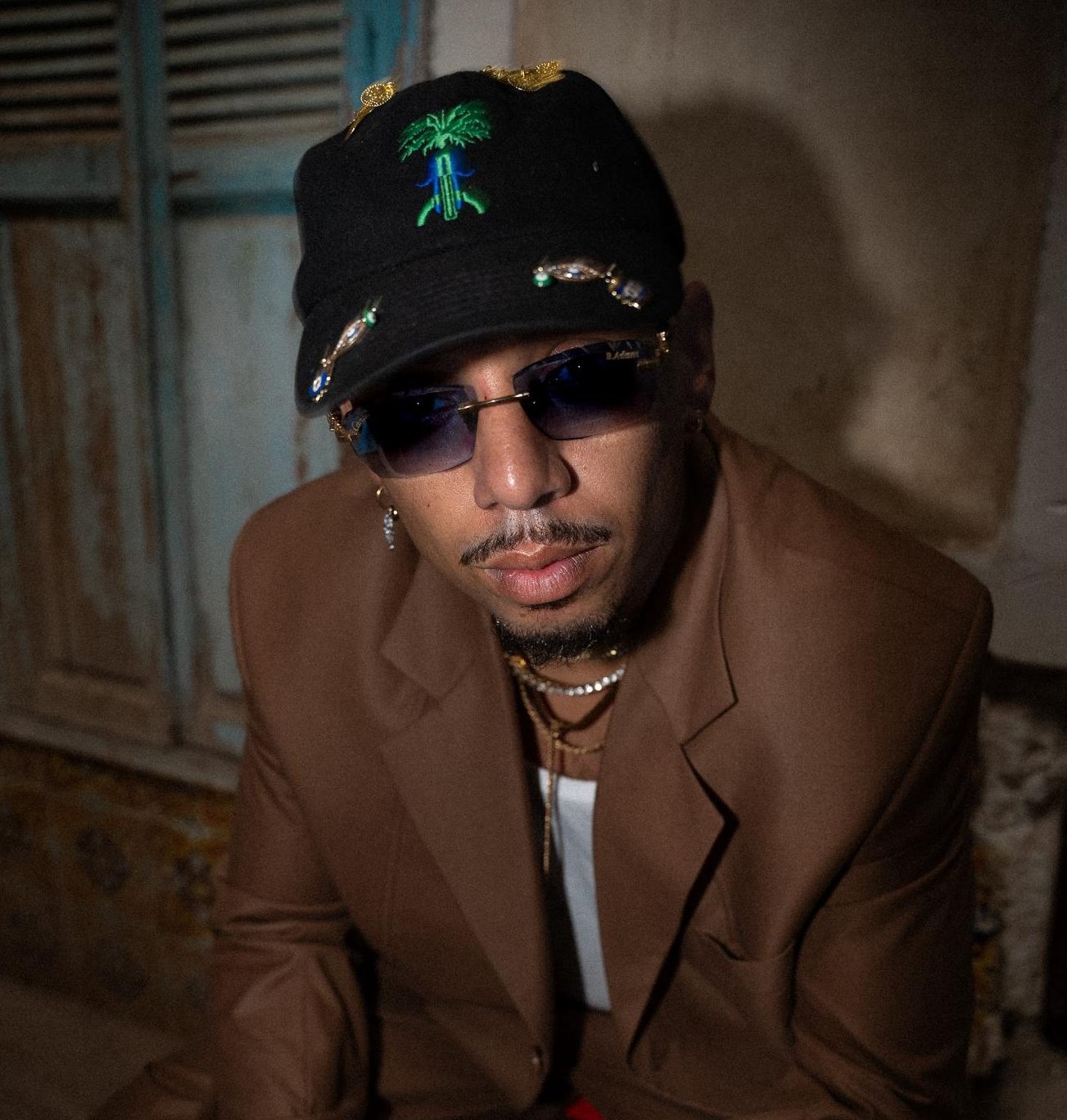
When an infectious song blares through the speakers, imploring people to dance the night away, it’s hard to ignore that calling. Benny Adam’s viral hit single, “Mok ya Mok,” does precisely that.
The song, released this past February, amassed 19 million views almost instantaneously, calling North Africans and Moroccans residing in the diaspora to celebrate and cement their independent journeys back to self and the responsibility of the legacies they hold.
“When you’re away from Morocco, everything gains weight: the tea, the dialect, even the chaos of Casablanca traffic,” Adam tells Rolling Stone MENA from his window-filled studio home in Morocco. “That distance taught me that my identity is a blessing, not a burden.”
The music video for the song begins with a Moroccan man packing up his Parisian apartment with his non-Moroccan girlfriend. He begins to sift through old cassettes and plays one with a written note on it. The moment he hits play on the player, he’s brought back to life; every fiber of his being is moved.
The man is literally unable to control himself from the hypnotic melodies that flow through him.
“Mok ya Mok” captures the memories and feelings of generations of diasporic Moroccans caught in the crossroads of cultures, languages, and time zones.
“Moroccan nationality is acquired at birth and can never get lost,”Adam shares. “It speaks to something unfiltered that a lot of us in the diaspora carry inside. There’s pride, nostalgia, confusion, identity, all wrapped into one feeling. You don’t have to choose, you are all of it. And that’s your power.”

Adam held confidence at an early age, leaning into his entrepreneurial spirit. He was born in Casablanca, Morocco, and moved to Montreal in 2001. He began his creative journey as a cartoonist, selling his custom-made comic books in school.
As he drew his illustrations, Adam would listen to Algerian icon Cheb Khaled, French singer Charles Aznavour, and French rapper Booba in the background, slowly falling more in love with sound.
In 2005, when Adam turned 16, he expanded his hustle to selling his CDs to fellow classmates in school. The year proved to be pivotal to understanding his own musical presence, transforming the school yard into an immersive sound and rap experience. His evolution continued to expand into production and eventually led to the founding of an entirely new genre: Draï.
Draï, Adam explains, is a unique blend of culture and life experience, drawing from his Amazigh ancestry and the vibrancy of Moroccan excellence in every beat and stage he graces.
Draï, he adds, is a sonic blend of drill, Algerian Raï, and Moroccan chaabi music.
“Draï isn’t just a blend—it’s a statement,” Adam says. “It’s proof that we can be modern without erasing where we come from.”
Adam shares that the powerful sound of draï is rising to the surface both in and out of Morocco, thanks in large part to the genre’s combination of drill’s structure and aggression, Raï’s emotion, and chaabi’s rhythm.
Despite that, Adam shares that draï still feels too underground and lacks the proper credit and recognition.
“People don’t know it,” Adam bluntly explains.“Even in Morocco, it’s not respected by institutions. It’s like hip-hop in the States—it’s always been marginalized, but it’s the most powerful thing there is.”
Adam underscores the importance of legacy and history by including an excerpt from a speech by Moroccan King Hassan II in the song, which addresses issues surrounding identity and assimilation.
“When he talks about how Moroccans can’t be assimilated, about the West not trying to understand us—he was right,” the artist says. “King Hassan II stated that if they got the first generation, the second or third would be pulled back to Morocco. That’s exactly what happened to me—and 75% of the Moroccan soccer team, too.”
This idea of having a generational conversation among Moroccans runs deep in the artist’s work and is integral to the inception of “Mok ya Mok”. “This collab is not a remix—it’s a spiritual exchange between eras, with the same emotional frequency,” Adam asserts, highlighting his goal of preserving the art and innovating, not changing entirely.
Adam first stumbled upon the Moroccan legend Khadija Warzazia when his friend told him about her. He was inspired by her 22 years of experience as the leader of Bnat el Houariyat, an all-women music and dance group based in Marrakech.
Warzazia is one of the first women to publicly perform Houara music, a practice historically dominated by men that embraces a mix of indigenous and Arab music originating in the southwestern Moroccan towns of Taroudant and Ouled Teima and the surrounding areas.
“I dug through her old records and came across a live recording of ‘Mok ya Mok’—it stopped me in my tracks,” Adam says of Warzazia. “It wasn’t just beautiful; it was timeless. I didn’t want just to sample her. I wanted to have a conversation with her across generations.”

If you phonetically pronounce the name ” Benny Adam,” you’ll notice it translates directly to “Bani Adam,” which means “son of man” in Arabic—that embodies what it means to be the descendant of the original man.
He states that, “At the end of the day, I’m Moroccan, but I’m also Bani Adam. I feel like I belong everywhere.”
Adam’s work conveys a transnational consciousness— a love letter to those who speak French, Arabic, Darija, and indigenous languages, and to those who call many places home. Adam sings “Maro-canadien, muslim arabo-berbère afro-caucasien,” in his lyrics, thus claiming every layer of his identity.
He reflects, “I don’t make music to cater. I make it to leave a blueprint—for the kids who look like me, sound like me, and want to create with no compromises. My albums aren’t here to sell something; they’re here to say something. This is the trail I’m leaving behind, so others can walk further.”
His grounded disposition comes even as his sound builds global momentum.
“I don’t think about the buzz. I don’t think about success or numbers,” he explains. “I create like a five-year-old who’s just happy to be in the studio. That’s how I stay aligned with my essence.”
He keeps no platinum plaques in his studio despite earning over 20. “I want to feel like I’m new to this. That energy keeps me excited, keeps me curious.”
Adam tells Rolling Stone MENA, “My identity is layered, complex, beautiful— it’s a mirror for the ones who rarely see themselves fully reflected—but who exist everywhere”
And to any 13-year-old Moroccan kid in Montreal just discovering his music, Benny’s advice is simple.
“Keep doing whatever you’re doing. The answers will unfold. This path will take you where you need to go.”