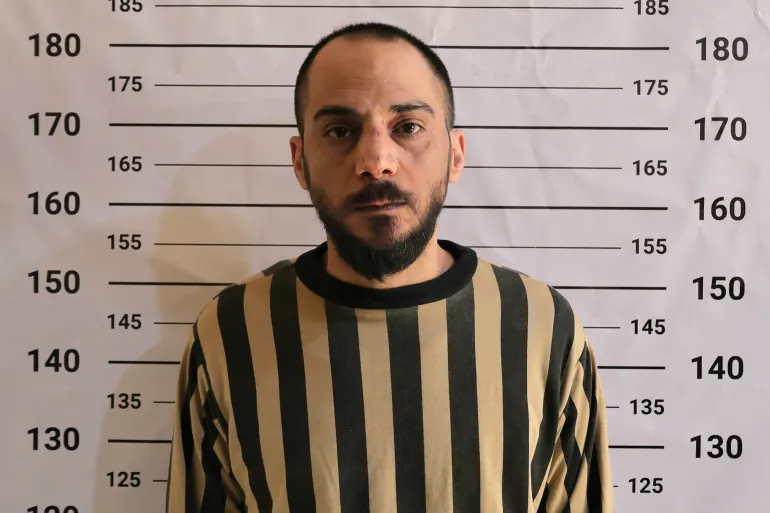
More than a decade after the massacre – and years after the footage first surfaced – Syrian authorities have finally arrested Amjad Youssef, the man long identified as the documented perpetrator of the Tadamon massacre, one of the most clearly documented atrocities of the Syrian civil war.
The Interior Ministry said the arrest was carried out through what it described as a “meticulously executed security operation,” adding that Youssef Amjad is considered the primary suspect. Interior Minister Anas Khattab confirmed the development publicly, stating that Youssef Amjad is now in custody.
Amjad Youssef, identified as the main perpetrator of the Tadamon massacre, has been captured and is now in custody after a successful security operation.
— أنس حسان خطاب (@Anas_Khattab_sy) April 24, 2026
The massacre dates back to 2013, but it did not fully enter public consciousness until a leaked video began circulating years later. In it, a uniformed man – identified by investigators as Youssef Amjad – orders a group of blindfolded civilians to run, only to open fire on them moments later. Their bodies are then dragged and dumped into a pit already filled with victims, before being set ablaze.
Investigations have put the death toll at no fewer than 41 civilians. The footage quickly became one of the most widely cited pieces of visual evidence of the petrifying execution-style mass killings during the war.
A 2022 investigation by The Guardian, conducted with the Newlines Institute, reconstructed the incident in detail, confirming the location, sequence of events, and identities linked to the video.
The Guardian described how the executions appeared methodical, with blindfolded detainees taken from a small white transport vehicle and led to a large pit lined with car tires. A second soldier, affiliated with the Syrian armed forces, was shown using an AK-47 to carry out the shootings.
In one of the published clips, an executing soldier is seen addressing his superior in Syrian dialect: “For your eyes, boss, and for the olive-colored uniform you wear.”
The investigation also concluded that the killings were carried out “in cold blood,” with victims showing no sign of restraint or hesitation, and in some instances suggesting a disturbing sense of enjoyment in the act itself.
The case later expanded to 27 video clips reviewed by researchers, documenting a total of 288 victims, including young men, middle-aged civilians, and a smaller number of women, children, and elderly individuals.
The case regained momentum after the fall of Bashar Al Assad’s government in December 2024, when families from the Tadamon area began reporting additional alleged killings from the early years of the conflict.
Since then, Syria’s new authorities have periodically announced arrests linked to alleged war criminals from the Assadist regime. However, Youssef Amjad’s arrest stands out, not only for the unequivocal monstrosity of the crime itself, but for the clarity with which it was documented, leaving little ambiguity about what took place.
The arrest reopens a case that was never really closed, returning it to the heart of Syria’s unresolved questions over wartime crimes, while families of victims continue to await justice.