West to East and from Cali to Pali, City of Angels plays like a night drive you take solo. Los Angeles is still glittering behind you, palm-shadows and lights, eyes that read you before you speak. Then, mile by mile, something else starts to appear ahead, softly at first. Jerusalem arrives the way it often does in ghorbah, in exile, as a pressure in the chest, as somewhere you can feel before you can see.
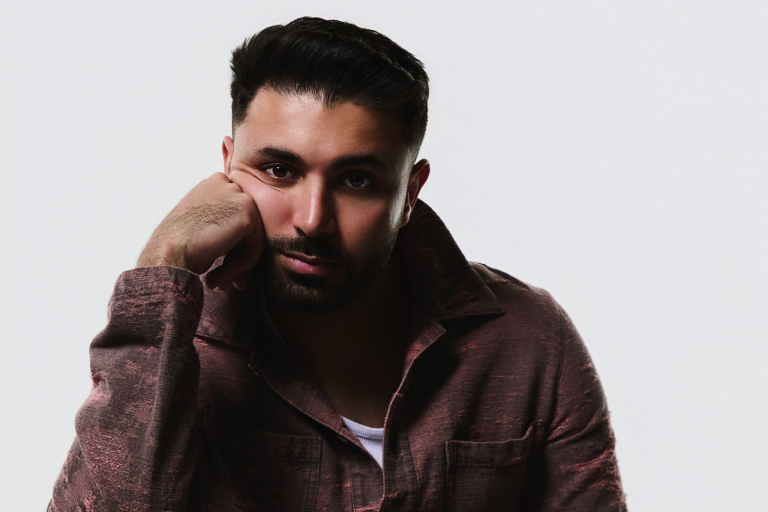
A Jerusalem-born, Palestinian rapper pushing through diaspora, City of Angels is Konstancy’s debut album, built with Los Angeles as its landscape and Palestine as its inner compass. Its writing lives in that corridor between places, where the body stands in one city and the heart walks another.
The beats stay smooth, old-school warm, built for cruising. The voice stays calm, built for carrying. The record moves at its own pace. It trusts the distance. Part of that control lives in the production choices, including work from Illmind and Mario Luciano, names that help explain the album’s ease. Their presence shows up in what doesn’t get overcrowded: drums that stay patient, melodies that glow and then step back, space that leaves Konstancy room to carry the verse. You also hear an artist who knows the power of restraint, who understands that coolness becomes a language when your life has taught you to keep the longing from spilling everywhere.
That’s the first thing the album gets right. It never feels rushed to impress. It feels lived-in. The whole thing lands like your shoulders dropping as you finally reach that quiet stretch of freeway and the noise falls behind you.
The night before the album dropped, Konstancy posted “Opps in the Hills,” a three-minute Instagram freestyle. Smooth and composed. A late-night temperature check. It set the tone for what City of Angels does at full length.
When “Welcome to the City” hits, the arrival scene comes with its own running commentary. “Palm trees out the window when the plane land,” TSA mangles your name, and the gaze lands: “there go another Arab.” He clocks the aesthetic too, the revolution as accessory: “Seen two white ladies rockin kuffiyehs… They done gentrified the revolution baby, count me out.” Even his sarcasm stays controlled, almost polite: “But fight on ma’am, shit more power to ya.” The hook turns into a sentence you carry as your bags circle the carousel: “You gotta watch yourself.” In this city, even angels learn how to fight.
Then the album settles into its cruise. The songs behave as scenery, as memories surfacing the moment the beat opens space. Konstancy lives in that pocket. He lets the instrumental breathe, and the listener with it. The ride stays steady while the mind drifts where it wants.
There’s an edge that stays quietly present. You hear it in the way Konstancy carries himself. His pen stays sharp while the beat stays smooth. “Spin the Block” brings that muscle forward. The grip tightens, and behind the calm sits a world of systems that watch, police, label, and punish. He writes from close range: “Mass incarceration, occupation by police / Patrolling every pavement, how the fuck can I find some peace?” “Angel” opens the chest of the record. Especially in the second verse, the song reads as a letter written when the house finally goes quiet, when love shows up as responsibility. He inhabits a voice, a father shaped by occupation, instability, and loss, carrying the ache of loving someone from far away.
In his own words, “Angel” was written with Reem Nabhan and Hind Rajab in mind, not as a literal retelling, but as a way to hold the innocence that keeps getting taken. The words land because they’re lived. Midway through, his voice softens into something almost parental: “Keep my angel closest / Even when I’m gone baby / I’m right here on your shoulders.” He closes with the line that lingers the longest: “I dedicate this here to the soul of my soul,” a phrase that traveled from Gaza, and a phrase that fits this album’s bloodstream, love as shelter, love as inheritance.
“Thick N Thin” works as the exhale. Survival turns into a chorus. Talking with Konstancy, he describes writing that verse on a rooftop in Jerusalem while watching rockets pass overhead on the way to Gaza, speaking directly to his younger brother. He goes back to 2001, his brother’s birth during the Intifada, the road to the hospital threaded with tanks and gunfire, and the way they kept moving anyway. The warmth comes from how protective it is even while it’s documenting violence. “Alhamdulillah we still breathin homie,” he says, then turns and steadies his brother with the simplest prayer: “My brotha I pray that you don’t fall and break.”
“Watermelon Sweetheart,” with Lana Lubany, brings sweetness into the corridor. Romance comes the way it comes in exile, softness braided into alertness. Lana adds brightness that stays grounded, and the hook captures the album’s favorite braid, sugar and steel in the same hand: “She a rebel and a diva… my shooter and my keeper / Extra sugar in my tea cup, I’m talkin bullet in my gun.” Love, here, carries tenderness and protection at once. The track flashes through the windshield, vivid and quick, then disappears, leaving a grin behind.
“Dreams” is where hunger starts to hum louder. The hook loops for long nights, the kind you repeat while the world takes its time catching up. “I used to pray for times like this,” he says, and the song turns that prayer into motion: flights, studios, old streets, new rooms, life lived out of a bag.
That steady cruise gets its moment of speed. “In My Bag” kicks the needle up. 120 mph. Tinted windows. City lights smearing into lines. Adrenaline sharpening the world. The track is a surge, a shot of heat on an album built for glide. You hear release in it, the brief freedom of letting the ego run, the relief of moving fast enough that thoughts can’t catch up.
“Hero” is the heart of the drive, and it hits the hardest. Konstancy tells it the way you tell stories at the table: a grandfather, a mentor, a man whose love showed up in lessons, in respect, in the way he held a family together. Then he slips into Arabic, and grief speaks in its full register: “فا هلأ من السماء صرت ترشدني… وبتحكي للكل عني سمعت السماء بتعرف اسمي.” (So, now, from the heavens you guide me … and tell everyone about me, I heard that the heavens know my name.) Everyone recognizes the ache of losing a grandparent, the way a home changes shape after. The song holds that universal pain with a Palestinian weight inside it, legacy and loss in the same hand. And the pain never leaves.
“These Walls” closes as a letter from the West to the East, and the addressee stays beautifully unresolved, a “you” that keeps changing shape, sometimes a girl, sometimes home, sometimes a homeland spoken to like a lover. The beat swells, then loosens its grip, and he says it plain: “And I been really missin home today / Knowing beside you is where I’m supposed to lay / I call but don’t know what I’m supposed to say.” The song goes weightless, and somehow heavier. The hook repeats between verses, then takes over the closing stretch: “All you needed was love.”
City of Angels gives you old-school cool with real craft, and it makes ghorbah (exile) feel audible. It makes longing feel holdable, something you can carry. Konstancy makes the corridor feel like its own country for the length of the ride. Then the last track fades, and you realize you’ve been riding that distance with him the whole time.
And in the quiet after, the album turns back into what it always was, a letter home. “My east side girl, I’m writing you from the West.”