
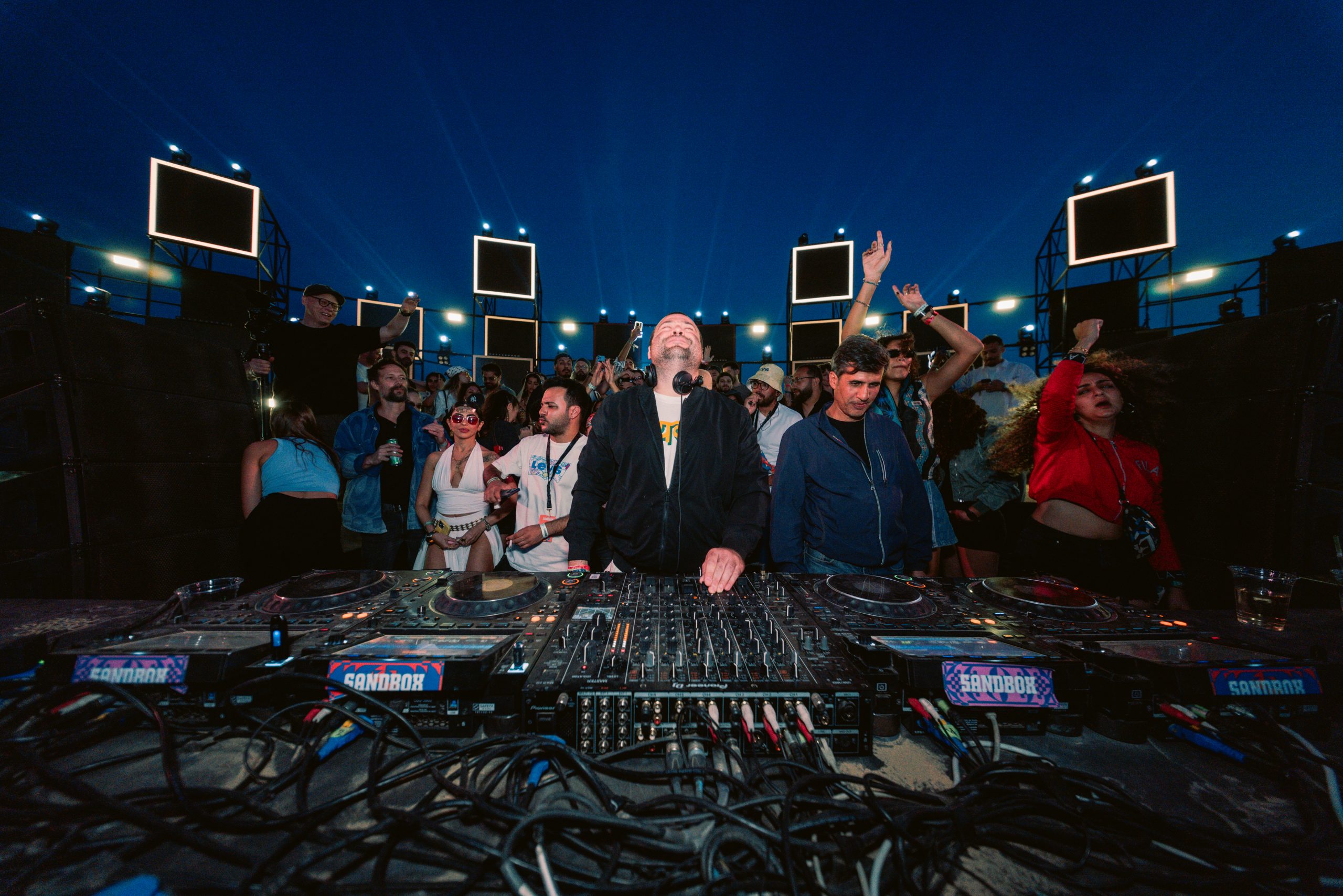
From May 7th to May 9th, the 12th edition of Sandbox Festival returned to El Gouna on Egypt’s Red Sea coast. Across three relentless days by the beach, stretching from afternoon into sunrise, every detail played a role in shaping the overall experience of the festival, and each deserves a closer look to better understand where Egypt’s EDM scene currently stands through the lens of one of its biggest, most influential, and most ambitious festivals.
We were on the sand this year, curious to see what remained and what had evolved in the twelfth edition – and we were met with two moods of Sandbox: one that dominated the daytime and allowed for a richer experience centered around the music but not limited to it, and one that turned the nighttime into a maze of music discovery and FOMO-fueled hikes between the many stages operating well into sunrise.
Sandbox at Day
Running from around three in the afternoon until five in the morning – all by the sea – Sandbox naturally unfolded in two moods and two energy frequencies, making the daytime experience feel entirely different from the nighttime in almost every aspect: the atmosphere, the crowd, the music, and even what you could actually do there.
Since Sandbox happens in El Gouna, you don’t really get that usual city chaos or the stress of commuting to a festival. Most people are already staying nearby or within El Gouna itself, so getting there isn’t a whole ordeal. Traffic around the gates was calm, and while the crowds at day weren’t large, spirits were high and the entire experience felt notably easygoing.
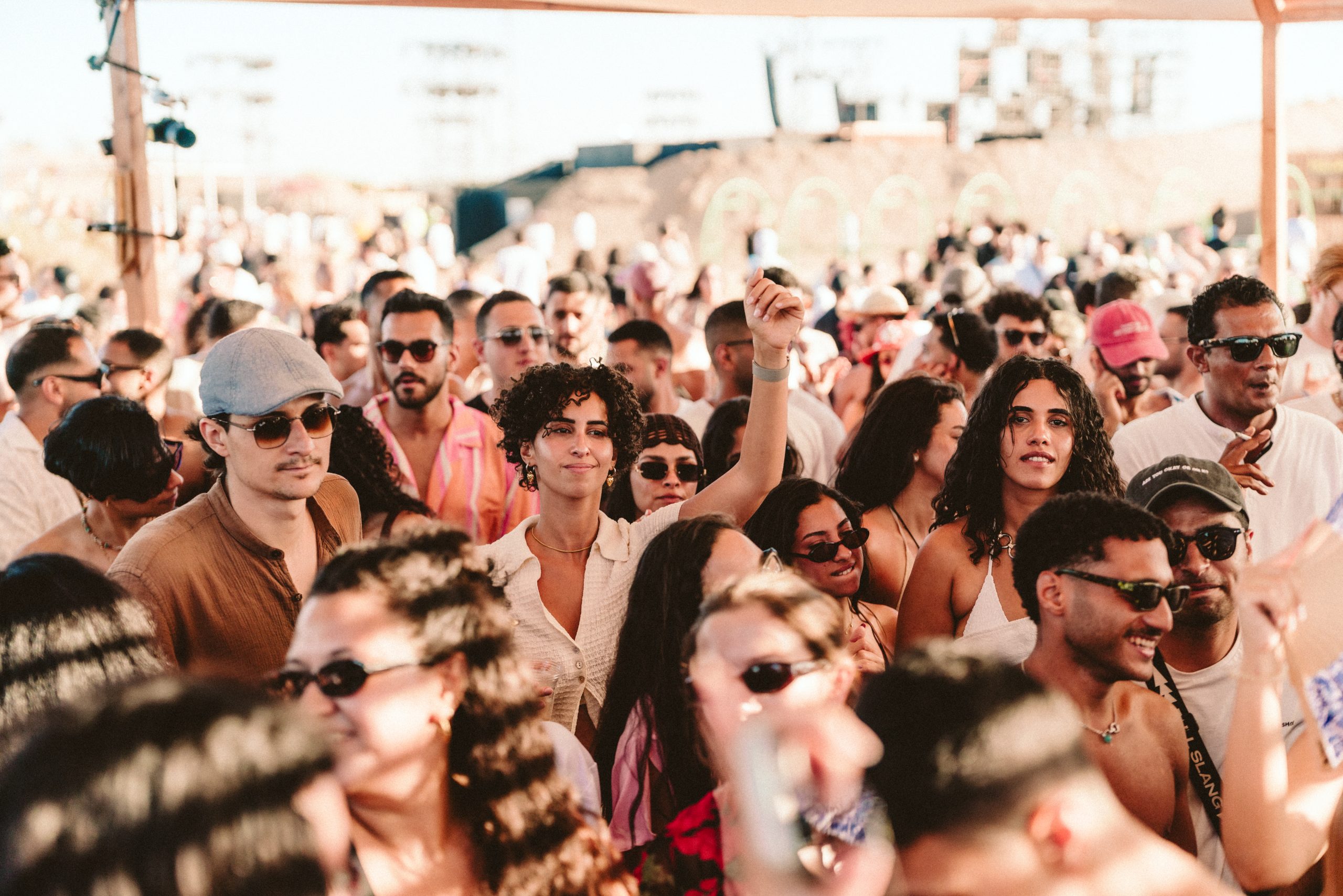
Once you were in, there was a lot to do and experience during the day. There was the Sukun Hut, where people meditated, attended yoga sessions, and got massages. Others were enjoying a casual summer day by the sea, while some were doing what El Gouna has long been known for – kitesurfing – or wandered through the Sandbox merchandise area.
The crowd felt absolutely relaxed. Most were simply looking to enjoy a summer day by the sea, accompanied by the right music.
Demographically, the crowd was highly diverse: locals, people from across the Arab world, Asia, Europe, the Americas, and Africa. With that, the festival created a space that felt safe, open, and welcoming to everyone.
The daytime music programming leaned heavily into summer-driven sounds: deep house fused with jazz, tropical grooves, disco, italo, and funky rhythms. It played things relatively safe, favoring accessible, widely likable sounds with broad appeal.
The daytime programming was spread across only two stages, the Beach Hut stage and the Yellow Tape record box, which felt more than enough for the crowd. In many ways, limiting the programming to two stages worked in the festival’s favor, allowing more focus on the DJs performing during the day without constantly pulling the audience in different directions.
That became one of the defining traits of Sandbox’s daytime experience. People could fully attend an entire set uninterrupted, with sustained energy throughout – or at most move between two sets happening simultaneously. Because the options were deliberately limited and the stages were located close to one another, audiences were able to properly engage with and judge what they were hearing instead of constantly rushing between performances.
Yet, had the daytime music programming begun a couple of hours earlier than its usual 3:00 PM, it would have placed greater emphasis on the festival’s daytime atmosphere, activities, and overall vibe, while also giving audiences more room to fully experience a longer Sandbox day. It could have also opened the door for more DJs to get real exposure – the kind who actually know how to hold down those loose, sun-soaked tropical grooves that fit the daytime energy so naturally.
Over the three days, the daytime had this raw, effortless energy to it. What made it hit differently was that it wasn’t just about the music. The music was always at the center, sure, but it wasn’t carrying everything alone. It was surrounded and supported by everything happening around it, and that, as a result, made the whole experience feel fuller and ultimately more lived-in.
Sandbox at Night
At night, the festival shifts into a completely different mood. Getting there, though, becomes part of the challenge; traffic ramps up heavily, and at times you end up stuck in long jams because the roads leading to the gates are easily congested. Yet once inside, despite the crowd being considerably larger than during the day, the entry process remains well organized and smoothly facilitated.

The night mainly revolves around music, stretching from early evening until 5 in the morning – and accordingly, the stages multiply. Four main stages operate only at night: The Playground, The Space Stage, The Groovebox, and The Sandbox Stage, in addition to The Secret Stage, and music playing in small huts: Be Indie and the Selectbox.
The music played across the main stages is fundamentally different from the smaller ones. The larger stages feature the festival’s most prolific names, while also giving space to a number of rising acts. Meanwhile, the Selectbox highlights some of the region’s most promising selectors, while the Be Indie stage focuses on emerging independent artists experimenting with more alternative forms of electronic music.
Unsurprisingly, amid the glamour and scale of the larger stages, these smaller setups – whether you call them stages, booths, or huts – managed to build audiences of their own. More often than not, they were packed with people who were there for a reason, actively chasing the kind of sounds these spaces were built around: ambient electronic textures, drum and bass, hardstyle, and other more leftfield corners of the EDM spectrum.
The main stages offered a different approach to electronic music, not necessarily in essence, but more in presentation and scale. Yet they did not lean into mainstream EDM – in fact, the festival as a whole largely avoids that territory. What the larger stages did feature were bigger, more recognizable names. The sound leaned heavily into deep house, tech house, techno, disco, and other similar variations of electronic music.
You could still expect something familiar and easy to lock into on the main stages, but never anything close to the overly commercial, mainstream version of EDM people usually associate with the genre – especially given the festival’s lineup curation, which by design leaves very little room for that direction.
Music was playing simultaneously across all stages, yet one particularly smart – and somewhat ironic, given the festival’s name – detail stood out: high sand barriers were placed between the stages to prevent sound from clashing or bleeding into one another. It is something many festivals with multiple active stages often fail to properly handle, but at Sandbox, preserving every element and layer of the music felt crucial to the overall experience.
Unlike the daytime setup, having music spread across numerous stages at once became a double-edged sword. On one hand, it gave exposure to a large number of artists and genres simultaneously, allowing audiences to move between vastly different sounds and experiences within the same night. The number of stages was large, and what each one offered varied significantly – which, in many ways, was part of the festival’s appeal.
On the other hand, that abundance could also become overwhelming. Some attendees found themselves lost between options, constantly moving from one stage to another in fear of missing out, searching for the best set of the night, especially those unfamiliar with much of the lineup beforehand. The stages were positioned relatively close to one another, though, making navigation fairly easy.
Yet many festival-goers found no issue with that at all, instead embracing it as part of the experience itself – a continuous musical journey where there is no singular main stage and no overwhelming crowd centered around one performance. Instead, the festival unfolds as an immersive space where music keeps flowing wherever you walk, giving Sandbox another distinctive edge of its own.

At night, the crowd felt completely different from the daytime – far more music-centered and focused. People came with a clear intention: to experience the music at its fullest. And despite the festival running for long hours, most benches stayed empty. Very few people actually stopped to rest; instead, the crowd kept moving, trying to squeeze every bit out of the experience. Some even roamed in search of the so-called secret stage, finding part of the experience in the journey itself.
Notably, the festival remained packed until closing at 5 AM – even on the final night, when a closing set extended the experience by an additional three hours. People stayed without hesitation, sustaining the same high energy they carried from the very first day, almost without fatigue.
And while this edition did include a proper number of local artists – something that deserves recognition – they were not always given prime time slots or main-stage opportunities. Most of the time, those positions were reserved for international acts, which is fairly understandable.
Twelve and Counting
Through twelve editions, Sandbox has continued to take place in a region that is not easy to operate in. This edition witnessed a decline in attendance due to regional instability and the ongoing war in nearby countries, which by nature hindered travel for many. Yet these difficulties, throughout the years, have become an inseparable part of Sandbox’s identity – a festival that keeps going, and actually evolving, under rough conditions, whether locally or regionally.
Sandbox also arrives at a moment where a lot of people are starting to question clubbing and festival culture in general – not just in Egypt, but across the region, and probably across the globe. In that sense, the festival positions itself as a different model: one with no hierarchy of access, no VIP culture, no curated influencer presence, no guest list or backstage separation, and no tolerance for disruptive behavior. Instead, it creates a space where everyone exists on equal footing, merging into a shared environment defined by music, collectiveness, and harmony.
With the 12th edition now concluded, and despite the challenges it operated within, anticipation for what comes next is already building.



Abdi Declares the SDF Integration Into the Syrian State Complete
The SDF has completed its integration into Syria’s state institutions, a major step toward a unified Syria.