360 deals have become increasingly common across the music industry, with artists signing away touring, merch, licensing, and publishing in exchange for advances that function more like debt than investment. Streaming payouts hover at fractions of a cent. The economics that once sustained mid-tier careers have been restructured to serve extremes: massive scale or nothing at all.
The art world followed a similar logic. Mega-galleries absorbed competitors. Mid-size dealers shuttered or merged into larger operations. Even the independents, the ones who market themselves as alternatives to the blue-chip establishment, are often quietly de-risked by larger players, their operations subsidized by collectors or institutions with different incentives entirely.
The middle didn’t simply decline. It was absorbed, restructured, and in many cases, phased out altogether.
So what does actual independence look like now? Not the aesthetic of independence, the kind that gets performed for branding purposes, but the reality of it. The version where no one else holds the paper.
—
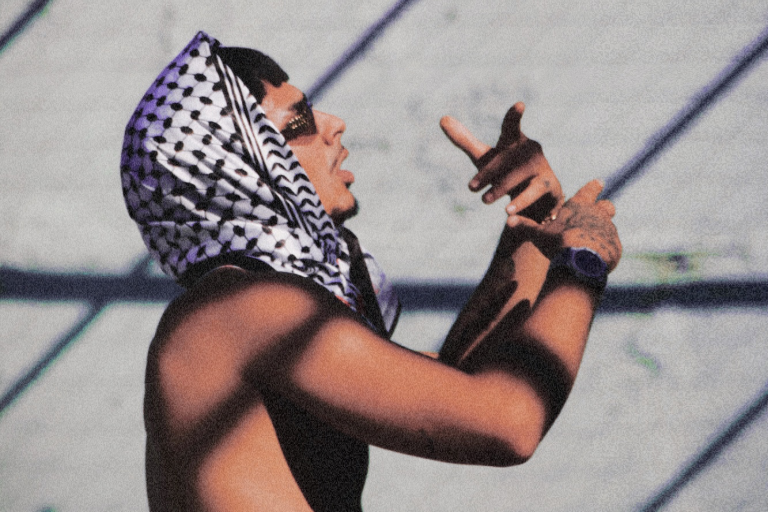
Jet Le Parti exists on a page between pages.
There are paintings scattered across collections around the world, though you won’t find public prices, public displays, or any official point of inquiry. There are books, self-published, never submitted to traditional channels. There is sound, noise and techno and ambient work, that circulates in the thousands rather than the millions, not because it failed to reach further, but because it was never thrown toward the algorithm in the first place.
And then there is the infrastructure. When the traditional routes for distribution, exhibition, and broadcast didn’t align with what he was trying to build, Le Parti built his own. Base 36 operates as a hybrid gallery and cultural initiative, mounting exhibitions in short-term warehouse spaces that materialize, run their window, and dissolve back into whatever the building was before. Relaispunkt extends that model internationally. RP.1 functions as a label. Converting Culture is an underground publication dissecting how culture is produced, filtered, and absorbed. 121.radio provides broadcast. Each entity addresses a different problem: how to show work, how to release music, how to distribute ideas, how to reach an audience without intermediaries dictating terms.
Production, distribution, broadcast, publishing. He built all of it. By any conventional measure, this shouldn’t work. An artist constructing label infrastructure, gallery infrastructure, publishing infrastructure, and radio, all while refusing to optimize for visibility or play the publicity circuits that typically sustain this kind of operation. It’s an anomaly, a kind of quiet freak occurrence in an industry that tends to reward the opposite. There’s something almost mythical about it. More rumor than presence. The work circulates, the name surfaces in unexpected contexts, but the person stays just out of frame.
A career constructed in negative space.
—
The training grounds were spaces that no longer exist.
Afterhours in Philadelphia, back when the warehouse scene there still had room to breathe. Tire shops and foreclosed basements. Factory floors in Strawberry Mansion where everything was BYOB and the lighting was barely functional. Hazy rooms where no one really spoke, just bodies and sound pushing through concrete until morning. Before that, there were abandoned brickyards outside Columbus, Georgia, where a teenager first learned what it felt like to occupy somewhere that wasn’t meant for anyone.
The music came out of those rooms. Noise and techno, ambient and neoclassical, work built for warehouse floors and 4am comedowns rather than playlist placement. Releases continue to surface quietly under his own name and through RP.1, finding their way into DJ sets and private channels rather than promotional cycles. Monthly listeners number in the thousands. That’s design, not failure.
Brooklyn continued the pattern. A studio in Bushwick, roughly 3,000 square feet of raw industrial space. No shower, no kitchen, plumbing rigged by hand. Days spent painting in isolation. Nights that opened the same rooms to crowds who would never see the canvases drying on the walls behind them.
Base 36 formalized what was already happening. A gallery that refuses to operate like a gallery: no fixed location, no permanent roster, no representation deals. Short-term leases in warehouse districts. Exhibitions that appear, run their course, then disappear. Most young gallerists and label operators come into this world with family money somewhere in the background, institutional backing, a safety net if things don’t work out. Through Base 36, Le Parti self-funded the entire operation from the beginning.
—
“You have to love the work to stomach this life,” Le Parti says. “You keep taking the shots.”
Outside of an occasional post or appearance on 121.radio, broadcast through base36.fm, he lets the work move without dragging a persona behind it. He ghostwrote before any of this surfaced publicly. Poetry circulated through private channels for years. The instinct has always been the same: let the work speak, keep the personality out of the way.
Most artists spend years auditioning for access. They submit to labels, pitch to curators, wait for someone with distribution or wall space to finally say yes. The gatekeeping isn’t incidental to how the industry operates; it’s structural. And for those without connections or capital, the wait can be indefinite.
“If the world isn’t positioned to provide it, then you have to change the world,” he says.
—
Le Parti carried his projects through Brooklyn, then Los Angeles, Berlin, London, and eventually into the Gulf, where Sibyl, his advisory practice, brought him into the region through the visual art side. Moving like that, across that many borders without institutional backing or a major label’s infrastructure behind you, requires something different than talent. It requires tolerance for the unknown, for the silence between moves, for the possibility that momentum stalls and no one notices or cares.
“Risk versus reward is useless when you’ve missed your shot,” he says.
—
There’s a division among artists that rarely gets named directly: those who wait for conditions to improve before moving, and those who move regardless. Most treat a project as something that can be paused, pivoted, or abandoned if the math stops working. A backup plan exists somewhere, even if it’s never spoken aloud. Le Parti never operated that way. The results have followed over time, but the posture came first and never wavered.
Most people fold under less pressure than this. They hedge. Conform. Find an easier path that still feels close enough to the original idea.
Somewhere else, in spaces that don’t photograph, transactions that don’t announce themselves, there’s a different path. It’s not a model. It’s not scalable. It costs more than most people are willing to pay.
When the conversation turns to compromise, to bending the practice toward something more palatable or more aligned with what the industry tends to reward, his answer is short.
“At the end of the day, I’d rather die than fold,” he says.
—
Jet Le Parti is an artist and founder of Base 36, Relaispunkt, and RP.1. More at base36.fm