

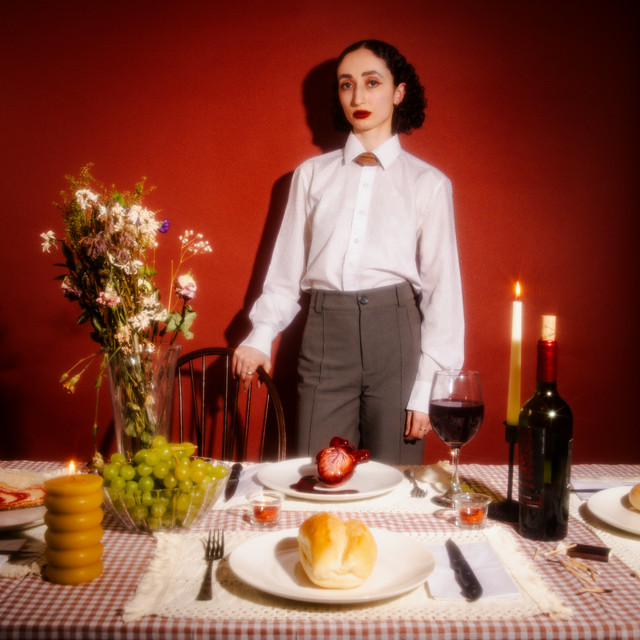
Emel Mathlouthi has a voice that sits somewhere between a soft caress and a wildfire. And yet, if you sit with her, really sit with her, she speaks softly, in that exact way her music feels: deliberate, and laced with something just under the surface. Whether it’s rage, exhaustion or that quiet kind of knowing. Perhaps it’s the residue of a lifetime spent trying to break through a system that never wanted her to be more than a slogan.
When we talk over a crackly Zoom call, she is in Tunis in between tour stops. Her toddler son is constantly demanding attention (to watch cartoons) in the background.
“We both want different things right now.” she says, half-laughing, half-weary. “I’m trying to manage some discipline, managing his screen time to make him have his own positive experience, but also still be present for my music.”
But even in this liminal space, there’s something unshakably steady about her. She speaks with the cadence of someone balancing on a highwire. There is no team of nannies or proactive PR squad buffering the chaos for her.
“I don’t manage,” she says plainly. “Because I am an independent mom and an artist at the same time–meaning I am like the boss here.”
She pauses briefly to take a breath before continuing, “People don’t often talk about this; how hard it is for women to do this. Most independent artists I know, either don’t have kids or have entire systems around them to help out. Not so many like me are in this configuration,” she says.
“But I think being a mom has taught me resilience and made me more humble–it’s not just about me now, my little quest for recognition etc..it’s also about..” her son interrupts her whining loudly on the other side of the phone, “like now,” she laughs softly.
It’s this particular collision of a performer and a mother, who is also a songwriter, a producer with an inherent dissident nature, that makes Emel impossible to flatten into a label. For years, the media tried though; “Voice of the Revolution” was the headline.
In Tunisia during the Arab Spring, a shaky video of her singing “Kelmti Horra” on Habib Bourguiba Avenue surrounded by her fellow Tunisian freedom fighters, became an accidental anthem, bouncing from phone screens to the frontlines of revolutions across the Middle East and North Africa.
Her voice, raw and operatic, cut through the smoke of tear gas and echoed through protests from Tunis to Cairo.
Tunisia found its unofficial protest singer. But the world didn’t want much more than that.
“Western media only caught that side of me.” She reflects. “It was really frustrating that they weren’t talking about my songwriting, or artistic skills. I was composing, producing and using elements to create my own sound and genre. I still am.”
As liberating and impactful the title was for Mathlouthi, it inevitably became her Achilles heel, alienating her into a rather generic category that dismissed the richness of her artistic proposal and the blueprint she was creating in the electronic music sphere.
It didn’t tick the check boxes the Western music industry had set for Arab music, and so it was classified as merely “world” music. No one understood she was in a lane of her own; creating something that will long remain unprecedented for generations to come, which made her feel like an outcast.
But Emel has always been persistent since she was a kid, singing Celine Dion during her dishwashing duties against her parents’ wishes. She didn’t need the validation nor the industry recognition of her range. And so, fiercely, she forced the world’s eyes to see her for who she truly was, and eventually created her own scene. Her own revolution.
“I always believed that I have a mission–to expose injustice, and help people believe in themselves, feel their own power and have hope to build their own reality to make change.”
Born in Tunis and raised on her father’s diverse, eclectic vinyl collection–from El Sheikh Imam and Marcel Khalife to Björk, Joan Baes and back to Fairuz then to the Cranberries–her sound was never confined to a single genre or geography.
“There were no limits on what I could listen to or process, and that has always been part of my upbringing, so naturally that’s how my music evolved as well,” she reflects.
Her early university years were lived in that grey zone between tradition and rebellion, where she’d skip engineering lectures to rehearse with her indie metal band, Idiome, until the crack of dawn, covering every kind of music from Dylan and Shakira to Pink Floyd and Celine Dion.
“These moments–performing with my band–is when I realized how much of a performer I wanted to be. I would get on stage and I would just get into it, there was no doubt or question,” she recalls, adding, “I suddenly discovered that whole other persona of me, and it was a thrill, and to this day, being on stage is really the thing that I was born to do. That’s the real me.”
But the Tunisian state didn’t quite agree. Her music was banned from the radio in 2008. So she left. Paris became her temporary turf for a while, and she kept writing, quietly, obsessively, until her 2012 debut “Kelmti Horra” launched her into a vortex of politics and praise.
“I left knowing I had a bigger goal and purpose in life, which is to speak up for all the people I left behind.” She recalls. “But, It was a very lonely path to be a revolutionary thinking person, and it is hard to survive when you are really unapologetic and truthful. But I have always had that dream that I wanted to build a movement.”
And she did.
In 2017, she put out her album Ensen, a deliberate move to break free from being the “voice” of the revolution, showcasing a more mature experimental sound, thematic depth and a personal songwriting that reflected her own artistic vision and individuality.
She had just given birth to her daughter in New York, and wanted to create something deeply personal and vulnerable, built entirely from her organic library of Arabic sounds.
“It was important for me to define myself in a different way than what Western media was trying to portray me. I really wanted to place myself as a producer because even though I was a producer on my first album, I never really felt–as a woman–that I could define myself as such.”
Still, no label came. She never signed to a major.
“Luckily–or not–I never compromised,” she says. “Sometimes I think I could’ve made things easier for myself if I just did it. But I didn’t want easy. I wanted to be truthful.”
Then came the Covid pandemic in 2020, forcing everything to halt but not her. It found her on the rooftop of her childhood home in Tunis recording The Tunis Dairies.
Alone, just a guitar, her voice, and a laptop. The record featured acoustic versions of her own songs alongside covers of Leonard Cohen, Nirvana, and Jeff Buckley, all of which had shaped her sonic identity. She wanted people to see the other side of her—not just the protest singer singing for the revolution, but the melody-obsessed kid who wanted to feel free.

But her most radical work yet might be MRA, an all-female collaborative project that took her three years to bring to life, and in her words “came like a little bit of an extreme”.
“It was the hardest thing I’ve done,” she says. “But the more difficult it got, the more stubborn I became. I wanted to prove that it was possible to work with women; that women can be producers, mixers, and more..not just be the pretty voice.”
It wasn’t merely another album she wanted to put out, but rather a statement she wanted to make, a reaction to a frustration that has bubbling for years, and most of all an epitome of what she stood for.
“To this day, I am still puzzled by how the brain of so many female projects is just a man. And as much as I love working with my male counterparts, I just don’t want to be in a situation where I have to work with a man because that’s what is easy and available,” she explains.
For an artist as versatile as Mathlouthi, objectification often comes with the territory, a constant struggle to reclaim control and ownership over her image from the public projection.
However, she doesn’t romanticize the chaos of it all. She’s tired.
And sometimes, she’d fantasize about singing, “easy songs” But she won’t.
“I don’t think I can,” she says. “To me, music has always been revolutionary. Even when I tried to do pop, it came out political. It’s who I am.”
That includes the pressure she constantly puts herself under to be hyper-productive. “I always think that there’s more to say, more to create. But that pressure, to stay creative, is what keeps me alive.”
When asked about her artistic blueprints for that, she hummed contemplatively then said, “We don’t really have that notion of ‘blueprints’ in the Arab world. Every now and then someone starts a movement, but we rarely recognize who paved the way.”
However, to this day, her guiding lights include El Sheikh Imam and Marcel Khalife, and listening to them always reminds her why she started making music in the first place. “They taught me that music doesn’t have to be complex to be heard–just you and a guitar can go a long way. And it doesn’t have to achieve the commercial success everyone is after nowadays, for it to be something that can’t be erased.”
Even after building a life and community in New York, Tunis still tugs at her, and going back is something that almost never leaves her mind.
“I have been thinking a lot about going back, now with all of that experience and distance I have had, to look at things from a different perspective and create a new me,” she says.
But for now, she is writing her own memoir on the road. Her journal doesn’t leave her bag, documenting what she’s seen across the years. But most importantly, she is rewriting her own narrative, her story and journey through her eyes, as it should be.
In a world still eager to flatten her into a headline, Mathlouthi insists on taking up space—with her grief, her voice, and her refusal to be categorized. She demands to be known for everything that she does. She is not here to be your heroine, or your revolution’s soundtrack, a tagline she’s long outgrown. She is Emel, purely on her own terms.



Shobra El General Puts the Street Back Into Mahraganat on ‘I Want to Pay the Rent’
In a time of crisis and artistic detachment, Shobra El General finds the right medium for his social commentary on ‘I Want to Pay the Rent’.