
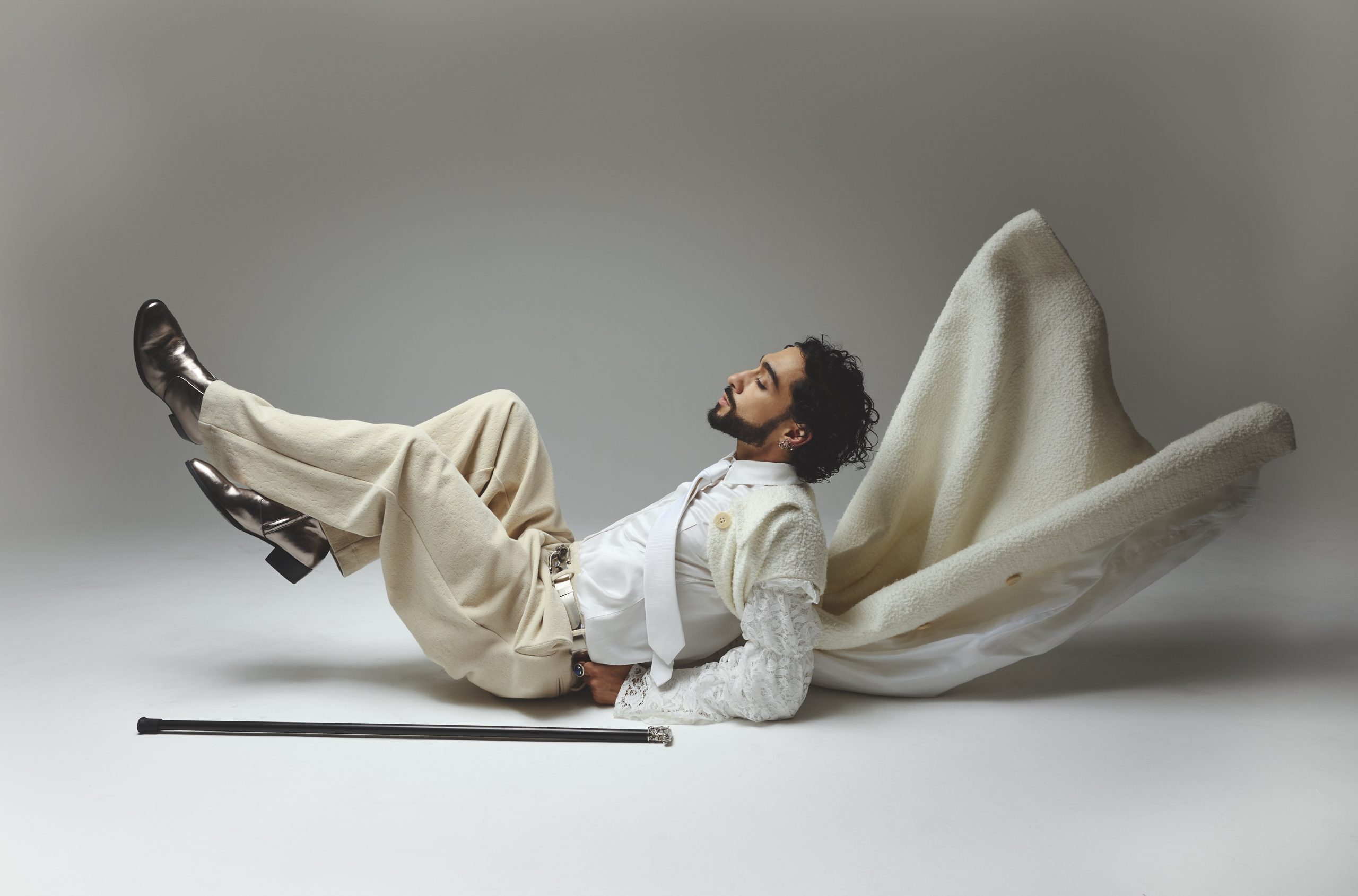
Sofiane Pamart’s fourth album arrives at a moment when his image is already firmly inscribed somewhere between myth and discipline – the almost monastic relationship to the piano that has come to define him. But Movie fractures that mythology in a way that feels both deliberate and inevitable – rendering it secondary.
When we spoke a few weeks before the album’s release, Pamart kept returning to the same idea, almost cautiously, as if naming it too directly might reduce it. The message, he said, had already outgrown the instrument. The piano was never meant to hold it alone. It was simply the door.
Behind that door: a lineage. His grandfather, a Moroccan miner who came to France as part of a labor system that relied on imported, often undocumented workers, appears like a force within the work. A life shaped by extraction, by silence, by a country that needed bodies more than it acknowledged names. An accident ended that life. What remains is the question of how and whether such lives are told.
“These are symbols that go beyond speech,” Pamart said. But Movie is built in relation to that limit. Not everything is said. Not everything can be.
There is something precise in the way he frames it: to tell a story that exceeds you, you have to pass through yourself first. But you cannot stop there. The personal, in this sense, is a threshold.
The album unfolds like a series of scenes – porous. The collaborations with voices as distinct as they are geographically dispersed do not register as features in the conventional sense. Loreen, Rema, Nelly Furtado, Oscar and the Wolf, they don’t adapt to his universe so much as they inhabit it, almost like actors stepping into a scene whose emotional logic precedes them.
“I create a listening climate. A film that activates the imagination. You decide.”
Pamart spoke about them the way a director might speak about casting. In terms of both sound and presence. He offers a frame, sometimes just a theme, and leaves space for something unpredictable to become.
“Midnight in California” is one of the clearest examples. The voice is that of Jimmy Butler, a figure synonymous with the spectacle of high-level sport. But here, that image is undone. Pamart doesn’t approach him simply as an athlete, but through something more intimate: a shared intuition of what it means to carry absence.
Closer to a text than a statement, recalling the fragile directness of By.Alexander’s “I Collapsed.” A collage of sound, text, and lived experience where boundaries blur. Butler speaks about his father, about loss, in a way that feels unguarded, nearly unfinished, as if the words were still in the process of becoming.
What emerges is another figure of the hero: no longer the invincible body, but the orphaned child who became a father – the man behind the projection. In the absence of a script, there is only a shared emotional terrain. What stitches it together is trust, something like an invisible glass, allowing the fragile, the unresolved, to be told.
He described it himself in cinematic terms. It’s about structure, scenarios, casting, the construction of emotional arcs that don’t resolve cleanly. “I create a listening climate,” he said. “A film that activates the imagination. You decide.”
Choirs rise and dissolve into something close to liturgy in “Your Inner World,” then pull back into near-emptiness. The piano remains, but it is no longer central in the way it once was. It is one voice among others, sometimes leading, sometimes receding, always a ground for everything else to exist.
What holds the record together is a thread he names without hesitation: love.
Romantic love, certainly: fragile, elliptical, often deferred. But also sacred love, rendered through images that feel almost biblical in their scale, and something more difficult to name: a collective tenderness that exists alongside loss.
The album is built on the premise that emotion only becomes legible when it is no longer singular, when it passes through other voices, other bodies, other histories.
“It’s one of the most beautiful human acts, to testify to where you come from.”
At one point in our conversation, I thought of James Baldwin, clarifying what this album does at its best. Baldwin once wrote: “You think your pain and your heartbreak are unprecedented in the history of the world, but then you read… the things that tormented me most were the very things that connected me with all the people who were alive, who had ever been alive.”
There is, inevitably, a political dimension to the album, though it never announces itself directly. It appears in the way a figure like his grandfather is neither reduced to a symbol nor expanded into a narrative that would make him easier to consume.
To keep that presence at the center of a global project: one that moves between continents, languages, and audiences is not neutral. It combats a certain kind of erasure without turning it into spectacle.
“It’s one of the most beautiful human acts,” he said, “to testify to where you come from.” The word testify matters. It implies responsibility, but also distance. You speak from something, not only about it.
And yet, for all its scope, Movie is also an album about lack. what it means to have nothing. What it means to build from that point, and to never fully detach from it.
Even grief follows that logic. When he mentions losing a friend, he doesn’t frame the resulting music as his mourning. “It doesn’t represent my grief,” he said. “It represents grief.” To move from possession to participation. To refuse the idea that emotion gains value through exclusivity.
“The instrumental allows me to say everything without saying anything,” he explained. “I can give everything and remain secret.”
Speech, for him, is both necessary and insufficient, an inevitable tool for sustaining visibility, but not for producing the work itself. “To exist, you have to speak,” he said. “To make something great, you have to step back.” Movie exists precisely in that gap.
“I know my potential. But I have very little ego. I make the work for the work.”
By the time our conversation ended, one idea had become unmistakably clear: Pamart is no longer interested in being the center of his own work, because the scale of what he’s trying to articulate no longer fits within that frame. “I know my potential,” he told me. “But I have very little ego. I make the work for the work.”
It’s a statement that, like many things he says, risks sounding declarative on paper. In the context of Movie, it reads differently. The album asks to be experienced as a space where stories intersect, where emotions circulate, where the boundary between individual and collective experience begins to dissolve.
What remains, after it ends, is not a portrait of an artist. It’s something more diffuse: the sense that what we feel, however intimate, is never entirely ours.
And that, in itself, might be the closest thing to transcendence the record offers.







Abdi Declares the SDF Integration Into the Syrian State Complete
The SDF has completed its integration into Syria’s state institutions, a major step toward a unified Syria.