
You don’t realise how long you’ve been scrolling until your food goes cold.
The kibbeh – frozen and ferried home in your suitcase, your mother insisting it would “taste the same” – sits untouched, its steam fading faster than your attention. You’re in a bathrobe, iPad propped against a glass, thumb moving with steady insistence. Rows blur. Genres collapse into each other. A thriller starts to resemble a romance; a comedy looks suspiciously like homework.
Five minutes of choosing becomes forty, and you still haven’t pressed play.
There’s too much to watch, and the question becomes what’s worth committing to: what travels beyond the algorithm, what people return to in group chats, what holds past the second episode.
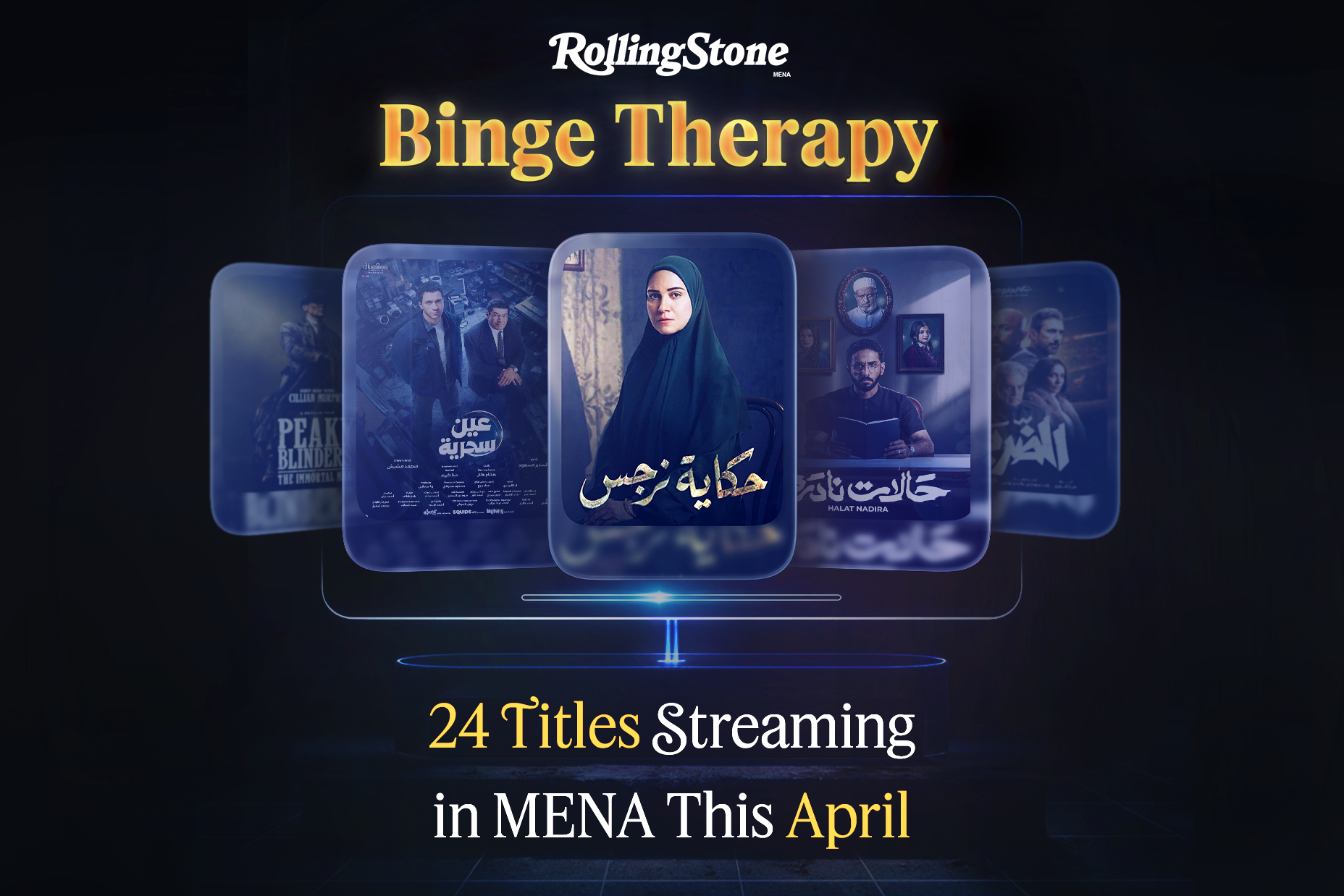
In this inaugural edition of Binge Therapy, we bring you a list of the best series, films, and documentaries streaming across platforms in MENA/SWANA. The list is curated, vetted, and written by Yasmina Bitar.
Wa Nensa Elli Kan
TV Series | Romance Drama | Egypt
Some shows sharpen you. Others undo you slightly, without asking permission. Wa Nensa Elli Kan leans into the latter.
Yasmine Abdelaziz and Karim Fahmy reunite in a premise that wastes little time: she’s a celebrity whose visibility turns dangerous; he’s a former fighter hired to contain it. Proximity does the rest.
The series doesn’t over-explain its chemistry or dress desire up as something more respectable. At some point, you stop evaluating it and start anticipating it: the look, the pause, the moment just before someone says too much.
In an era crowded with restraint, Wa Nensa Elli Kan feels simpler and more effective – a romance that makes you feel first, then figure out why.
Watch Wa Nensa Elli Kan on MBC Shahid.
Louis Theroux: Inside the Manosphere
Documentary | United States
Louis Theroux – the softly awkward, relentlessly curious British documentarian – was always going to end up here, inside the closed loop of the internet where masculinity is rehearsed, monetised, and endlessly repeated.
In his latest documentary, he enters the “manosphere”: a loose but highly visible network of podcasts, YouTube Channels, and online forums built around a singular vision of male dominance. Here, dating is a zero-sum game, intimacy a tactic, and women something to be evaluated, ranked, and, ultimately, beaten.
His method hasn’t changed: he listens; he nods, and lets the silence stretch.
Opposite the movement’s most fluent salesmen, better known as influencers, including Myron Gaines and Harrison Sullivan, he rarely needs to intervene. The script is already running on dominance, value, and control. The familiarity unsettles more than the extremity. And while the accents are American; the cadence is not. You’ve heard versions of it elsewhere, clipped into TikToks, echoed on gym floors, slipping into language that once felt neutral.
Rather than dismantling the argument, the documentary lets it run until it exposes itself, showing how far it’s already travelled.
Watch Louis Theroux: Inside the Manosphere on Netflix.
Hekayet Narges
TV Series | Social Drama | Egypt
The name – Aziza, “Bint Iblis” – arrives as a warning before settling into fact: a woman who did something impossible to absorb, then became something easier to fear than to understand.
Directed by Sameh Alaa and written by Ammar Sabry, Hekayet Narges revisits one of Egypt’s most disturbing cases and lowers the volume.
While the premise edges toward spectacle – a woman abducts three newborns to assemble the life she was denied – the series resists it. What emerges is a slow accumulation of pressure: a husband who withdraws without communication, a family that insists without listening, a culture that treats absence as failure and failure as defect. And by the time something becomes unthinkable, it has usually already been made inevitable.
Hekayet Narges emerged as this Ramadan season’s strongest offering from Egypt, continuing to spark ethical debates and unfold as an empathy test too convoluted to simply pass.
Watch Hekayet Narges on WATCH IT.
Heya Kemya!?
TV Series | Comedy | Egypt
Some comedies chase attention. Others rely on the slow, uncomfortable recognition that you’ve seen this before, or worse, that you’ve lived it. Heya Kemya!? is after the second.
The premise – a half-brother appears at a funeral, then disappears just as quickly – works as provocation more than plot: relatives inserting themselves where they’re not needed, old tensions resurfacing with suspicious timing, and conversations tipping into louder, less accurate versions of themselves.
You’re the only one watching it properly. Your dad is drifting in and out of sleep. Your grandmother is asking questions about plot lines the writers have already abandoned. A cousin repeats a line louder, improving it slightly in the retelling.
Heya Kemya!? works because it understands something simple: in this kind of room, the television is never the only performance.
Watch Heya Kemya!? on MBC Shahid.
Ghalat Banat
TV Series | Social Drama | Kuwait
Ghalat Banat is unsettling in how contained it looks.
Set in 1980s Kuwait, the series follows a family managing a daughter’s “mistake” careful recalibrations. Rooms shift around her, conversations shorten, and decisions are made in kitchens, in passing, in tones that leave little room for disagreement.
Instead of arriving all at once, control settles in gradually, coyly disguised as concern, sometimes sounding almost reasonable when said out loud.
Where other shows stage shame loudly, Ghalat Banat turns inward. It’s a smaller lens, and for that reason, a sharper one.
Watch Ghalat Banat on MBC Shahid.
Love Story FX
TV Series | Romance Drama | United States
Love Story has me – a reliably anti-imperialist Arab – softening, somewhat unwillingly, at the edges of Americana.
The series traces the courtship of John F. Kennedy Jr. and Carolyn Bessette-Kennedy, but what travels is the image: the backwards cap, the surgical side part, and sunglasses sharp enough to cut through history. By the time it reaches you, between TikTok edits and group chats, it plays as a mood board.
This is Ryan Murphy, the prolific showrunner behind some of television’s most stylised dramas, including American Crime Story and American Horror Story, at his most recognisable: collapsing narrative into atmosphere, and turning myth into something you can almost wear. The Kennedy construct – the question of why a nation that prides itself on having no kings keeps reproducing its aesthetics – is left untouched.
You don’t come away knowing much more than you did, but you come away wanting the sunglasses.
Watch Love Story FX on Disney+.
Fi Al Thell
TV Series | Social Drama | Turkey
It wouldn’t be Arab streaming without a Turkish drama, and Fi Al Thell understands the appeal.
It opens at full speed: a man avenges his family, lands in prison, is pulled into a cartel, and returns years later to find the woman he loves married to someone close enough to make it unbearable. You can guess who. You’d probably be right.
From there, it escalates without hesitation. Declarations land like ultimatums. Loyalties fracture on cue. Just as the story begins to settle, it swerves, louder and sharper each time.
You start at a distance, telling yourself it’s too much. Then it’s midnight, then 2 a.m. Then it’s light outside and you’re still there.
Watch Fi Al Thell on MBC Shahid.
Bil Haram
TV Series | Social Drama | Lebanon
Arab television has always had a theatrical instinct: moral monologues, heightened emotion, the sense that everyone is auditioning for absolution. Bil Haram picks up that sentiment, building its world around performance.
Set within a travelling theatre troupe, the series leaves behind the genre’s familiar villas and police stations for a space shaped by disguise; masks, rehearsed truths, and borrowed lives.
Maguy Bou Ghosn reunites with director Philip Asmar and producer Jamal Sinan in familiar terrain, where compromise builds gradually – and you watch it like a rehearsal, tracking what slips through rather than what’s said.
Watch Bil Haram on MBC Shahid.
Bait
TV Series | Psychological Drama | United Kingdom
Riz Ahmed writes and stars in Bait as Shah Latif, a struggling Pakistani-British actor whose life tilts into absurdity when he’s rumoured to be the next James Bond.
After bombing a crucial audition, he’s mistaken for Dev Patel on the street – an error that goes viral and hands him a version of success he hasn’t quite secured.
Few questions test national identity as cleanly as who gets to play Bond. On paper, it’s about casting. In practice, it’s about who is allowed to count as British at all.
Diaspora stories often over-explain themselves, translating and justifying before they’re even questioned. Bait resists that, trusting instead that you’ll recognise the awkwardness, the ambition, and the quiet dissonance of being seen and not quite accepted.
Watch Bait on Amazon Prime Video.
Ein Sehreya
TV Series | Social Drama | Egypt
Surveillance usually belongs to institutions. Ein Sehreya puts it in different hands.
Essam Omar plays a security engineer who installs cameras for a living, until he starts using them for something else. Pulled into the orbit of a lawyer who understands exactly how far the law can stretch, he begins constructing cases against corrupt businessmen through systems never designed for this kind of use.
Corruption settles into the background, ambient and recognisable in small transactions and in murmurs before it’s ever provable. You hear it mentioned in passing – mid-dinner, mid-scroll, a day later when the episode should have worn off but hasn’t.
The question returns later, almost casually: when the systems meant to protect you stop working, what are you willing to replace them with?
Watch Ein Sehreya on Yango Play.
Matbakh Al Madeena
TV Series | Social Drama | Syria
Syrian television is at its best when it remembers something simple – people are enough to carry it. Matbakh Al Madeena begins there.
Maxim Khalil plays a Damascus chef whose life runs on routine: orders called, plates assembled, a space where everything has its place. Then his daughter disappears.
What follows is erosion. The kitchen continues, but without the structure that made it feel contained. Movement turns mechanical; conversations stall mid-thought, and what once felt steady begins to slip.
The series stays close to that rupture. It remains with what’s left behind, and how long a life can continue around that absence.
Watch Matbakh Al Madeena on MBC Shahid.
Etnen Gherna
TV Series | Romance Drama | United Kingdom
Arab television has never struggled with romance. Subtlety, however, is harder to come by.
Asser Yassin plays a man carrying grief with brooding discipline; Dina El Sherbiny, an actress who stays just ahead of how she’s perceived. What passes between them unfolds through negotiation: a sentence cut short, a look held a second too long, a rhythm that never quite settles. Everything moves on timing – the sense that something might happen, or might not, and that both possibilities remain open longer than you expect.
You keep waiting. Somewhere in that waiting, it starts to feel familiar – uncomfortably close to something of your own.
Watch Etnen Gherna on MBC Shahid.
Baba Wa Mama Geran
TV Series | Comedy | Egypt
In Baba Wa Mama Geran, a divorced couple ends up as neighbours, still within earshot of each other’s lives, their conflict carried through children, mothers-in-law, and interference masqueraded as concern. Arguments seldom end, as they migrate, from kitchen to hallway to voice note. Then the mothers take it online.
What used to be contained becomes content. A complaint becomes a post. A post becomes a clip. The story improves slightly every time it’s retold, especially once the mothers-in-law discover the comment section and treat it as an extension of the living room.
Their relationship, or the lack thereof, has too many witnesses to count. You watch as marriage reveals itself as something rarely confined to two people. Divorce doesn’t change that; it simply gives everyone else a better view.
In a region where relationships are rarely private, Baba Wa Mama Geran knows exactly what it’s exposing.
Watch Baba Wa Mama Geran on MBC Shahid.
In Broad Daylight
Film | Crime Thriller | Egypt
Egyptian-Canadian actor Mena Massoud’s first Arabic-language film doesn’t ease him back into Arab cinema. In Broad Daylight casts him as an international con artist moving between identities, accents, and cities – a man whose survival depends on being believable, but never fully known.
Constant reinvention unfolds through stories that have to land on the first try. The pressure of being watched closely enough to be recognised and exposed.
That tension sits just beneath the performance. A line delivered a fraction too smoothly. The personal almost holds, then doesn’t. You start to notice the slippages, moments where something feels slightly off, even when everything appears to be working.
In an industry that still treats departure as success, Massoud returns with a face people already think they understand – Aladdin trailing behind him whether the film acknowledges it or not. The role plays into that recognition, then gradually erodes it. You stop trusting him. Then you realise you were never meant to.
Watch In Broad Daylight on Netflix.
El King
TV Series | Action Drama | Egypt
There’s a point in most shows where things slow down long enough to allow you to think. El King moves straight past that point.
Mohamed Emam plays a warehouse worker pulled into an expanding criminal world, but before long the story gives way to him; the way a scene tilts in his direction, the sense that whatever happens next follows his lead.
Emam doesn’t hesitate. He meets problems head-on, resolves them immediately, and moves on just as quickly to the next. The pace leaves little room to sit back and take stock, as you tell yourself you’re watching him, not with him – that you’re still deciding what you think.
Then something shifts. A look holds a second longer than it should. A decision lands cleanly. You catch yourself hoping he gets away with it, just this once, just to see what happens next.
Sohab El Ard
TV Series | Social Drama | Pan-Arab
Most television depends on distance. Sohab El Ard removes it.
Written by Ammar Sabry and directed by Peter Mimi, the series sits with the ongoing genocide in Gaza without the buffer most shows rely on, pulling what’s usually kept at the edges into the centre of the frame.
The effect is intrusive, with scenes arriving without warning. The rhythm doesn’t reset when the episode ends; silence stretches, the ordinary stops holding, the phone stays face-down a little longer than usual.
It treats watching as a habit – something easily formed, rarely interrupted – and then quietly breaks it.
Watch Sohab El Ard on MBC Shahid and WatchIT.
All That’s Left of You
Film | Action Drama | Palestine
All That’s Left of You doesn’t ease you in. It drops you into motion – a boy running through Nablus where a protest is already underway, and you sense that you’ve arrived too late to understand anything cleanly.
Cherien Dabis builds the film across three generations of the same family, with the late Mohammad Bakri and his sons Adam and Saleh carrying different versions of the same history. Memory, grief, expectation, all of it moves forward quietly, passed between them almost imperceptibly.
It settles in specific moments: a wedding dance that lingers, a classroom lesson that drifts, old propaganda videos replayed like something already absorbed.
Palestinian films are often asked to make their urgency legible – to explain, to clarify, to prove. Here, it’s already embedded, carried in gestures, pauses, and the way ordinary life holds more than it appears to.
Watch All That’s Left of You on OSN+.
Peaky Blinders: The Immortal Man
Film | Crime Drama | United Kingdom
A decade on, Peaky Blinders returns as its own afterlife. Tommy Shelby is back – Cillian Murphy still carrying that same controlled, almost reptilian composure.The aesthetic, too, remains: tailoring, smoke, violence polished into something approaching elegance. Almost too well.
Set against a wartime backdrop, the film rarely strays from familiar terrain; pubs, canals, and backrooms lit just enough to feel like memory. The story moves, but rarely with urgency. New additions, including Barry Keoghan as Shelby’s son, fold into the existing rhythm without shifting it.
If you’ve followed Shelby this far, the film lands as a final indulgence. If not, it holds at a distance – a world you can enter, and just as easily leave behind.
Watch Peaky Blinders: The Immortal Man on Netflix.
Mawlana
TV Series | Social Drama | Syria
Taim Hassan has built a career on a particular kind of authority – measured, composed, just opaque enough to invite belief. Mawlana builds atop of that legacy.
Hassan plays a man fleeing his past who assumes the identity of a religious figure in a village already waiting to be told what to believe. The series tracks recognition: how quickly certainty forms around consistency, how a room quiets before it questions. The scale stays small – a village, a handful of people – but the mechanism travels easily, from one voice to another, from private belief into systems that begin to resemble truth.
From The Ashes: The Pit
Film | Social Drama | Saudi Arabia
From the Ashes: The Pit returns to familiar territory: an all-girls’ school where hierarchies move through the corridors with the ease of something understood. If Al Rawabi School for Girls mapped those dynamics socially, The Pit pushes them somewhere darker.
Then it removes the exit.
A group of girls are trapped underground, water rising, time compressing.Everything clarifies faster than it should under pressure, As roles emerge quickly: the leader, the rival, the excluded.
I spent a decade in an all-girls’ school, long enough to know the warfare is psychological, precise, and learned early. The series makes those stakes physical without disrupting the logic beneath them. You see it immediately: the hierarchy re-forms, with each person returning to a part they never really stopped playing.
Watch From The Ashes: The Pit on Netflix.
Halat Nadira
TV Series | Psychological Drama | Saudi Arabia
Where does the psychological end, and the supernatural begin? Halat Nadira asks the question and lets it linger.
A psychiatrist moves through cases that resist classification: patients describing presences, families insisting on explanations that don’t align. Jinn, trauma, memory – each one makes its own sense, depending on who you ask.
Arab horror remains rare, but it already understands something essential: fear comes from proximity. Diagnosis and possession occupy the same space, each shaping how the other is understood.
The episode ends, but the explanation still eludes. You carry it with you, into the dark, turning it over under the duvet, unsure which version will let you sleep.
Watch Halat Nadira on MBC Shahid.
Share’ Al A’sha (Season 2)
TV Series | Social Drama | Saudi Arabia
The first season of Share’ Al A’sha met a hunger for Saudi stories that trust intimacy, allowing young women’s desires to hesitate, contradict themselves, and unfold without spectacle. It was a series people felt as much as followed, shaped by mood and texture.
Season two holds onto that instinct, but less securely. Developed by a Turkish creative team for MBC, it continues to hover between aesthetic sensitivity and lived specificity, where emotional consequences don’t always have time to be processed.
Even so, its presence matters. There are still few Arab series willing to give young women this kind of interior space – pauses that stretch, conversations that twist, emotions that resist easy resolution.
Watch Share’ Al A’sha on MBC Shahid.
Al Darba
TV Series | Social Drama | United Arab Emirates
The fight is the easiest part of Al Darba.
Inside the ring, everything is clear: rules, opponents, outcomes you can measure. Outside, that clarity disappears.
The series follows Saif, an MMA fighter chasing some version of stability – money, recognition, and a way out – in a system where every win resets the clock. The underworld sits close, close enough that his ambition slips into it without much notice.
For Emirati television, this shift matters. Drama has often been built around contained spaces, family homes, majlis conversations, with conflict carried through dialogue. Al Darba relocates that tension onto the body, where it resists explanation or negotiation.
What matters is what Saif carries out of the ring, and how little of it leaves him once the fight is over.
AlKhallat+: Desert Rules
TV Anthology | Comedy | Saudi Arabia
Being taken seriously sits at the centre of AlKhallat+: Desert Rules, where its characters move through the pressure of having to earn it.
The four-part anthology from Telfaz 11 returns to the AlKhallat universe with a broader, more cinematic scale. A son tries to prove himself to a father who has already decided who he is; a security guard chases admiration until it turns into something closer to survival; a filmmaker is offered the opportunity he’s been waiting for, only to confront what it demands; a poet moves between self-doubt and performance.
The trailer points to stories shaped by small, consequential decisions that begin to define a life before it has fully taken shape. That pressure surfaces later in conversations at your own dining table, when your dad asks about your five-year plan as if you’re already behind.
The humour is sharp, satirical, and slightly unforgiving, placing its characters in situations that reveal what drives them. It draws on a mode of social comedy that has been less visible on the Arab screen in recent years.
Here, it is poised to return with more precision, bringing that sensibility back into focus – one that makes you smirk, then recognise something of your own in it.




Abdi Declares the SDF Integration Into the Syrian State Complete
The SDF has completed its integration into Syria’s state institutions, a major step toward a unified Syria.