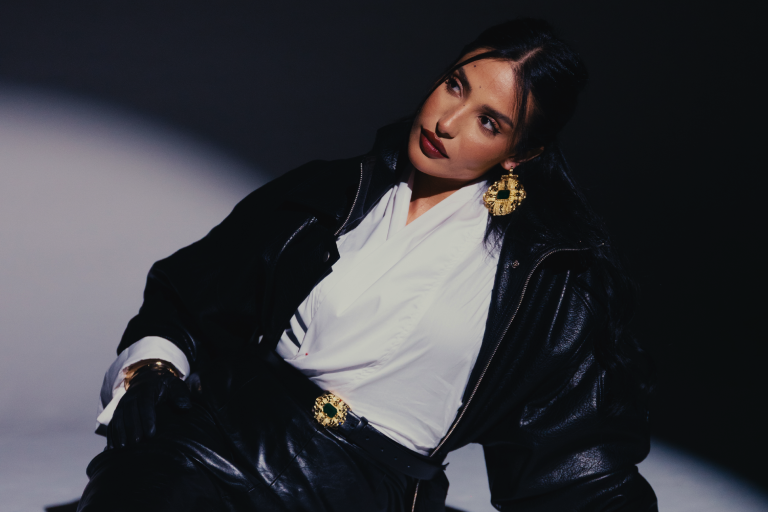

It’s said there are two tragedies in life: the first is not getting what you want, and the second is getting it. TUL8TE has got everything he wanted as a rising Arab musician, but now he has to contend with the spiritual cost of keeping it all. His success has brought more than chart-topping albums and streaming records; it has also made him the star of an industry desperate of a unifying Gen Z phenomenon. An industry that keeps betting on him to win the summer album race, year in and year out, with his records already measured against Amr Diab’s and Tamer Hosny’s.
That bet, sooner or later, comes with a pull toward engineered, virality-optimized pop, and when I spoke to the young serenader last year, he was as adamant as ever about resisting it. Sadeek El Bernameg, his fourth studio album, is where his resistance meets the industry’s pressure head-on, and where he goes looking for a way to answer the market without selling out to it.
He starts the album the way you would start an exam, with the easiest, most accessible question, leading on a strong foundation and building confidence before moving to the tricky problems. And so, the album’s opener, “Men Gheir Kalam,” greets the audience with the, oh, so familiar breezy, Spanish acoustic guitars, a sprinkle and a dash of Y2K pop influences, and smoothed out, sentimental vocal delivery that recalls Tamer Hosny’s early career.
Last year, “El Hob Gany” became one of TUL8TE’s biggest breakout stories, taking over the region and winning the summer song race in stride. I have previously made the argument that TUL8TE reverse-engineers his own successes, popping the hood and transplanting whichever parts landed the hardest into the next production. “Enta Habeeby” is a fine example of that.
The song learns three lessons from “El Hob Gany”: the sly use of maqsoom, the Egyptian shaabi-pop beat, its unabashed borrowing from ’90s Amr Diab tropes, and the intentional use of structural repetition (the chorus loops back on itself four times at the end of the song). Whether “Enta Habeeby” matches “El Hob Gany’s” reach remains to be seen, but the intent to reignite that regional frenzy is unmistakable.
“Garee2a Awy” is proof that a song can be engineered for virality and still be a good time. First released as a COLORS Studio single before being reworked for the album, it immediately found a home in TUL8TE’s catalogue of viral hits and onto car speakers from Cairo up to the North Coast, and, honestly, how could it not? It’s built from roughly 40-second segments, each one optimized for becoming a “viral moment,” packed with dynamic drums, restlessly progressive sound design, and sticky vocal melodies, with not a second left unaccounted for. The lyrics are amusingly kinetic and translate easily into TikTok choreography. Even though I felt I saw the sausage being made here, “Garee2a Awy” remains one of the album’s tastiest offerings.
If you haven’t kept up with interpolation, it’s a fast-rising habit in global pop, where musicians “borrow” a melodic or rhythmic segment from an earlier hit, disclosed or otherwise, in order to maximize the song’s chances of going viral. Unlike sampling, which lifts from the actual recording, interpolation works on the composition, the written music itself, and can stretch to borrowing a hit’s structure or its overall mood.
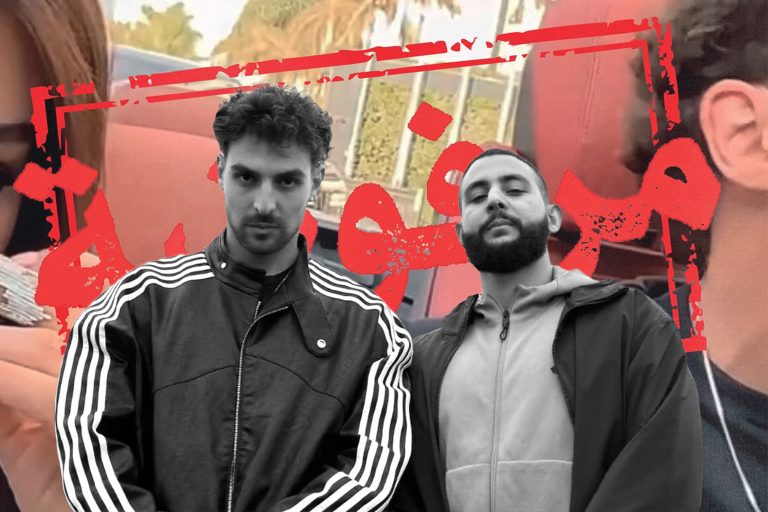
The Arab internet has long whispered about whether TUL8TE interpolates the Y2K greats, your Amr Diabs, Tamer Hosnys, and Mohamed Hamakis, until recent talks of a lawsuit and a track scrubbed from YouTube dragged the whispering into the open. For me the question was never whether he interpolates, but whether he does it, as one savvy YouTuber recently framed it, in a tasteful way, like Kanye, or a graceless way, like Ava Max.
I’ll keep making the case for TUL8TE being on the tasteful end of the spectrum. Yes, his songs often set off that nagging where-have-I-heard-this, but the results feel fresh enough, and, more to the point, his songs stand on more than one leg; there is enough of his own contribution in them to make the style unmistakably his.
That case gets harder to argue on “Ha’ak Alaya,” which stretched my good faith past its limit. The first thirty seconds alone flash back to three different songs, one Tamer Hosny, one Hamaki, one Yasmine Niazy. Around the midpoint, an orchestra hit lands exactly where it lands in that same Hamaki record. Fans online diverged on guessing which hits served as inspiration behind “Ha’ak Alaya,” but converged in thinking that the song sounds way too familiar to simply enjoy.
However, TUL8TE clears the nostalgification charges on “Wala Ash Wala Kan,” one of the album’s quiet standouts – a subtle synth-pop number built from deliciously ethereal leads and immersive textured percussion. The lyrics here are more coherent than a curated set of love catchphrases, even though the song still favors mood-building over storytelling. TUL8TE’s warm and close vocal delivery also captures the listener in an emotional one-on-one that distances him from the generic radio fodder.
If you know your Levantine shaabi, you’ll catch the sleazy keyboards slithering through the intro of “Kobtan,” and you’ll see the tasheeleh, dabke’s answer to the beat drop, coming from a mile away. If you don’t, consider yourself pleasantly ambushed.
Having already planted a flag in Dabke last year, with “Daroory,” the single off Narein, and “Quesm El Shakawy,” both remembered as two of his sharpest and most fun 2025 releases, TUL8TE presses deeper into Levantine folk-pop, this time taking on the wild beast of Western-Syrian shaabi: waves of hoarse, Da’oor-recalling quarter-tone keyboards and unrelenting drums. Whether you find the wedding-singer-in-a-suit-and-tie sentimental interludes between the dabke stretches endearing, as I did, or awkward, as plenty online have, is your call.
Against his best efforts, Sadeek El Bernameg still comes across as milder, more cautious, and more calculated than TUL8TE’s earlier albums, and yet, for a record that was never allowed to fail, it works the high-stakes pop machine with real grace. The collaborator list has grown taller, now taking in lyricists, instrumentalists, producers, and engineers, so the one-man-band wunderkind is gone, but his hands-on direction still shapes every corner of a genuinely coherent album. Maybe that’s why he keeps putting so much weight on the album as a form: the deep cuts are where he can still experiment, still fool around, still play for the sheer love of the game.