
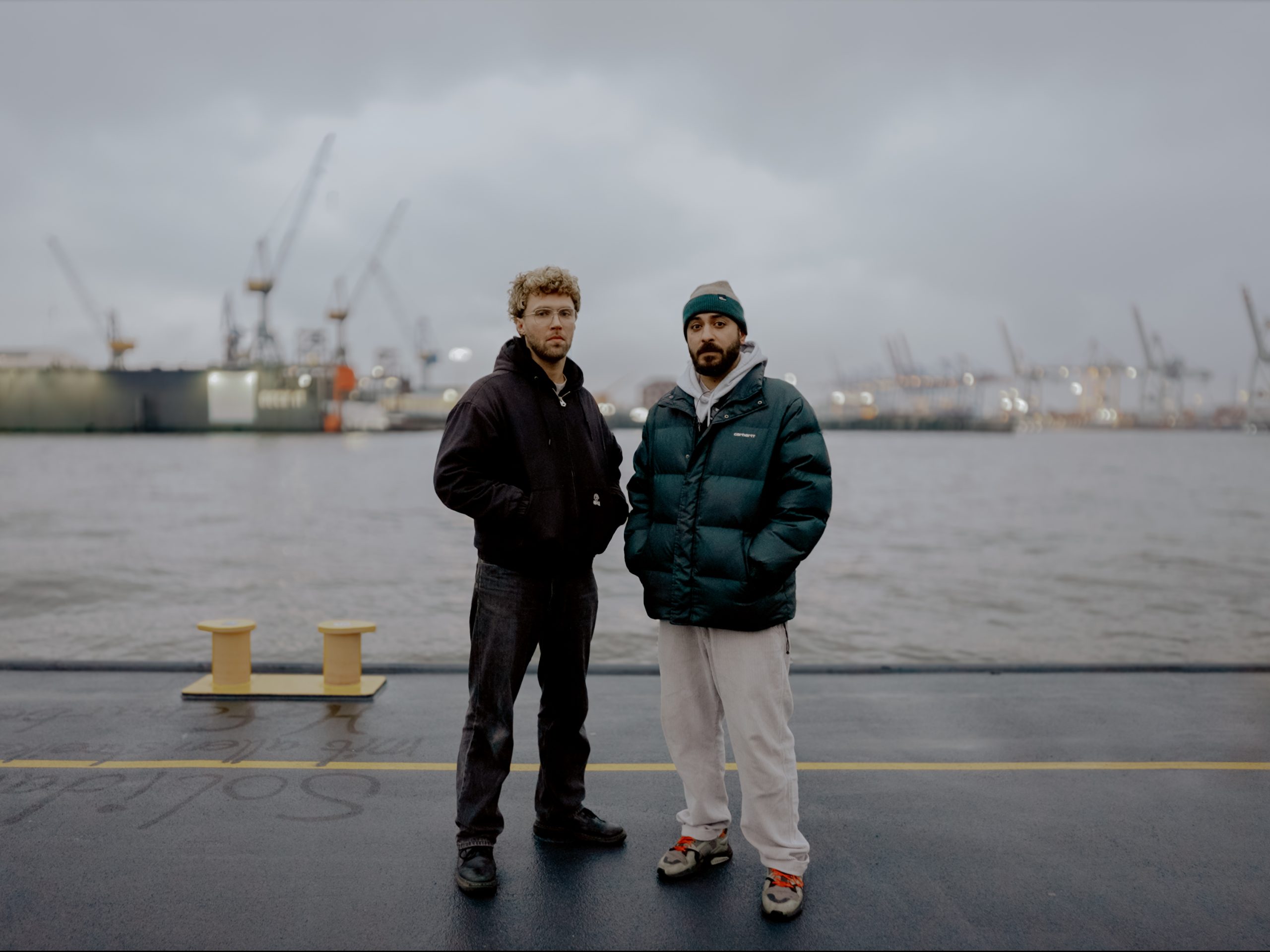
For a duo like Shkoon, the phrase debut album * feels misleading. It suggests a beginning, when in reality, Traces feels more like a culmination. It merges at the exact point at which years of musical exploration, political memory, and emotional excavation combine.
On Traces, Shkoon sharpen the emotional and political language that has long defined them. The German-Syrian duo turn migration, memory, and the afterlife of home into a borderless electronic sound that is intimate, haunted at times, and increasingly expansive.
Since their early rise, Syrian vocalist, lyricist, and producer Ameen Khayer and German musician Thorben Diekmann have occupied a rare space in contemporary electronic music. Their work resists the easy shorthand of “Arabic influence” laid over European club structures.
Instead, it carries the weight of lived experience from exile to conflict, exploring longing and emotional release, all while remaining catchy, melodic, and built for a wider collective feeling.
Previous releases such as Rima, Masrahiya, and Greater Than One established their reputation for blending electronic frameworks with Arabic musical language. Yet, Traces pushes further inward. It is less concerned with surface hybridity than with what remains after the dust has settled.
Ahead of the album’s release, Rolling Stone MENA spoke exclusively with the group about the pressures of expectation, artistic evolution, and the concepts behind Traces.
“The deeper you go down this path, the higher the expectations become,” Ameen tells me. “At some point, we felt we needed to loosen ourselves from that pressure a little and become more confident in speaking about what we actually feel right now.”

That confidence is not easy. In a world of constant catastrophe, where events change by the hour and the political weather shifts faster than art can respond, making emotionally honest music can feel like stepping onto unstable ground.
“That may not always line up neatly with what is happening in the world,” adds Thorben. “Things are shifting every day. You can write a piece of music and, before you have even finished mixing it, the world changes again, and the music can suddenly feel contradictory to something that has just happened.”
The result is an album that does not pretend to resolve contradictions. Instead, it places that contradiction onto the mantlepiece. Traces is not an escape from the world, nor is it a direct, unfiltered political manifesto. The album is far more immersed in memory: a record about genuinely carrying pain, returning to heritage and roots.
Inherited Sounds and Lived Histories
That tension sits at the heart of the album’s opening emotional statement. “With ‘Tired Way’, Thorben sent me a sketch on piano,” Ameen explains. “He lives in Hamburg, and I live in Berlin, so we often work remotely. I listened to it and immediately got goosebumps. The melody gave me a feeling straight away, and the lyrics started coming into my head.”
The song carries lyrics by Syrian coastal poet Hussein Hamza and traces the feeling of traveling down a road that no longer feels certain. It is a song about exhaustion, but not surrender; about searching for direction while trying to hold onto some fragment of youth and lightness. In Shkoon’s hands, that private uncertainty becomes tied to a wider emotional and political atmosphere.
“At that time, there had been massacres in the coastal region,” Ameen tells me. “People were being killed because they were Alawites. That was in my head. It is always connected to something political, even if it is hidden inside the music. It is not about being afraid of what people will think. It is about living with that feeling and expressing it honestly.”
“I do not care what someone’s religion or belief is. For me, people were killed, people were insulted, and I am always emotionally connected to those places. That is where ‘Tired Way’ came from.”
The personal becoming collective has long been central to Shkoon’s appeal. Their music works with inherited sounds and lived histories that continue to reverberate long after the original event has passed.
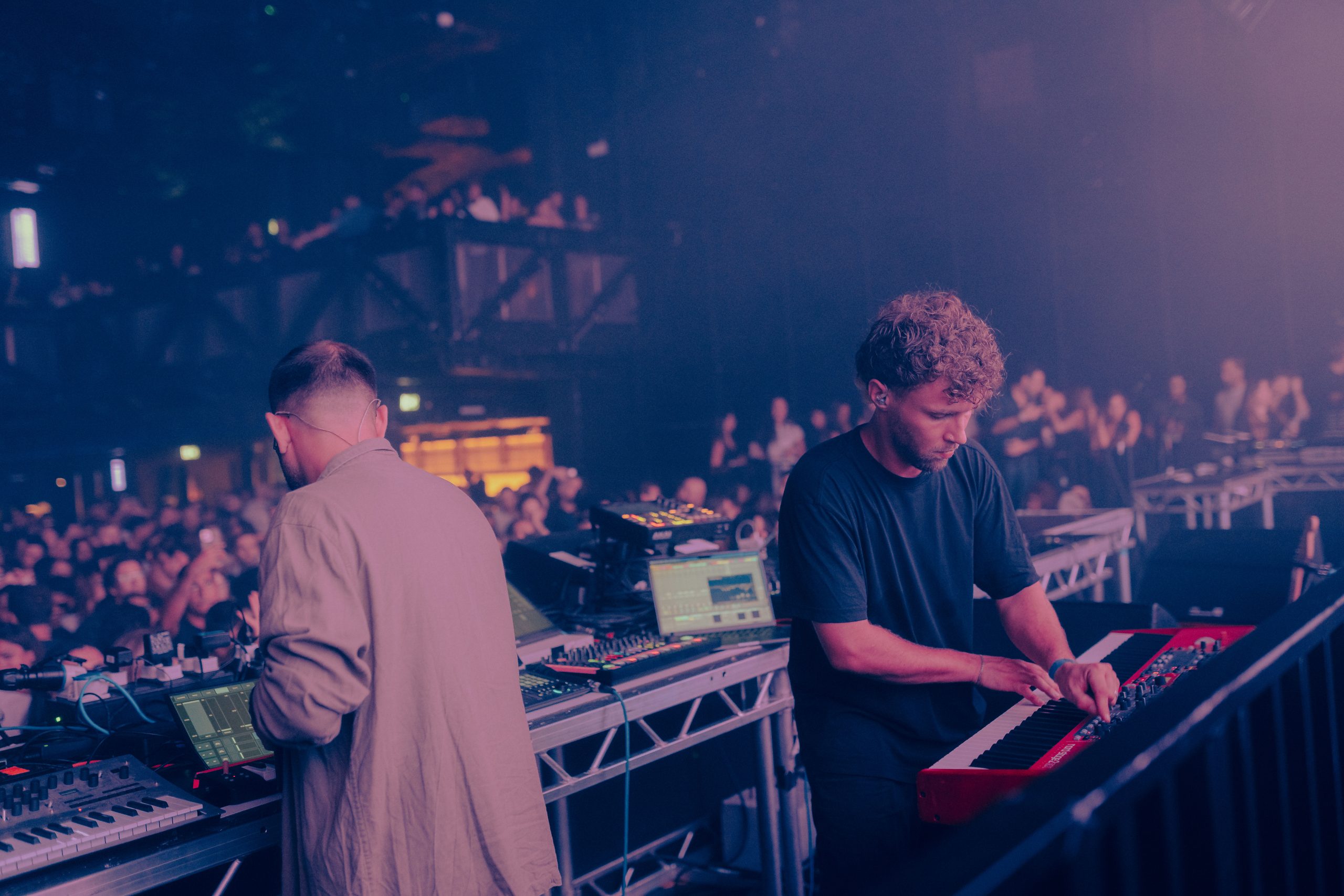
For Ameen in particular, that relationship to history is not abstract. Born in Deir Ezzor, he later studied and lived on Syria’s coast, where he was imprisoned as a political activist at the outset of the Syrian revolution. That experience sits somewhere beneath the music.
If Masrahiya was, in part, about standing up, speaking out, and performing resistance, Traces feels less about the moment of rupture itself than about what remains after it.
The song “Hannen” is built around a chant sung during the Syrian revolution, the track draws on a voice from the past and reanimates it in the present, for Shkoon’s music has never treated political memory as museum material.
For Ameen, that idea of people gathering through sound was shaped not only by Syria but also by Europe. When he first arrived in Hamburg, he did not experience the city simply as a place of alienation. He saw possibility in its openness, its harbour history, its internationalism, and its club culture.
“When I left home and came to a place that I planned in my head to call home, I was searching for somewhere new,” he says. “A lot of Arabs talk about culture shock when they arrive in Europe. For me, it was not culture shock as much as admiration for what I saw around me.”
Ancestral Echoes
Elsewhere on Traces, Shkoon turns toward kinship and intimacy. “Khala”, whose title means “aunt” in Arabic, reaches toward a familial figure associated with trust, guidance, and emotional nearness.
Rooted in Iraqi musical tradition and shaped by a folkloric call-and-response structure, the track places one voice in conversation with many. Lyrically, it centers on heartbreak, patience, and the instinct to reach toward family in moments of vulnerability.
“Khala” is one of the clearest examples of that instinct of communal address, a song not only about longing, but about the people one turns to ultimately survive it.
“But right now, when you look at what is happening in the world — and the way colonialism never really ended — there is an awakening happening for a lot of people.” Ameen declared.
“Arab heritage is beautiful and strong. It is something that should be shown, maybe especially to our non-Arab audience. Arabs already know this heritage exists, but it is important to remind others that it exists and that it should remain.”
That philosophy is audible in the album’s focus track, “Winn Buya Winn”, which draws from Iraqi musical tradition and lyrics by Mohammed Jawad Al Amouri. The word “Winn” itself carries the sound of pain — an expression of internal tension and emotional rupture.
The track revolves around a compelling idea: that pain is not only something to endure, but something that can carry its own strange beauty.
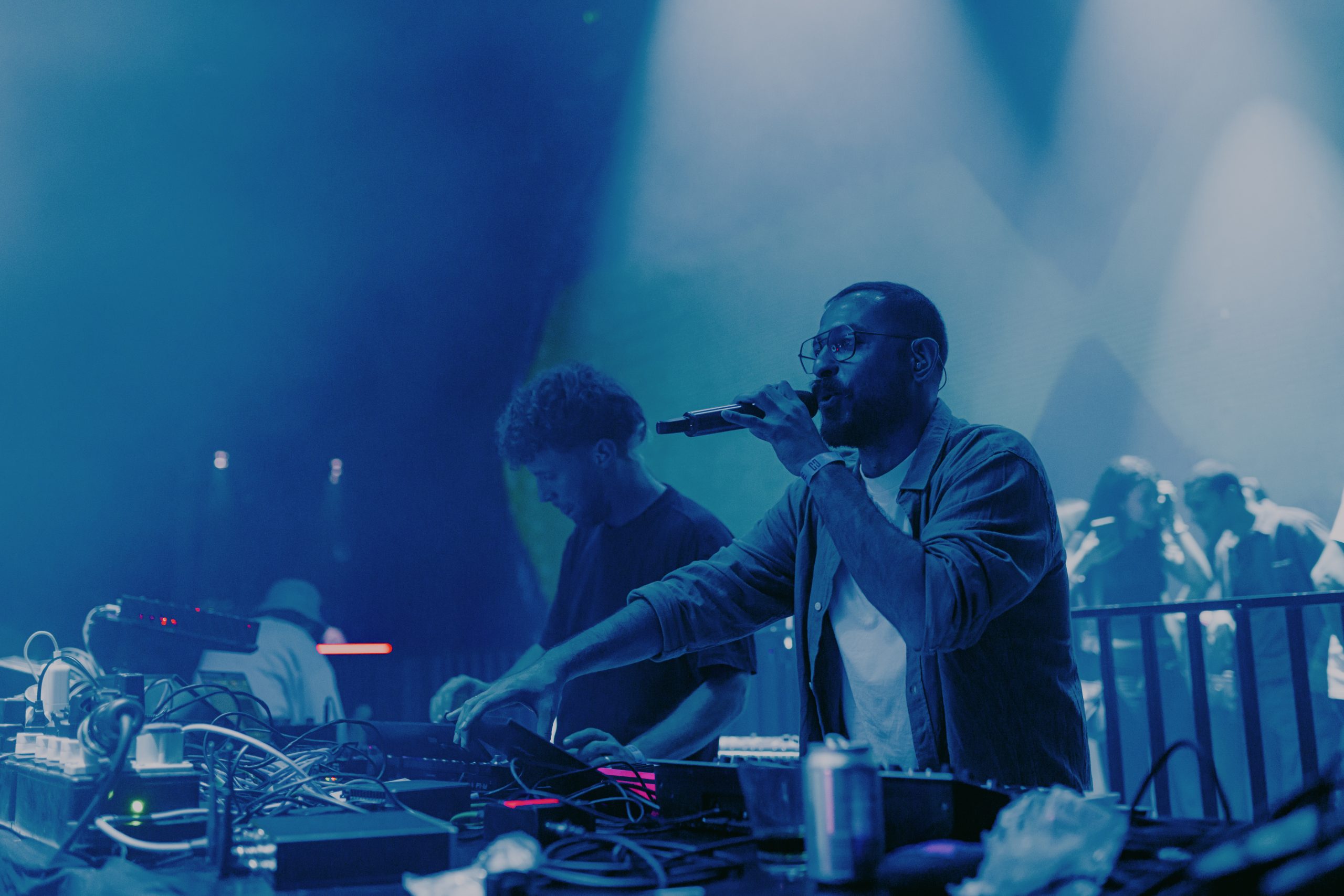
“We always try to get out of the frame. That is how we love to work together. When we sit and make music, something clicks. I might say: let’s play this note, or let’s try this rhythm, even if it does not seem to fit with the speed.”
That willingness to let things clash rhythmically and culturally is part of what gives Shkoon a distinct signature. Arabic music, with its maqams and microtonal emotional emphasis, does not always sit neatly inside Western expectations, and for the group, they are seldom trying to sand down those rough edges.
“Sometimes a rhythm does not fit naturally, but you can tweak it,” they say. “You can make it fit unnaturally. That is also how Arabic music can sound to people in the West. For them, it can sound like a music error. But for us, it hits the heart.”
Shkoon’s music is hybrid. After all, their lives are hybrid, and their audience is ultimately hybrid. Syria, Germany, Iraq, Lebanon, Europe, the Arab world — in Traces, these are not merely locations on a map. They are inheritances, atmospheres, wounds, and opportunities.
“When you listen to Bayat or Saba or those maqams, they do something to you emotionally,” Ameen says. “That is the point.”
When asked what they listen to, both musicians describe a listening practice that is wide and curious and predictably border-crossing.
Ameen points to electronic music, tech-house, strange beats, African music, and Sudanese punk. Thorben talks about discovering local scenes around the world, from Japanese funk and disco to Yellow Magic Orchestra.
“Both of us collect music from all over the world,” Thorben says. “It is so interesting when you go into different countries and discover that there is a whole local scene built around one specific sound or function that you had no idea existed.”
Shkoon’s sound is not built from a closed archive; the music has evolved constantly, absorbing and translating. Delving into Traces, you sense that Shkoon is not trying to tell the whole story — and perhaps that is precisely the point.
A trace is not the event itself, but what survives it: a mark, a quiet proof that something has passed through and altered the surface. For Shkoon, memory does not resolve neatly, and neither does home.
* The duo released several albums before Traces, but they’re presenting the new record as their debut full-length album.







Abdi Declares the SDF Integration Into the Syrian State Complete
The SDF has completed its integration into Syria’s state institutions, a major step toward a unified Syria.