This review contains spoilers.
In a newly familiar pattern, Ramadan television in Egypt is arriving in two halves this year. The first stretch crashed on the shores of harsh expectations, as viewers searched for a much-needed distraction between news cycles, and the offered menu failed to fully satisfy that hunger. Now that the second stretch is approaching its conclusion, at least one title has emerged as this season’s redeeming act: Hekayet Narges.
A true edge-of-your-seat melodrama – the kind that paradoxically detaches you from reality by pushing you even deeper into it – the show is sparking endless debates around iftar tables and across social media, as it resurfaces one of the most troubling urban legends of modern Egypt, a character so villainized in popular culture that she came to be known as Aziza “Bint Iblis,” Arabic for “Daughter of Satan.”
The original story unraveled like a what-the-fuck onion, revealing one layer of WTF after another as the public peeled through it. A woman incapable of conceiving children, due to a birth deformity according to one account, driven by societal stigma and familial pressure, descends into the harrowing business of kidnapping infants, building her nuclear family from three newborns abducted from different families in the early 2000s.
When Aziza was caught and brought to justice alongside her husband, sentenced to seven years in prison, she admitted to kidnapping her two younger children and revealed their original families, with whom they were later reunited – but insisted that her first child was her own, despite DNA tests to the contrary, and later ended her life during, according to one account, a visit from her older son, who was trying to convince her to reveal his true family.
Going in, it was hard not to worry that a premise with this much potential for character study and social commentary would get flattened into pure scandal – one more lurid treatment of a sensational crime. Having watched through most of the show, I’m happy to report the opposite.
The series, directed by Sameh Alaa and written by Ammar Sabry, has the good sense to approach the material with a sharp eye and restless curiosity for social and psychological dynamics. Rather than structuring itself around two oversized leads, Hekayet Narges plays more like an ensemble piece, cleverly nodding to the fact that a woman does not kidnap herself a family in a vacuum. That is rarely a personal crisis. It is social. Domestic. Economic. Gendered. It takes a whole ecosystem to produce a disaster like this.
Every key figure orbiting the two leads – Narges and Awni – is given enough time and enough emotional room to register as part of the machinery that made them. Narges’ sister and parents turn her barrenness into a lifelong humiliation. Her ex-husband moves on into another marriage despite her refusal. Her mother tells her she would have preferred one son to her four daughters.
The same care extends to Awni. The series walks us, slowly and deliberately, through his formation too, so that by the time he gets pulled into the infant-kidnapping scheme, the move does not feel scandalous. It feels legible, and horribly in character.
And yet the title is not coy about where the center of gravity lies. This is Narges’ story. More than that, in almost every couple and every nuclear family the show touches, it is the female experience that drives the narrative while the male perspective recedes into second position. That gendered focus gives the series a spiritual kinship with works like El Gaar El Sabea, where familiar stories get turned upside down when told from a feminine perspective.
That female perspective comes into especially sharp focus in the subplot of Narges’ sister, Huda, and her husband, where the male figure is portrayed as a black hole, absorbing everything Huda achieves and accumulates without giving anything back.
That’s where the show draws its power: it does not tell us the story of what Narges did so much as the story of what made her capable of doing it. Her ex-husband, her parents, her brother-in-law – they create a context in which her actions start to feel deterministic and inevitable, the last piece in a domino chain she neither set nor triggered.
Another factor contributing to the show’s well-roundedness is its unseasonably strong dialogue. In a Ramadan cycle where people are already half-joking, half-serious about whether AI is sneaking into scripts and writers’ rooms, Hekayet Narges sounds written by people who actually listen to people.
Conversations carry a social realism that is almost documentary in its flow. When Narges is about to leave to kidnap her second child, she does not announce it in some ridiculous screenwriter voice – no mafiosi “I’ll be back with a baby,” no dead-on-the-nose “I’m leaving to kidnap a newborn,” which we have, oh so painfully, grown used to. She simply presses on the cotton-stuffed belly she has been wearing for months and says, “I think I might go into labor tonight.”
The ensemble structure pays off not only in world-building, but in performance. Riham Abdel Ghafour gives Narges the empathetic embodiment she requires, making the pain she felt as worthy of compassion as the pain she inflicted. Restraint defines her performance as she approaches Narges’ reactions and emotional outbursts with surgical precision. Hamza El Eily brings a bruised masculinity to Awni, exhibiting with nuance the cost of vulnerability in an alpha-centric society.
The rest of the cast decisively reject the “supporting” tag, grounding themselves, one scene at a time, as narrative pillars. Samah Anwar and Arifa Abdel Rassoul team up to draw an unforgiving image of matriarchy in crisis, while Passant Abu Basha and Tamer Nabil close a narrative loop by showing up as the dead end where you hoped an emergency exit might appear.
Among the show’s most unsettling truths is that, infant kidnapping aside, Narges and Awni’s marriage is weirdly one of the most beautiful traditional marriages captured on the small screen this season. As deranged as that sounds to write, the series earns it.
One of the quietly devastating expressions of that bond comes when Narges buys Awni a prosthetic leg he thought was too expensive to buy for himself. Scenes like this drive us to wonder how differently would their story have unfolded had society allowed them to be happy on their own terms.
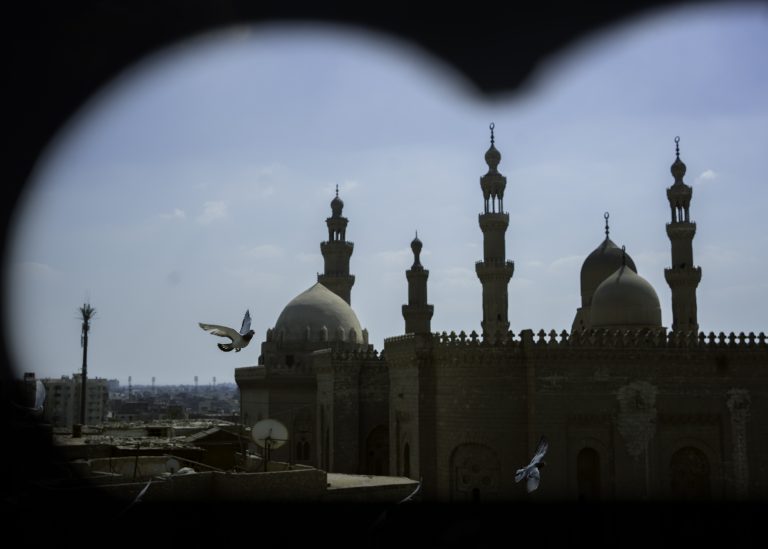
The set design deserves its own flowers too. The series captures a cramped Cairene neighborhood with disarming confidence, finding beauty in it without deodorizing it. It understands the erosion of privacy that comes with this kind of urban planning, or the the lack thereof, but also the intimacy and accidental solidarity it can produce. Walls are thin, doors are porous, everybody knows too much about everybody else – and yet that same suffocation becomes its own form of closeness. The show knows how to hold both truths at once.
That may be what makes Hekayet Narges feel so complete. It does not reduce its world to a scandalous crime or a moral lesson, but instead gives us a whole social habitat – its tenderness, its cruelty, its gender structures, its humiliations, its improvisations, its daily micro-transgressions that quietly build into something absolutely obscene.