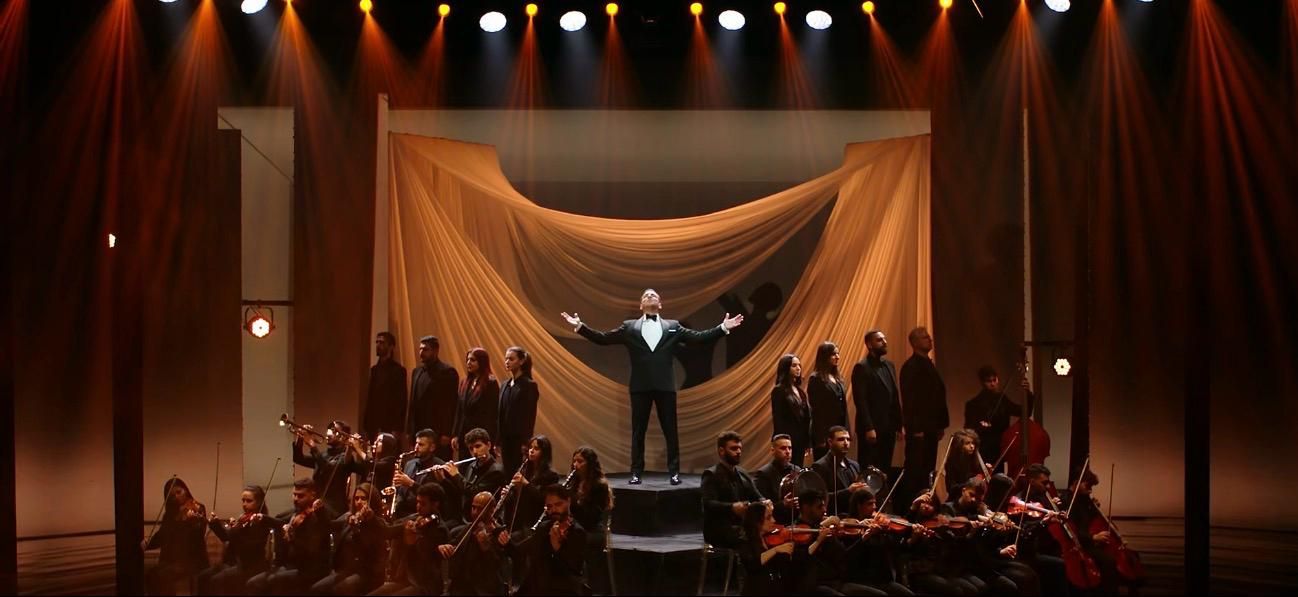
There is more to “Ghannaki Al Qalb” (“My Heart Sings to You”) by international tenor Amine Hachem than is apparent on first listening. There’s the sound of the orchestral arrangements — performed by the National Philharmonic of Ukraine and Ukrainian Radio Symphony Orchestra — at times lush and dense, at other moments spare and haunting. The tinkle of a piano rises to the fore, followed by the blare of the brass, and through it all, Hachem’s unapologetic vocal glides over the arrangement, commanding a warm, assured and powerful tone, carrying the song’s emotional weight.
There’s so much going on in the song, which debuted last fall, that the sonic cohesion is almost miraculous. It’s sonically very ambitious, where each element finds its place perfectly without overcrowding the frame. Ghannaki Al Qalb is engineered and layered with precision enabling a grand performance to breathe without losing the heart at its center.
A Miracle of Sonic Cohesion
If “Ghannaki Al Qalb” is a sweeping operatic love letter, then Ghassan Abdelnour is the steady hand that ensured it breathed into harmony. Serving as the recording producer and sound editor for “Ghannaki Al Qalb,” Abdelnour played a pivotal role in translating an ambitious artistic vision into a seamless sonic experience. The results speak for themselves. Since the song was released on November 11, 2025, it has reached the #1 position on the YouTube Charts in Lebanon, surpassing 4.5 million views (the entire population of Lebanon is around 5.8 million). The song also received widespread regional exposure, with airplay across major television and radio platforms including MTV, One TV, Radio One, Sawt Lebanon, and One FM, solidifying the recording’s cultural and commercial impact.
By working in close creative partnership with Hachem, Ghassan was instrumental in shaping a cinematic soundscape that honors the emotional depth of the composition, elevating it through meticulous production design on an orchestral scale.
“The goal was focused on the translation of an ambitious artistic vision into a cohesive and immersive listening experience,” says Ghassan. “From the outset, the sonic identity of the track was conceived as one of the defining pillars of its success.”
Sculpting Sonic Worlds
Abdelnour’s reputation for technical precision and creative intuition is grounded in a diverse body of work across film and music. He has a number of projects to his credit, having worked with Tony Award winner Joanna Gleason on her feature film The Grotto as well as INT.HALLWAY/NIGHT, directed by Billy Zane (Titanic). He has also worked on At the Sea, a drama film directed by acclaimed filmmaker Kornél Mundruczó starring award-winning actress Amy Adams. Across genres, he is regarded as a meticulous craftsman whose sensibility extends well beyond mere sound engineering.
“My goal is to sculpt sonic worlds that amplify the artist’s narrative and resonate deeply with audiences,” he says.
Building Bridges
For “Ghannaki Al Qalb,” a number of bridges were built, the first a sonic bridge between two different musical universes. The production of the song had to honor the authenticity and emotional ornamentation of the Arabic musical tradition, while integrating the scale, structure, and grandeur of operatic and symphonic writing.
“Realizing this balance meant navigating differences in tonal architecture, vocal treatment, orchestral space, and rhythmic phrasing.” Ghassan recalls, “The focus was on translating the artist’s vision into a unified sonic language, one where Arabic melodic sensibility could coexist organically with Western operatic power.”
Western operatic power here also meant a cast of perhaps hundreds, as it involved the Ukrainian Philharmonic and Symphony Orchestra. All these elements needed to mesh with the performances of an Arabic choir, not to mention, the percussionists, the pianist, the solo violinist, and Hachem’s powerful vocal enveloping it all.
Bridge building was not only sonic, it was cultural, and it involved recordings made in multiple locations. The process demanded both technical innovation and artistic sensitivity. Ultimately, it resulted in a sound that felt neither hybrid nor juxtaposed, but fully integrated.
A Turning Point
The success of “Ghannaki Al Qalb” has come at a turning point for the evolution of music and sound in the region. There is a growing openness to genre-expansive work in the MENA region, one that blends rich musical heritage with global musical currents.
“I see this as the beginning of a new stylistic movement gaining acceptance,” Ghassan says.
The artistic trajectory of “Ghannaki Al Qalb” is already taking shape on stage as well, and is being channeled into a larger body of work. “Antar & Abla”, a large-scale operatic production with Amine Hachem as lead tenor and artistic director, has been staged in the UAE, marking a significant cultural milestone. This is a broader creative ecosystem, a collaboration that is reshaping the modern landscape of Arabic opera.