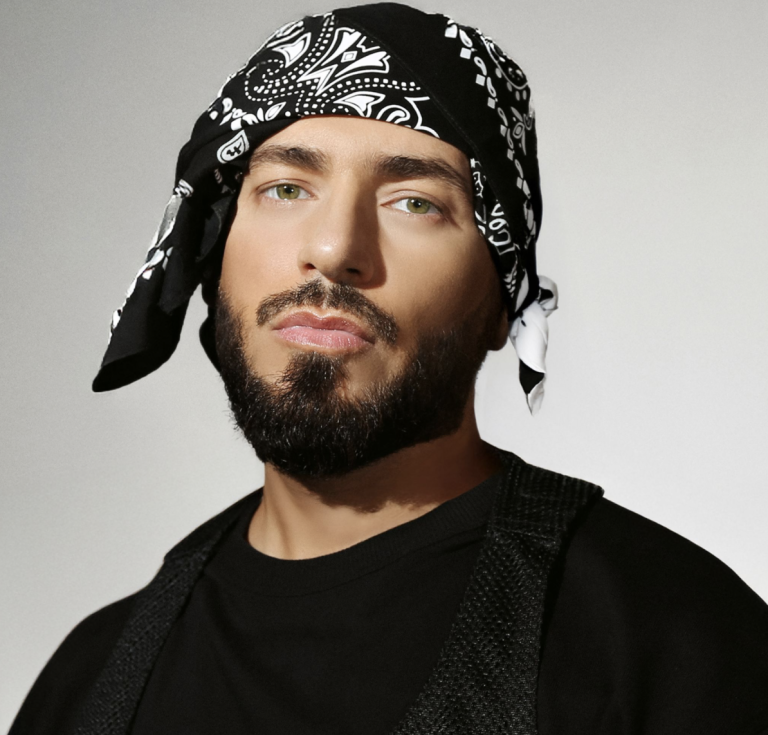
“Sometimes, I don’t want to talk about politics. I just want to talk about my mental health or about love or whatever.”
That’s how Palestinian-Jordanian rapper The Synaptik describes the burden of being an artist from a region often seen through a distorted lens. There’s little room for nuance in an industry eager to confine your music to tropes of dissent, exoticism, or diasporic nostalgia.
But the pressure to package identity doesn’t exist in a vacuum.
In Gaza, at least 70,000 Palestinians have been killed or are missing and presumed dead, even by the most conservative estimates. The surviving population—what remains of 2 million—faces the threat of death by starvation, described by the UN as deliberate and systematic.
A growing consensus of experts, including human rights organizations, genocide scholars, and UN bodies, agree that Israel is committing genocide in Gaza. And that’s not to speak of the structural violence and unchecked settler terrorism that characterize Israel’s illegal occupation of the West Bank.
In Sudan, a brutal power struggle shaped by foreign interests has killed an estimated 150,000 people, displaced more than 12 million, and pushed more than 25 million into starvation.
Yemen’s devastating war grinds on amid near-total media silence, with more than 17 million people living with ‘acute hunger’ and more than 233,000 dead, according to outdated UN OCHA projections.
In Syria, Lebanon, and Iran, regional conflict deepens internal collapse after years of compounded crisis and mass displacement.
Artists across the Middle East and North Africa (MENA) are creating against this crushing backdrop, which shapes their daily lives and how their work is consumed. They’re bearing witness to the destruction of the worlds that formed them—places whose creative traditions have shaped how humans imagine and understand culture.
And even as much of the world ignores the context, music from the MENA is going global. In 2024, the region saw the fastest growth in recorded music revenue worldwide, a surge largely disconnected from the devastation unfolding around it.
Music isn’t just an escape in this moment; it demands engagement with audiences that are, at best, numb—and at worst, indifferent.
“There’s a lot of pressure on people from Palestine to have a political message in their music or in their art,” The Synaptik tells Rolling Stone MENA from Ramallah.
His reality is shaped by the current crisis and the expectation that every bar speaks for a people.
For The Synaptik—whose music explores neurodivergence, personal relationships, and generational trauma—music began as therapy.
“For me it’s very personal and intimate. It’s me dealing with my emotions and the things that immediately relate to me,” he explains. “Then I saw people connecting with it in ways I didn’t expect.”
It came with an obligation he didn’t choose.

“I wrote something about my friend and people said it changed their lives because it reminded them of Palestine.” For the Synaptik, it’s an inescapable lens—but one he understands.
“I bear the responsibility now of being a positive role model. That’s the least I can do.”
That responsibility comes with the industry’s appetite for narratives of pain and resilience, forcing artists to strike a difficult balance between speaking out and steering clear of exploiting tragedy. That pressure intensifies as independent musicians from the region become increasingly dependent on Western and diaspora audiences in the streaming era.
For most, digital visibility doesn’t lead to ownership or sustainable income—especially when deals brokered from abroad rarely favor artists on the ground. Reaching a global audience often means conforming to its expectations, translating lived experience into trending content.
Nadine El Roubi, the genre-bending Sudanese rapper based in New York, also feels the pressure to be an educator as much as an artist. At home, she says, her lyrics need no translation.
“Sudanese people know what I’m talking about,” she shares emphatically.
But when she speaks to audiences in the West, she often feels the burden to “give background, justify it, explain myself.”
But visibility can also offer a narrow path to changing minds. Syrian-American rapper Omar Offendum has seen firsthand how visibility can shift perspectives over time.
“If one person hears a lyric and is moved to think differently about a topic, that’s a win,” he says.
Yet he’s cautious not to romanticize it.
“I’m not going to bring down a regime with one verse. But I can plant a seed in someone’s mind.”
The Synaptik, too, notes the costs and benefits of global exposure. He worries that Western audiences “vibe to a beat in Arabic” without understanding the message, or, worse, expect musicians to perform a digestible version of trauma and politics.
Many audiences and gatekeepers, he suggests, want a version of Arab artists that’s angry enough to perform their pain but not disruptive enough to challenge the worldview of those watching.

“I’ll always tell the truth, but I refuse to make money off exploiting a stereotyped image or clichés…I’m staying away from the things that do not represent me.”
Rising artists are caught in this catch-22 as they navigate an increasingly global stage. Yet even as domestic and external systems limit expression and mobility, artists from the region have long found ways to be political. Those same systems make the act of making music inherently political.
Scholar and cultural critic Rayya El Zein calls this “politics in motion.” For the Lebanese-Palestinian-American ethnographer—whose work examines Arab subcultures and political aesthetics—this means agency and political subjectivity can be expressed through affective engagement.
Politics isn’t just formal resistance. It also lives in the moments when music moves people to question their assumptions and to protest in small but meaningful ways.
If music mirrors its time, today’s Arabic charts reflect an era of folk beats, curated nostalgia, and identity branding. Struggle is routinely stylized and normalized, rarely examined for the conditions that shape it. The result is an increasingly re-orientalized soundscape made for universal appeal.
What’s at stake, as El Roubi makes clear, is being showcased rather than seen: “Sometimes I wonder if being visible is enough, or if it’s just another form of tokenism.”
To meaningfully celebrate identity, you must also confront context—and the urgency of reality.
“There are so many ways to interpret what artistic practice is for, in this moment,” El Zein notes. “Is your job to just keep going the way you were before? Is it to do resistance? Is it to testify to the horrors we’re all witnessing, or is it something else?”
Lina Makoul is also familiar with this paradox. Raised in Akka, the Palestinian powerhouse first gained attention when she won The Voice Israel. Western media quickly cast her as a symbol of coexistence, a contradiction with her lived experience.
“People want me to represent them, but I’m just trying to be an artist.”

Determined to take back control, she made the decision to part ways with her label and management in 2020, sacrificing her previous work in the process.
“That’s when I started gaining my strength as an artist,” says Makoul, who describes herself as “100% Palestinian, 100% independent.”
For her, personal and political liberation are intertwined.
“We may not have the tools to liberate the land, but we can liberate ourselves. Through our art, we can create spaces for others to do the same.”
As a Sudanese woman who performs in English, El Roubi follows a similar logic.
“Even if I’m not always talking about politics, being a woman, being Sudanese, being North African is political whether I like it or not,” she says.
That pressure adds up.
“It’s tiring to constantly have to educate or raise awareness about your own oppression.”
Visibility, she concludes, isn’t freedom. Refusing to perform identity means embracing her complexity.
Khtek, the pioneering Moroccan rapper known for her raw critiques of patriarchy and imperialism, also grapples with the risks of speaking out in an industry known for sidelining those who do.
Describing a chilling effect that has intensified since late 2023, she says “it’s not just authorities anymore. It’s brands, it’s platforms, it’s people with influence.”
El Zein calls this dynamic “soft constraint.” Institutions may not censor artists outright, she says, but “what gets booked, streamed, or sponsored is shaped by what Western listeners are willing to hear.”
Visibility demands palatability.
The fear of external censorship, Khtek notes, often becomes internalized.
“We self-discipline to fit into what we think brands or bookers want to see.”

That impulse applies to lyrics, production, and visuals.
“There’s a whole aspect of our realities that gets lost,” she explains. “You reconfirm the stereotypes when you treat culture like a commodity.”
This fear is deepened by the erosion of digital safe spaces.
“They’re being flagged, restricted, shadowbanned,” a subtle but powerful form of censorship. “They don’t have to ban you outright,” Khtek says.
“They just make it harder for people to find you. To hear what you’re saying, to support you.”
Still, she refuses to be silenced. “The thing about artists in this region is that we’ve never had real freedom of expression. So we know how to adapt,” she says. “We keep going, we find a way to speak.”
The Synaptik echoes Khtek’s feelings about unspoken boundaries.
“It’s scary when you’re unsure what’s safe to say and what isn’t.”
Still, he insists, retreat isn’t an option.
“What we can do is just make the music, empower ourselves, and find creative ways to get our voices out,” The Synaptik adds. “If you don’t want to talk about it, that’s your decision—but don’t silence those who are trying to speak.”
That comment gets at a tension threading through these conversations. Across the scenes and the MENA, musicians are under increasing scrutiny—not just for what they say, but also what they don’t. Their listeners and their peers, they say, are increasingly aware of those who put optics over values. For those who do speak out, authenticity is a way to stay rooted amid pressure to sanitize reality.
“I don’t make music to prove anything,” The Synaptik says. “I make it because I have to—because it’s what I live.”
Makoul puts it more bluntly: “I’m not going to sugarcoat who I am for someone to be more comfortable.”
For Offendum, that responsibility is also about continuity.
“I’m doing this to pay homage to the people who came before me and to build something for the next generation,” he says. “That doesn’t mean I’m trying to speak for everyone, but I do feel accountable to a much bigger conversation.”

Diaspora artists often have more visibility, but that attention can eclipse voices on the ground, where risks are greater and resources are scarcer.
The rapper and poet, whose work fuses music and activism, says that this blend emerged out of the need to preserve cultural memory, navigate diaspora identity, and challenge dominant narratives.
“We didn’t have a choice. The activism and the music were one and the same.”
He, like many of the others, resists the idea that protest music must always take the form of slogans.
“Telling stories, celebrating joy, keeping language alive—these are all political acts in their own right.”
Art, for him, is also about the long view.
“It’s about archiving experience, but also continuing our cultural traditions—making sure they live on,” Offendum stresses. “That in itself is a form of resistance. If you have the platform, use it. Even if it’s imperfect, say something.”
None of these voices believe that music alone will dismantle systems of oppression. But none are willing to let silence fill the void.
“No song is going to turn the drone off,” Offendum says. “But music helps people feel less alone. It can be a space of remembrance and connection.”
“We’re all so desperate for leadership,” El Zein tells me. “But maybe it’s not about heroes or one big leader. It’s about each of us doing what we can, where we are.”
In the absence of easy answers, there is agency and immense urgency.
Reflecting on this, Makoul shares, “I tell myself, what do I wish another artist was doing that would help? Then do it yourself. It’s not about grandeur and it’s not about being a savior. It’s about doing the work, even if it’s imperfect.”