Abu Talal is not real, but he is the most accurately described person in the Arab world right now.
He has been around for ten years, and in any given moment, anyone can become him. He is not one person, but a condition.
Right now, he wakes up exhausted and opens his phone. The news looks like propaganda. The propaganda looks like news. He has a feeling about all of it, and the region has not once run out of material.
So he forwards things. Something that feels dangerous, feels like a warning, worth passing on. In doing so, he becomes a free distribution node in someone else’s information operation, a volunteer in a war he does not know he is fighting.
Abu Talal belongs to Al Hudood, the pan-Arab satirical news platform that created him. He is their archetype of the Arab media consumer, the person they are writing for and about at the same time. As a condition, he is wider than any one platform’s reach.
Share3, a Syrian satire platform built in exile, and WKM News, a one-man parody machine out of Beirut, are working the same problem from different corners of the same region.
At Al Hudood, 12 staff from across the Arab world and Europe meet most mornings. A writers room without a room, scattered across time zones, finding the joke inside the condition Abu Talal cannot laugh at alone. They are very good at it. They have to be. Reality has been doing their job for them.
“The deeper danger,” reads one internal document, “is not convincing Abu Talal that a specific narrative is true. It’s convincing him implicitly that knowing the truth is impossible.”
The Monday I am there, three documents have been distributed the night before. A structural analysis of the Lebanon war. A breakdown of the Strait of Hormuz crisis. And a document on Abu Talal, 37 bullet points of political sociology about the Arab information environment. I am given access to all three on the call.
Five writers are present. I am the sixth, introduced as a guest.
They start with Lebanon. Three interlocking problems: Hezbollah’s structural loyalty to Tehran, Israel’s pattern of citing violations it is also committing, and an international community both sides regard as wallpaper.
Camilia turns her camera on. “Hezbollah is not acting as part of the Lebanese state, but as part of the Islamic Revolution in Iran. That is how it was founded. That is how it still behaves.”
Fathi pushes back. Without weapons, they have nothing. Back them into a corner and what is left?
“If losing weapons is a death sentence, what do you expect them to do?”
There are those in Lebanon who would ask a different question entirely: what fills the space if they were to disarm?
“It was a suicide operation,” another voice says. “They went in knowing.”
The room moves between those positions. One side holds the structural argument while the other holds the reality of a group that cannot afford to disarm.
Adam closes his summary. “Iran established the party, funded it, trained it, supported it so it could act as an advanced front against Israel. That project was valid until October 7th. Which is now suspended.”
Moments later, someone in the chat window types a headline and it gets five thumbs up.
“Al Hudood studies: Understanding Hezbollah decisions based on its leadership’s explicit statements rather than South Globe thinkers’ analyses based on Edward Said’s stolen Twitter threads.
Twenty nine minutes of argument compressed into one sentence.
They move to the second document. The Strait of Hormuz. Someone reads aloud: “a global economy dependent on a 21 mile wide waterway.”
Before the discussion can begin, Adam types in the chat: “Trump confirms the Hormuz crisis won’t affect food production because he doesn’t feel hungry.”
This is how Al Hudood works. Two tracks running simultaneously, analysis and joke finding each other without snapping the wire between them. The argument that goes nowhere and the line that says everything the argument could not.
Al Hudood is Arabic for borders. It is also Arabic for limits. A publication that lives in the gap between what power says and what it means needs a name that carries both.
It was founded in Amman in July 2013 by Isam Uraiqat and two friends who had run out of patience with every other option. They were screenwriters and the work kept coming back gutted. Anything with an edge disappeared.
“We thought, we can write for ourselves,” Uraiqat told me. “What a mad idea, basically.”
Two months later Al Hudood went live and advertisers retreated the same week. They were not the only ones. In a region where liking a post can be read as an endorsement, and an endorsement can make you a target, engagement itself carries a price. It moved to London, where it has run on grants ever since.
The staff work under alter egos Uraiqat has used long enough that he sometimes forgets their real names. “The name you read is the one that sticks.”
Their website has also been blocked in three countries. Uraiqat is matter-of-fact about this. “It’s fine,” he said. “It’s not a big deal.” He also avoids traveling to most Arab countries himself.
With no advertiser pressure, no single country’s jurisdiction, and no real names, Al Hudood occupies a position almost no Arab media outlet can claim, which is exactly what allows it to say what others cannot.
Their editorial principles include “don’t punch down,” and “don’t stop at ten principles just because ten feels complete.” The one thing banned in meetings is saying “this is not funny.”
“That doesn’t help,” Uraiqat said. “How do you make it funnier?”
What happens when a headline is pitched is something between a writers room and a courtroom. Thirty iterations sometimes before something lands. The person who pitches the joke gets final say on the phrasing.
One staffer spent months trying to write a fake op-ed from the perspective of an extremist right-wing Israeli. Six drafts, same verdict each time: they already say this. This is literally their manifesto. They never found a way to out-extreme the Israeli right. The piece never ran.
Another writer kept pitching a headline Uraiqat felt was cheap. “The joke was just profanity, nothing beneath it,” he said. He fought it for months. Eventually he let it through and it became one of their biggest posts.
“That humbled the fuck out of me,” he said.
The lesson arrived just as the bigger problem did.
The gap between satire and reality had been closing since 2016. By the time Trump returned to office, it had shut completely.
“We are officially in a place where you can’t use hyperbole. Because they either have said it, have done it, or are on their way to doing it.”
I asked what was left when reality writes the joke. The question sat there for a while.
“We were forced to do much more difficult satire. Satire is not the place for nuance. And yet here we are, writing satire with nuance, which is a very complicated and in some ways unappealing thing.”
Arab political satire is older than the states it mocks, even older than the word satire itself. The oldest known work of literary satire was written by an Egyptian scribe named Dua Kheti around 2400 BC. It was funny enough to remember and useful enough to teach: a father telling his son to become a scribe by making every other profession sound like a punishment. Scribes copied it for hundreds of years.
The Onion, which most people reach for as a reference point, was born in 1988. This region was already doing it in the Bronze Age.
Three thousand years later, Egyptian satirist Yacoub Sannu founded Abu Nazzara in Egypt in 1878 with Jamal Al Din Al Afghani and Sheikh Muhammad Abduh, 15 issues before Khedive Ismail shut it down and put him on a boat to France, where he kept publishing and mailing copies home past the censors anyway.
Alexander Saroukhan gave it a weekly home through Rose El Youssef in Cairo. Syria’s Al Mudhik Al Mubki, or What Makes You Laugh and Cry, was another magazine that ran from 1929 until the Baath Party arrived and found it unfunny. It also kept finding the same ending.
Naji Al Ali, the Palestinian cartoonist whose work defined a generation, was shot dead in London. Ali Ferzat had his hands broken by Assad’s men on a highway outside Damascus. Others disappeared into prisons and didn’t come out.
Bassem Youssef brought it to prime time Egyptian television after 2011, drew audiences in the millions, and was off the air within two years. He has not lived in Egypt since. The pattern holds across a century and a half. The sharper the work, the higher the price.
What fills the space now is digital, distributed, and harder to shut down. Three operations, one registered in London, one built in exile and scattered across seven countries, one running from a Beirut apartment, all working from the same premise that the joke has to come from inside the reality it describes.
Share3 launched in early 2024 into a specific silence. Syrians had largely stopped following the news. Years of war and competing propaganda had produced an exhaustion so complete it had become atmospheric.
Mohamed Kamal, who is still in Damascus and asked that his real name not be used, had been inside that story since the beginning.
Expelled in 2011 and later arrested, he returned to Eastern Ghouta and taught himself to document what was happening. He was there during the 2013 chemical attack, when sarin rockets hit the Damascus suburbs before dawn, killing more than a thousand people as they slept. He kept working.
Qosay Amamh came from a different direction. Palestinian-Syrian, he had spent years as a radio presenter hosting voices the regime catalogued as opposition. They were guests who, as he put it, people considered dissidents just for appearing on his show. He had never done political satire once in his career.
When Syria’s Orient TV closed in 2023 and left them both unemployed and radioactive to every other outlet in the region, Kamal brought him the idea.
“We were considered troublemakers,” Amamh said. So they built their own thing, in Turkey, with almost nothing.
Share3, Arabic for street, publishes short satirical videos in Syrian dialect across Instagram and Facebook.
For the Syrian diaspora, scattered across a dozen countries but still largely organized around social media feeds, the dialect alone is a form of proximity. The homeland in the voice, even when the voice is making fun of the people running it.
Their programs take the raw material of the news cycle and let it hang itself.
‘The Syrian Week’ collects headlines from a given week and places them side by side with no punchline needed.
‘Transitional News’ takes official statements from the new Syrian government and adjusts the language just enough, inflating titles, layering honorifics, treating new ministers with the same breathless reverence once reserved for Assad’s apparatus, so that the original sounds exactly as absurd as it is.
“Sometimes I’m just walking back from the gym,” Amamh told me, “reading the news on my phone, and I find myself sending a voice message to myself with the whole thing already assembled. By the time I get home, it’s done.”
The network runs across seven countries. Amamh coordinates from Cairo, where he has been since being detained in Turkey while reporting on a Syrian child sentenced to life in prison, and later deported, leaving him in a precarious legal position.
“I am in a very fragile legal situation in Egypt,” he said. “Very. This is what increases the pressure.”
The team inside Syria is anonymous. Voiceovers are recorded outside the country entirely. This is not precaution for its own sake.
A recent Share3 investigation traced an official holding four government positions at once, whose family’s meat factory appeared to benefit from import decisions he had signed. Prices rose that same week.
The response was immediate: accusations of treason and a smear campaign targeting Amamh and a colleague.
“We were very afraid for the team inside Syria,” Amamh said. Death threats had already been arriving in private messages. “There’s always a slight discomfort around safety. It’s always there.”
They decided to hide everyone’s identity. That is what the last few weeks have looked like.
When Assad fell in December 2024 the mission changed a bit. Before, the job was getting Syrians to look up. After, it became something harder, insisting that holding power accountable is not the same as opposing it, in a media environment already sorting itself into loyalists and enemies with nothing in between.
“We are not opposition and we are not loyalists. We are simply journalists.” He said it the way people say things they have paid to mean.
Kamal puts it from inside Damascus, where the cost of saying it is different. “There is a phrase people repeat often: if you want to criticize, do it politely. I don’t really understand it. I’m not insulting anyone. I’m pointing out problems. They simply don’t want to accept criticism at all. Politeness is just a way to silence you.”
Someone in Beirut arrived at the same conclusion entirely on his own, without knowing any of this history.
He is in his early twenties, works in marketing, and started by sending memes to friends. He named his page after Wael Kfoury, a Lebanese singer known across the region as the King of Romance. Nobody was expecting political satire from that address.
Instagram banned it for using a celebrity’s name. He kept the initials, added Mindset, rebuilt and kept going. The memes became news and the news became WKM, now at 84,000 followers with ten thousand of those arriving in the last month alone.
The format is precise and deliberately familiar: black background, bold white text, a cropped face, a logo in the corner. It looks exactly like the breaking news graphics that appear on your phone at 2am and make your stomach drop before your brain catches up.
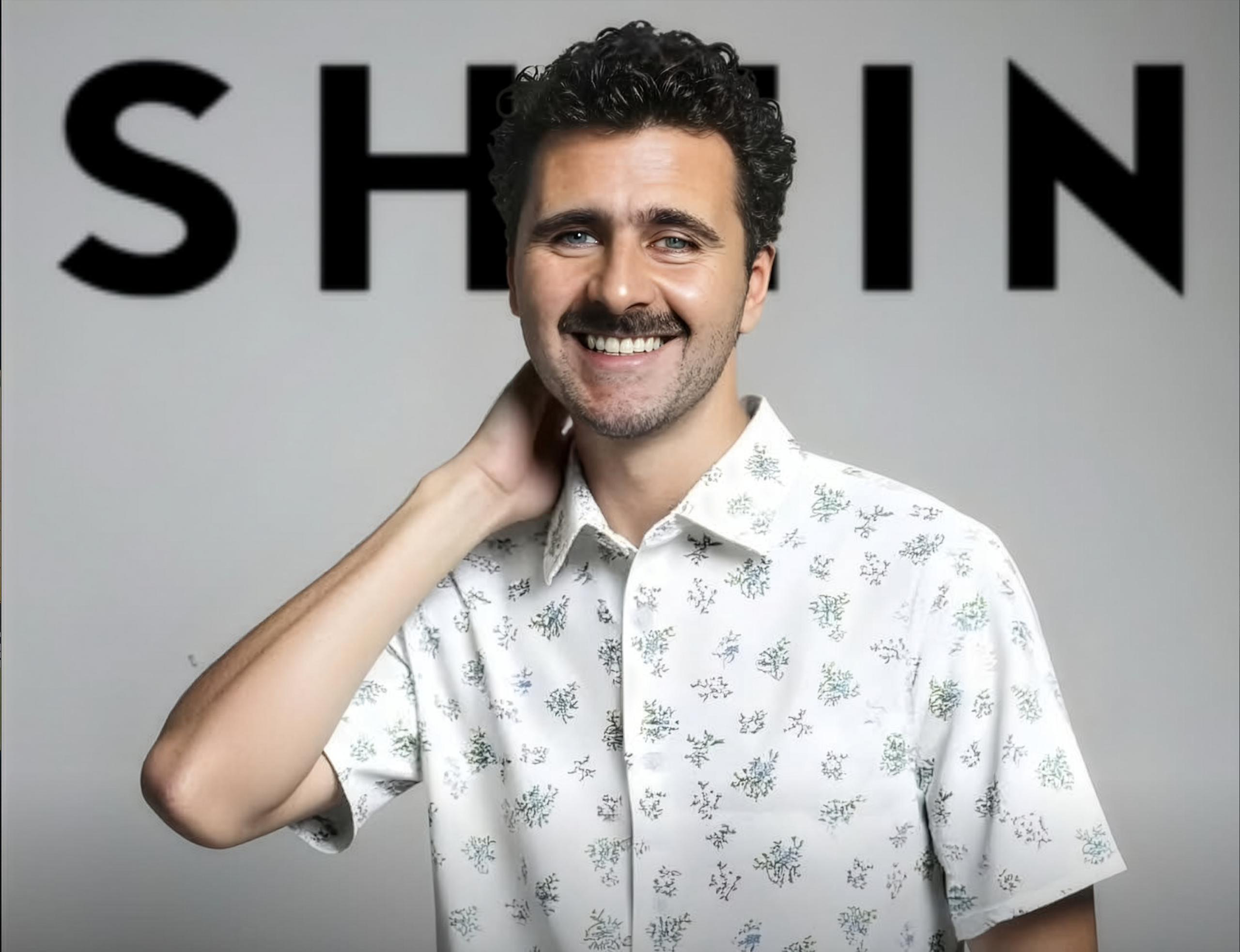
One post said Shein had launched an investigation after its website appeared to feature a model resembling Bashar Al Assad, framed as straight news. Hundreds in the comments were unsure whether it was real.
Another reported that DJ Khaled had confirmed he could speak out about Palestine but doing so would cost him his brand deals, his private jets, and the blessings he had spent years accumulating. That one spread because it read less like a joke than like an honest confession he never made.
“It’s clearly not true,” he told me, “but it kind of makes sense. You understand why people could believe it.”
He marks the account as parody and watches posts travel as if real. He stays away from religion. He posts every two days, started in Arabic, switched to English, and the account jumped. His audience is mostly Arabs, inside the region and outside it, sharing posts because the fake feels closer to the truth than the actual coverage.
“Satire becomes political by default when it reflects reality,” he said. “I’m not telling people what to think. But I’m definitely pointing out what feels off.”
He discovered Al Hudood and Share3 after starting, not before. He found the tradition without looking for it.
His next move is LinkedIn, a platform built entirely on institutional legitimacy and the performance of professional ambition. For an account that has spent two years making power look ridiculous, it seems like a perfectly logical place to expand.
Back in the Monday meeting, the stories get divided in under four minutes and the call ends shortly after.
Among the pieces published that week: four scenarios for how the war ends, none of them in your favor. Experts warn of gas buildup in the Strait of Hormuz. The Lebanese army restructured as a sports club. And a nostalgia letter to the days of well-mannered crime, bylined, in the Al Hudood tradition of correspondent titles that double as jokes, by the publication’s Nostalgist for Affairs of Occupation Etiquette, mourning the era when the occupier at least pretended to feel bad about it.
In 2021, Uraiqat wrote that satire won’t topple thrones but will unsettle their occupants. Four years later, with the region barely holding on, I asked him if that still held.
“I think so. It’s more difficult. There’s less space for it because authoritarianism allows for less satire to exist, and for less satire to have an effect.”
Then, after a long pause: “But here we are.”
Somewhere in it, Abu Talal is on his phone. His feed keeps moving. Fact, fiction, and satire all look the same.
The joke is the only thing still insisting there’s a difference, made from borrowed cities, under borrowed names, by people who know exactly what that insistence costs. When Abu Talal laughs, that’s the only victory to them that counts.