This review contains spoilers.
If you’ve been paying attention to Tunisian drama – which is enjoying a particularly strong production run this Ramadan – chances are you’ve already seen some of the memes and clips from the second season of Sahbek Rajel flooding social media. The show’s sophomore season is airing during the second half of the Ramadan cycle.
After a season that scored both popular and critical success last year, following a feature film released in late 2024, Sahbek Rajel has become a key pillar in a new wave of Arab sitcoms using police stations as a stage, from Lebanon’s ‘Marhaba Dawla’ to Egypt’s ‘Ashghal Shaqqa.’
These shows have created space to talk about one of the biggest taboos in the region – if not in the world – while drawing power from the comedy of discomfort: that sharp, exaggerated laughter aimed at jokes brushing up against subjects we’re not really supposed to talk about in public spheres.
The Police as a Corporate Ladder
Directed by Kais Chekir and written by Zyne El Abidine Mastouri and Ahmed Essid, Sahbek Rajel follows Azouz, a lower-middle-class man in his late twenties who lives in the houma – a working-class neighborhood in Tunisian dialect – and struggles with money as the unemployment crisis forces him to move in with his sister’s husband. Then his life takes a completely different turn when he is appointed an officer in a regional branch of the National Security apparatus.
From the moment the film first came out, the creators made a clear decision not to approach the police as an arm of state authority, or to focus directly on the institution’s relationship with citizens. Instead, they frame the police as a job, a workplace, and a site of internal relationships and power dynamics – not unlike any other company someone might work for.
Azouz leans on his social intelligence and workplace instincts to get close to his superiors, Mehdi and his father-in-law Si Lahbib, setting off a chain of ironies in which Azouz’s family and friends – many of them entangled in illegal activity – end up intersecting with Mehdi’s family, whose history in the police is defined by integrity and a rigid sense of discipline.
Azouz sees working in the police force as the opportunity of a lifetime after years of professional struggle, and from day one in the role, he is determined to hit his monthly target and leave a positive impression on his bosses by arresting his old friends from the drug trade, people he knew from his previous life.
He makes up for his lack of experience by listening to his assistants and giving them personal space to build confidence. He also cozies up to his subordinates outside the professional boundaries of work to earn their trust.
He is an employee before he is a law enforcer – driven by dreams of bonuses and promotion.
His relatives ask him to take care of administrative favors involving traffic tickets and the like, while the apparatus itself benefits from his network of friends and connections, especially Hatem (Tito) and Bakhtnou, who help the institution from below in several operations targeting criminal and illegal networks.
Azouz rises socially, and over the course of the show’s two parts, he gets to enjoy the perks of a better lifestyle: a more diversified social circle, a better home for himself and his family, and enough room to support his lifelong friends, both financially and professionally, by investing in a project they work on together.
The brilliance of this setup lies in how it plays a deeply human angle, expressing the utilitarian relationship between citizens and the police system, while also presenting an unfamiliar image of one of the most authoritarian executive institutions people encounter in everyday street life – all through the eyes of someone who belongs to both the police and the street at once.
For millions of middle-class families in Tunisia and across the Arab world – if not in most countries around the world – joining the police means a secure job, a monthly salary, and the social and health benefits that come with it, without necessarily carrying, in many cases, any political, statist, or even authoritarian connotations.
Azouz’s implausible – or at least underprepared, in dramatic terms – leap into the heart of the National Security apparatus plays almost like a story that begins with an unexpected acceptance email from a major company, where clinging to the opportunity becomes his only real option.
The Street Inside the Institution
With a spirit that carries more than a little Trojan cunning, Sahbek Rajel tracks the way the street slips into the institution built to police it. That comes through in the show’s unmistakable allegiance to folksy humor, which controls its rhythm and anchors its comedy in a cast of street-rooted characters and their folk wit, whether it takes the form of street smarts or naïveté.
In most of his assignments, Azouz relies on a street version of improvisation as an art form. He has a particular talent for slipping flattery without patronization, winning over his superiors while maintaining a sweet tongue both inside and outside the workplace. He shows just enough cunning and nastiness to get ahead, but never enough to tip into pure evil.
By contrast, Hatem (Tito) appears as the kind of man life has passed by – dressed in youth-chasing clothes, jobless, strapped for cash, and fully dependent on fleeting, unstable opportunities to make a living. His speech drags under the weight of fake, self-important wisdom, and his reactions are broad, loud, and cartoonish. He marries Azouz’s younger sister after secretly dating her, yet lacks every real qualification for sugar daddy status.
As for Bakhano – who becomes the comic spearhead of the second season after his character is given more room to breath – the show presents him as that one guy in the friend group untouched by emotional baggage or tragic love stories, and not in the habit of projecting his problems onto everyone else.
Bakhano exists in a kind of psychological dislocation from the reality around him, which is why his comedy always comes from a slightly surreal register. It shows up in moments like the scene where he tells a love story about a woman he briefly became obsessed with, only to discover she was married – despite never having spoken to her in the first place. Or the scene where he offers zatla joints – hashish in Tunisian dialect – to narcotics officers during a meeting meant to bring down a criminal network. Or one of the season’s standout moments, when he gives Si Lahbib, commander of one of the National Security headquarters, a makeover that makes him resemble the brightly adorned public microbuses of the street.
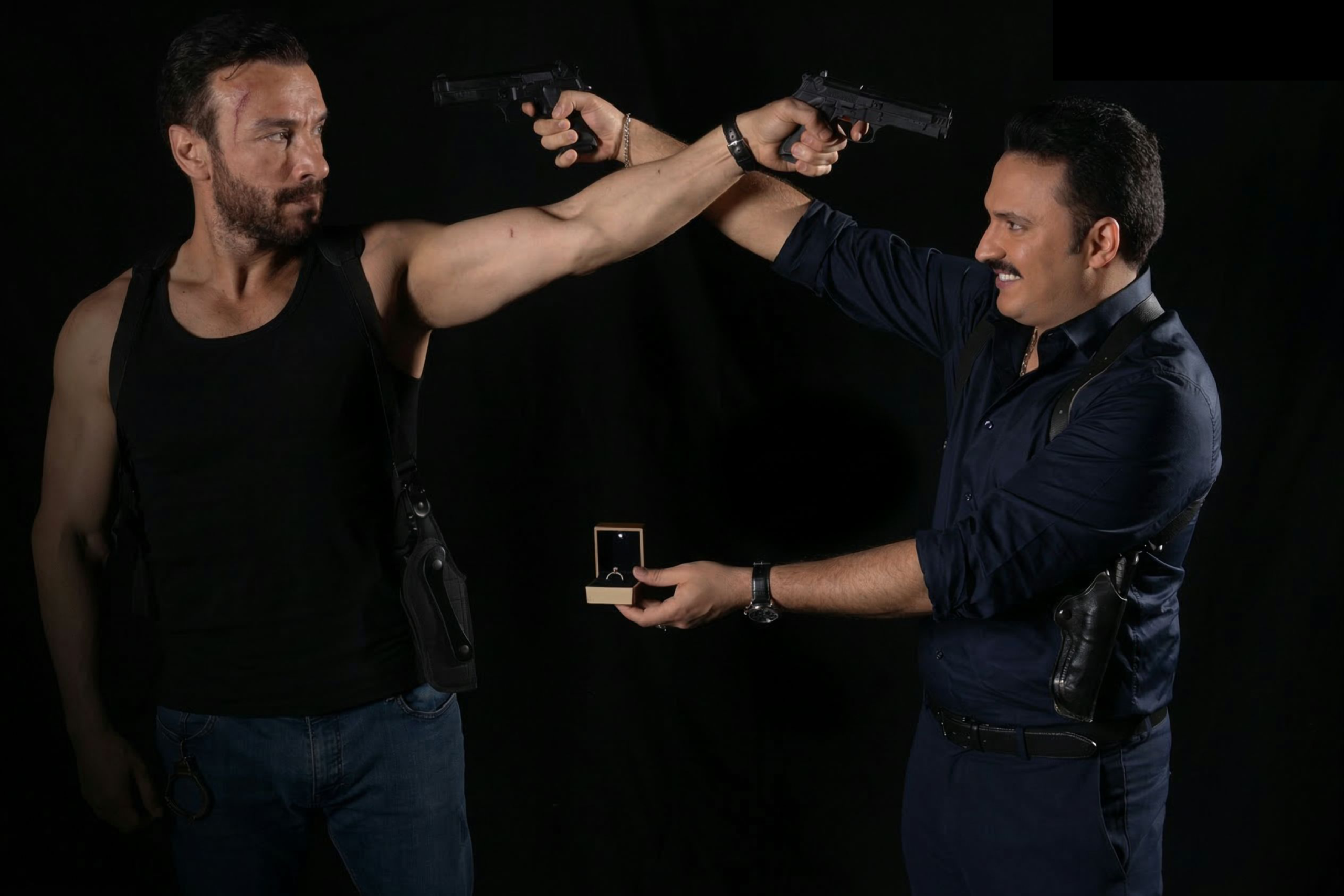
That same spirit extends into the show’s visual language, where Kais Chekir blends realism with caricatural stylization, especially in the characters’ looks and wardrobe. Azouz’s appearance – open-button shirts and a chain – borrows from the habits of an upwardly mobile middle class, while Mehdi wears sharply tailored clothes that reflect his discipline and seriousness. The same thread runs through Hatem’s American-style youthwear, Si Lahbib’s gleaming shaved head, and all the way to Bakhano’s striking haircut and deliberately dissonant colors.
Chekir also makes a point of breaking realism between sequences through exaggerated movement and reactions, while holding fast to a color treatment tinged with strangeness, to the point that many scenes feel as though they’ve been lifted out of a metaverse video game.
These choices intertwine with the police theme in ways that serve both action comedy and situational comedy, keeping the viewer in a constant state of anticipation for the next move and allowing the series to swing, deliciously, between the expected and the surprising.
After a feature film and two successful seasons, the creators of Sahbek Rajel recently announced the show’s renewal for a third season, set to arrive during Ramadan 2027 – further proof of the broad popularity Arab series can achieve when they venture into uncomfortable territory and explore the social dynamics shaping everyday life, even when that exploration comes from a safe position that respects every red line.