By 1985, Beirut was a city cleaved in two. The Lebanese Civil War had been raging relentlessly for 10 years, with West Beirut largely Muslim and dominated by leftist militias, while East Beirut remained predominantly Christian, under the control of right-wing Christian forces. Once known as the Paris of the Middle East, the city was witnessing a level of segregation that, for the first time in its history, had materialized into physical barricades.
Amid the sound of gunfire, chaos, and brutal scenes, a sentimental sound was taking shape. Ziad Rahbani was working on Houdou Nisbi, a phrase used by Lebanese journalists to describe a brief slowing in the rhythm of violence, a fragile pause rather than an end.
Ziad appropriated the term, stripping it of its journalistic context and embedding subtle commentary on Lebanon’s wartime condition, capturing tension, contradiction, and fleeting moments of respite.
Ziad’s album reflects everything surrounding it, yet also allows a momentary escape from it. Its title, translated as Relative Calm, feels like a ceasefire, a reminder that there is more to us than the violence outside.
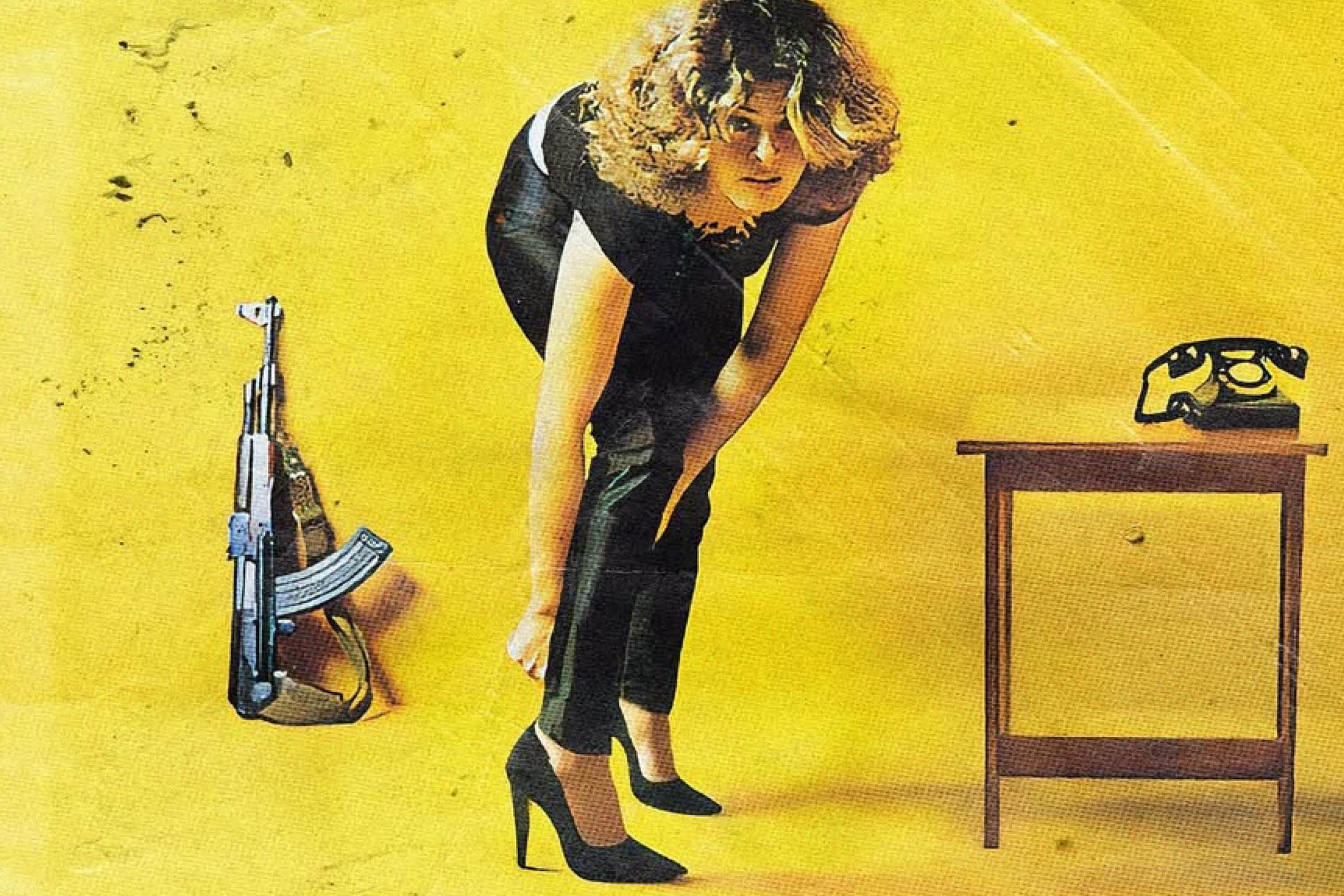
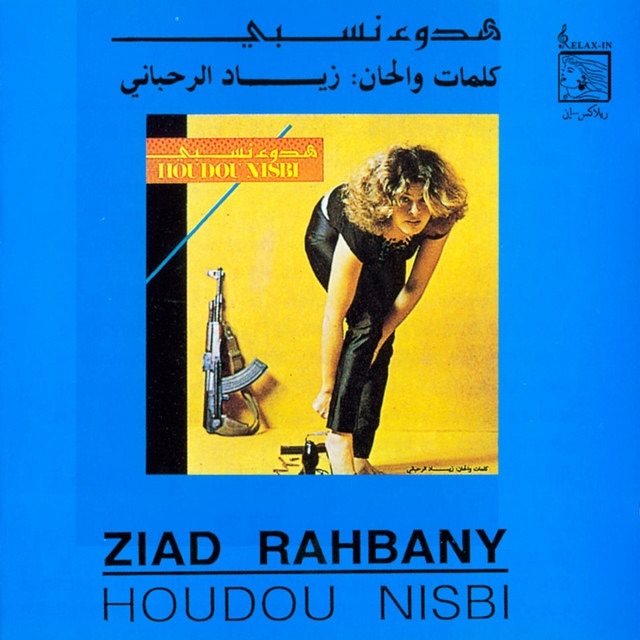
This sentiment extends to the album’s artwork: a beautiful woman in leather, adjusting her high heels and staring confrontationally into the camera; an assault rifle in the background, bullets scattered on the ground; and, in stark contrast, a flat yellow backdrop. The artwork reflects a state of multiplicity, both the country’s and the album’s. It captures Lebanon suspended between contradiction and coexistence, elegance and violence, desire and danger.
Much like the album title itself, the image suggests simultaneity, a moment in which opposing realities are forced to exist side by side. At the same time, it establishes the satirical tone that runs through the album, where everything is questioned and stripped of its melancholy.
Something Old, Something Borrowed.. Something New?
At the time of Houdou Nisbi’s release, Arab music was caught between two paths: remaining faithful to classical Sharqi (Eastern) formulations, or embracing the newly emerging Sawt Al Jeel (the sound of the generation). Shaped by artists such as Hamid Al Shaeri, Ahmed Fakroun, and Nasser El Mezdawi, Al Jeel represented a musical revolution that originated in Libya and Egypt and spread across the Arab world, breaking records and producing massive hits.
Jazz was not yet strongly present in the Arab musical sphere. It appeared in only a few works and underground scenes. While notable musicians were active, a fully structured scene was still missing. In Egypt, artists such as Fathy Salama, Yehia Khalil, Salah Ragab, and Ahmed Harfoush were exploring the genre. In Sudan, Sharhabil Ahmed and Kamal Keila were making similar strides.
Within this broader context, Ziad Rahbani built on the region’s emerging jazz sensibility with Houdou Nisbi, positioning the genre as the album’s dominant language and carefully blending it with classical Sharqi traditions, at a time when jazz was still largely viewed as foreign and rarely treated as a foundational framework.
Yet, Houdou Nisbi does not adhere to a single theme or style. Jazz coexists with classical Arab music, while Ziad Rahbani and his band also weave in elements of rock, funk, and even hints of samba and bossa nova. This fusion creates a broad, expansive listening experience, widening the album’s musical spectrum.
While the album can be listened to sequentially, the instrumental and vocal tracks are best appreciated separately, highlighting their striking contrast. At a time when listeners were accustomed to long vocal monologues, most of the album is instrumental, turning the vocal tracks into moments of pause that, whether intentionally or not, draw the listener’s attention to the lyrics.
This setup also emphasizes the craftsmanship of every musician on the record, allowing the music to stand on its own without relying on vocals or a prominent singer.
And jazz, in its origins, is mainly instrumental. It is a genre that gives artists the freedom to experiment with form, production, and structure without being constrained by lyrics or singable melodies. Ziad Rahbani fully understood this principle. By adopting it, he allowed listeners to engage with the music on their own terms, reflecting on their inner feelings and current state. The album becomes a space for reflection and pause amid the turmoil of everyday life, offering the Relative Calm that its title embodies.
The Vows
The songwriting on Houdou Nisbi, unlike many civil war-inspired works, largely avoided direct political commentary. Yet it remained subtle, gentle, and ironic, using metaphor and nuance rather than instructing listeners how to feel or perceive reality.
This approach gives the album a lasting quality, freeing it from attachment to specific events and allowing it to remain relatable across different times and places. Rather than presenting itself as a political statement, the album functions as a mirror, inviting listeners to recognize their own emotions within it.
The lyrics capture everyday life in Lebanon, carrying layers of depth, critique, and humor, while allowing space for personal reflection. Across the record, themes of love, longing, and melancholy dominate. On the surface, the songs may seem romantic, but beneath lies self-doubt, confrontation, hopelessness, and occasional pessimism.
Against the aesthetic trends of their time, the lyrics were neither elaborate nor overly polished. Ziad Rahbani embraced everyday Lebanese slang and dialect, which had rarely appeared in studio recordings before, giving the album its organic and felt texture.
Vocally, the album did not rely on a single lead singer; instead, it often used choral arrangements and layered voices that created a slightly synthetic, textured effect. This collective vocal production deliberately distances Houdou Nisbi from the cult of the singular star. Instead of centering emotion around one dominant voice, the album treats music as a shared emotional space, where feeling is distributed rather than owned. Voice becomes a part of the arrangement rather than its focal point, dissolving individual confession into something more communal. In doing so, Ziad Rahbani resists the hierarchy of performer and listener, allowing the songs to exist as open emotional environments.
This unconventional approach offered a model of musical freedom grounded in composition rather than ornament, shifting focus from vocal dominance to arrangement, production, texture, and experimentation. By moving beyond the traditional tarab framework, he established Houdou Nisbi as an early blueprint for modern Arab alternative music.
The Offspring
Houdou Nisbi shaped a generation of Lebanese artists who, following the end of the Civil War, embraced experimentation and sought new ways to expand Arab music’s stylistic range. Some followed the paths Ziad had laid, while others drew inspiration from his direction without replicating it directly.
Musicians such as Ibrahim Maalouf and Rabih Abou Khalil adopted jazz as a central language, blending it seamlessly with Arab melodic and rhythmic structures, continuing the synthesis Ziad had pioneered. Jazz singer Tania Saleh also followed Ziad’s path, giving him full credit and noting that Lebanon’s indie music scene began with him.
Beyond Lebanon, artists like Dhafer Youssef in Tunisia integrated jazz improvisation with modal and traditional Arab music, often using oriental instruments such as the oud, which rarely appear alongside Western harmonies.
The impact carries on, even along different paths, and is evident in early works by Soap Kills, where Yasmine Hamdan and Zeid Hamdan fused jazz and trip hop into a sound that defined alternative Arabic music in the ’90s. Ziad, in his duo project with Maii Waleed, carries forward the bossa nova and jazz elements that Houdou Nisbi introduced decades ago.
What began as an offbeat sound has grown into a recognized scene, with festivals like Beirut Jazz Week showcasing musicians across diverse jazz styles, and venues such as Salon Beyrouth and NOW hosting regular performances. While most of Lebanon’s jazz activity remains centered in Beirut, the city has become a regional hub where jazz and Arab music consistently intersect.
With Ziad’s daring choices, he continued the legacy of artists moving in new directions, showing that it was possible to merge sounds from other regions of the world into an indigenous framework. Across the ’80s, ’90s, and early ’00s, this mindset replicated itself across music scenes from Egypt to Morocco and from Libya to Tunisia.
Works like Houdou Nisbi opened horizons for something new. They offered an alternative to what people were fed on radio and television long before the internet made everything accessible, and genuinely shaped what came after.