The 400-something kilometers separating Cairo from El Gouna are a long, shimmering stretch of desert, flanked by wind farms and the Red Sea’s dazzling blue. The city I am headed to did not exist thirty-five years ago. Today, it is one of the most coveted tourist destinations in Egypt, a private haven of manicured lagoons and expensive calm. Yet its defining feature is not its skyline or exclusivity, but a festival that has quietly grown into the region’s most debated cinematic event: El Gouna Film Festival, which concluded its eighth edition last October.
Writing about GFF is a tricky business. Mainstream outlets, invited annually to cover the affair, often reduce it to a red carpet spectacle: a torrent of gowns, champagne-tinted photography, celebrity controversy and recycled press releases, with barely a paragraph spared for film. This coverage often triggers public backlash against the festival and its attendees, accusing the affair of being tone-deaf and detached from the broader Egyptian reality, marked by social conservatism and economic hardship.
Meanwhile, independent and alternative media often swing to the opposite extreme, focusing almost entirely on the politics around the festival: sometimes praising its resistance to state discourse and censorship, sometimes examining the festival’s exclusivity and extravaganza through the lens of class critique, but rarely discussing film itself. Pan-Arab online publication Raseef22 recently summed up that sentiment with a headline describing the festival as “All smoke, no kufta,” and asking: “Where’s the film in El Gouna Film Festival?”

As I settled into the passenger seat of my Uber ride to El Gouna, reading through an unlikely spectrum of media coverage on the festival, from Al Jazeera to Haaretz, I wondered what lay behind this polarized caricature.
The Beauty
The city of El Gouna was founded by one of modern Egypt’s wealthiest businessmen, billionaire Samih Sawiris, while the festival was founded by his billionaire brother, Naguib. Its birth carried rumors of real estate marketing, a glossy lure to sell more units in the gated city. Actor Taha El Desouki leaned into the joke at this year’s opening ceremony during a standup sketch, and the billionaire brothers chuckled.
Having a pair of billionaires behind the festival can be a blessing and a curse. On the one hand, the Sawiris brothers are credited for granting GFF a level of curatorial independence from either the state, the public or the mainstream media that few art events of this scale across the region can boast. It’s because of their strong gravitational pull that the festival can push through censorship-defying choices, like screening and then awarding the Best Arab Narrative Film to Feathers in 2021, a film exploring the depth of poverty in marginalized areas that provoked backlash from state-aligned media.
On the other hand, having public billionaire founders behind a festival hosted in their exclusive resort-city can easily be distracting and can undercut efforts to counter the narratives around the festival’s detachment.
Yet the relationship between the city and the festival extends beyond the Sawiris brothers and remains clearly intentional. It’s a symbiotic pairing that offers a glamorous setting for an industry long associated with extravagance, a pairing far from unconventional in the world of film festivals.
The Festival Plaza, designed by London-based Studio Seilern Architects, serves as the beating heart of the festival, its mighty arches towering over the Red Sea skyline. Smaller venues scattered across the marina-shaped city give the festival its rhythm, alternating between spectacle and environment.
As a former regular at Cairo International Film Festival, and someone who used to care only about the films and nothing else, back then I couldn’t silence a nagging voice in my head that said: perhaps a little glamour couldn’t hurt, as my friend and I joked about the festival’s “grey carpet” spirit. In 2021, Mada reported that CIFF started hosting lively red carpet events across all of its days in what Mada described as an attempt to keep up with El Gouna. Warmly received, the move only made more pronounced how lacking the festival circuit had been in terms of a sense of spectacle before El Gouna motivated a shake up.

El Gouna’s glitz doesn’t only fill a local and regional gap, but also signals parity and ambition on an international level, positioning the region’s leading cinematic event on par with its global counterparts.
That said, from a local perspective, this level of lavishness inevitably invites class critique. Even to the economic optimists, Egypt’s strategy of taking on debt in order to modernize its infrastructure and turbocharge its economy will unavoidably mean a few years of economic hardship before the country can reap the benefits of its modernized infrastructure. Those harsh few years are now. Egyptians are feeling the burn, and watching their favorite stars indulge in Gatsby-esque festivities would surely hit a nerve.
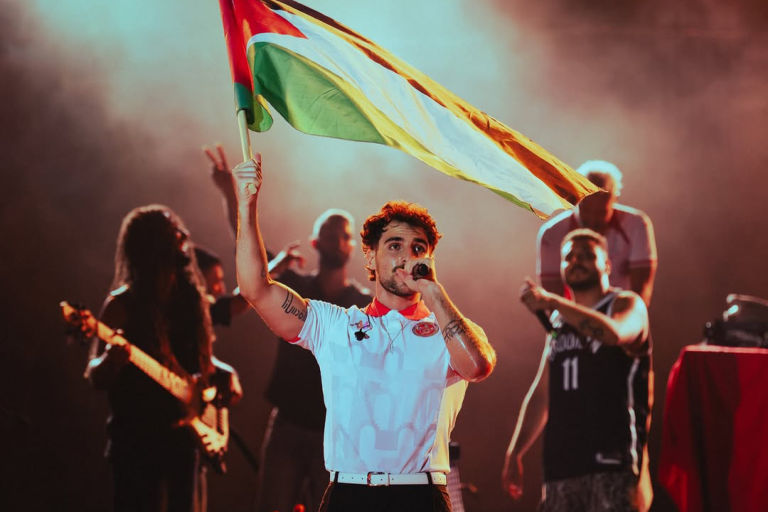
With that in mind, I was curious to see how these festivities unfolded on the ground. More often than not they felt like a self-aware pause from regional turmoil while keeping those realities visible. The opening ceremony addressed the ceasefire in Gaza before anything else, saying that only now could we dare to truly celebrate, and setting the tone for the days to come. At times, the general atmosphere resembled that of an Arab wedding during the war on Gaza, an uneasy mix of restrained happiness and half-hearted laughter.
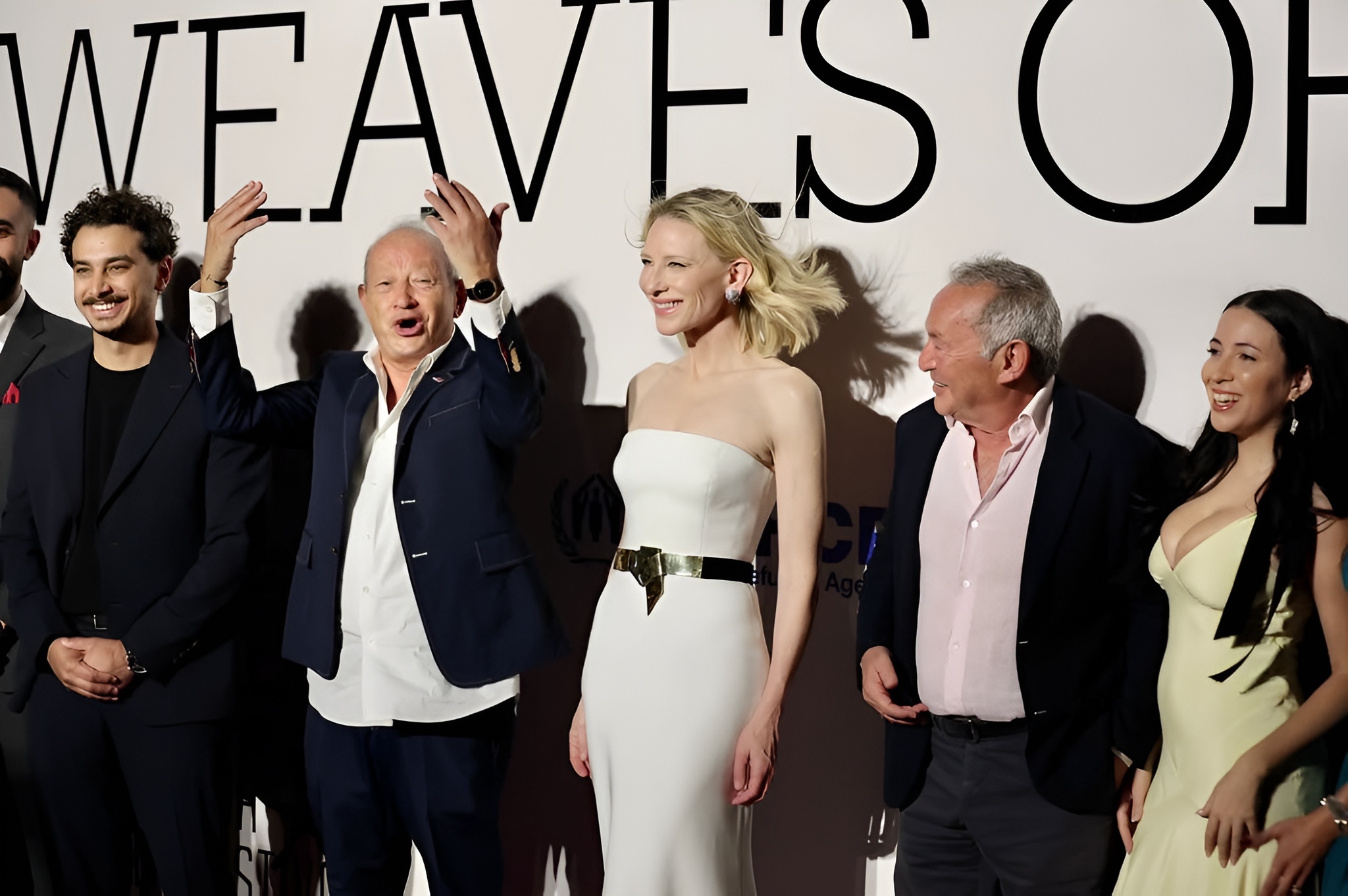
The festival’s directors made intentional efforts not only to signal groundedness but to embody it. The humanitarian programs were so densely scheduled that at times you may find yourself shaking more hands with UN officials than film folks. MoUs between the GFF and UN agencies were signed at the same open-air auditorium that hosted an in-depth conversation with Cate Blanchett, winner of the festival’s inaugural Champion of Humanity award, about her work as a goodwill ambassador for the UNHCR.
While these UN activations may seem to some a bit on the nose, the festival also took subtler approaches to staying attuned, such as the Eish competition. The short film contest, named after the Egyptian word for both bread and living, returned for a second edition, using storytelling to tackle food insecurity, dignity, and resilience under hardship.
And The Feast
What struck me in particular during my short stay at the festival was how underemphasized the city of El Gouna was in all communications and activities. The message was clear: during festival days, the city is only the backdrop, never the subject.
Going through the Festival Plaza every day felt like taking a crash course on Egyptian cinema, with a schedule so packed with panels, workshops, and talks that one wishes for two bodies.

At the heart of this year’s edition were three honorary celebrations of immortal figures in Egyptian cinema: a special exhibition marking 50 Years of Yusra, a series of activities celebrating legendary filmmaker Youssef Chahine’s centenary – that culminated in an around-the-clock screening of his 1958 masterpiece Cairo Station (Bab El Hadid), and presenting the Career Achievement Award to actress Menna Shalaby, marked by a career-spanning conversation with Menna moderated by filmmaker Karim El Shenawy.
Rich as the legacy track is, it should not distract from this year’s grand and precise programming, led by head of programming Andrew Mohsen – who started his career as a film critic at independent media outlets like Manshour.
The Feature Narrative Competition balanced local and global vision: from Mohamed Siam’s My Father’s Scent, an explosive Egyptian family drama that unearths generational trauma, to Tunisian filmmaker Amel Guellaty’s Where the Wind Comes From, a poetic road film about two young dreamers chasing escape.
Mohamed Rashad’s The Settlement, a CineGouna alumni project, captured working-class tension with sharp realism, following two siblings who accept job offers at a metal factory as compensation for their father’s death in a work accident – a social commentary as loud as metal plates clashing.
The local and regional titles sat alongside captivating international selections, including Jim Jarmusch’s Father Mother Sister Brother, which studies family dynamics under a microscope, and Mihai Mincan’s Milk Teeth, a portrait of fear and fragility set during the final years of Nicolae Ceaușescu’s dictatorship in Romania.

This international sweep expanded further through the Out of Competition selections, including Richard Linklater’s highly anticipated Blue Moon, starring the director’s longtime collaborator Ethan Hawke, while Ebrahim Saeedi’s Burning Dust, premiering at GFF, explored memory and heritage against environmental collapse set within a Kurdistani landscape.
If anything, the short film lineup felt even more sharp toothed, spotlighting works like Maïssa Lihedheb’s Samra’s Dollhouse, a hypnotic Tunisian-German co-production that interrogates the marriage institution through reversed gendered power dynamics, one of the year’s standout Arab shorts.
Alongside it, Yassmina Karajah’s Ambush zoomed in on a cultural clash between club goers and residents of a conservative neighborhood in Amman, while Abanoub Youssef’s Breaking Out of Ali and Maher’s Base, another El Gouna premiere, approached class division in Egyptian rural communities through a satirical lens.
This goes for the rest of the programming, which largely champions grounded, relevant, and politically engaged titles, and refuses to hide behind safe or picturesque choices. Still, the festival’s strongest statement came through the return of its Window on Palestine special program in its third edition.
The program screened eight films this year: Mahdi Fleifel’s 2012 documentary A World Not Ours, and seven new films from the radical project From Ground Zero+, a series of short, animated, and documentary works shot and produced in Gaza during the war.

Fleifel’s documentary is a brutal experience that leaves its audience feeling claustrophobic, as it traces stories from the Ain El Helwe Palestinian refugee camp in Lebanon. It begins with a sweet, warm, home-footage introduction that makes you believe for a few minutes that normal life might be possible in exile. Yet as soon as viewers settle into the film’s world, the walls close in, the air grows heavy, and normalcy feels like a cruel joke.
From Ground Zero+, developed and organized by Gazan filmmaker Rashid Masharawi, does not offer the luxury of soft openings. Instead, it throws its audience straight into catastrophe, with intimate footage that cuts through the distance of news coverage and media summaries. Mothers hesitate to kiss their infants for fear of disease. A teenager rushes to tell his mother that family friends escaped their devastated neighborhood, only for her to cut him off with the news that half of them were targeted and killed right after escaping.
Leaving the school theatre where the first three From Ground Zero+ films were screened, sun-drenched El Gouna looked different, shadowed by the sharp contrast between its Red Sea charm and images of Gaza’s Mediterranean shores that the films imprinted on the audience’s mind. Depending on what you choose to watch and attend, the GFF experience can be as grounded and film-centered as you’d like it to be. Even in terms of substance over flash, the festival surpasses local and regional counterparts.
That is what ultimately separates GFF from the caricature of a “billionaires’ festival.” The setting may be exclusive, and it really shouldn’t – a festival of this scale deserves to be enjoyed by a broader, more diverse audience – but its programming is not. It uses glamour as a Trojan horse for serious cinema and social urgency, making GFF one of the Arab world’s most necessary paradoxes: an elite space building a stage for voices that challenge the very elites hosting them.