Zaineb and Miriam were children when their father, the Iraqi sculptor Jewad Selim, died unexpectedly in 1961. His absence left a void both personal and cultural: he had shaped modern Iraqi art, yet his daughters were left with only glimpses of the man behind the work. Today, their understanding comes from accounts collected over time – family anecdotes, photographs, and the enduring presence of his art.
Looking back, Zaineb describes a father whose presence was defined as much by his work as by family life. At the height of his career, he was often absent – not by choice, but because he was juggling up to three jobs while also working towards exhibitions.
“He was extremely busy at the time – at the height of his career – so I didn’t see that much of him. I saw much more of my mother,” she recalls.
Even with this distance, the environments in which she grew up left vivid marks, particularly the periods spent moving between Iraq and Italy. Those landscapes, she explains, shaped fragments of memory that remained surprisingly clear over the years.
“I remember being in Florence, going to see the sights,” Zaineb says. “I went back recently with my son and his girlfriend, and I realised I remembered everything!”
For Miriam, the early experience of their father was framed differently. Her memories were less about shared moments and more about the way his presence as “Baba” was an integral part of family life that lingered after his death, and how his name, Jewad Selim, continued to circulate in ways she did not yet fully understand.
“My early memories are more posthumous,” she says. “I was, I believe, taken around with our mother a lot more as I was so young. I was very much aware of a very clear distinction between Jewad Selim the artist, and Jewad Selim ‘Baba.'”
This distinction, Miriam adds, appeared in small but telling moments, shaping her understanding of him long before she could comprehend the connection. She remembers a school art lesson being filmed for television, when a teacher intervened after she was dismissed for asking for another crayon: “Oh, that’s Jewad Selim’s daughter. Of course, she would want more colours!”
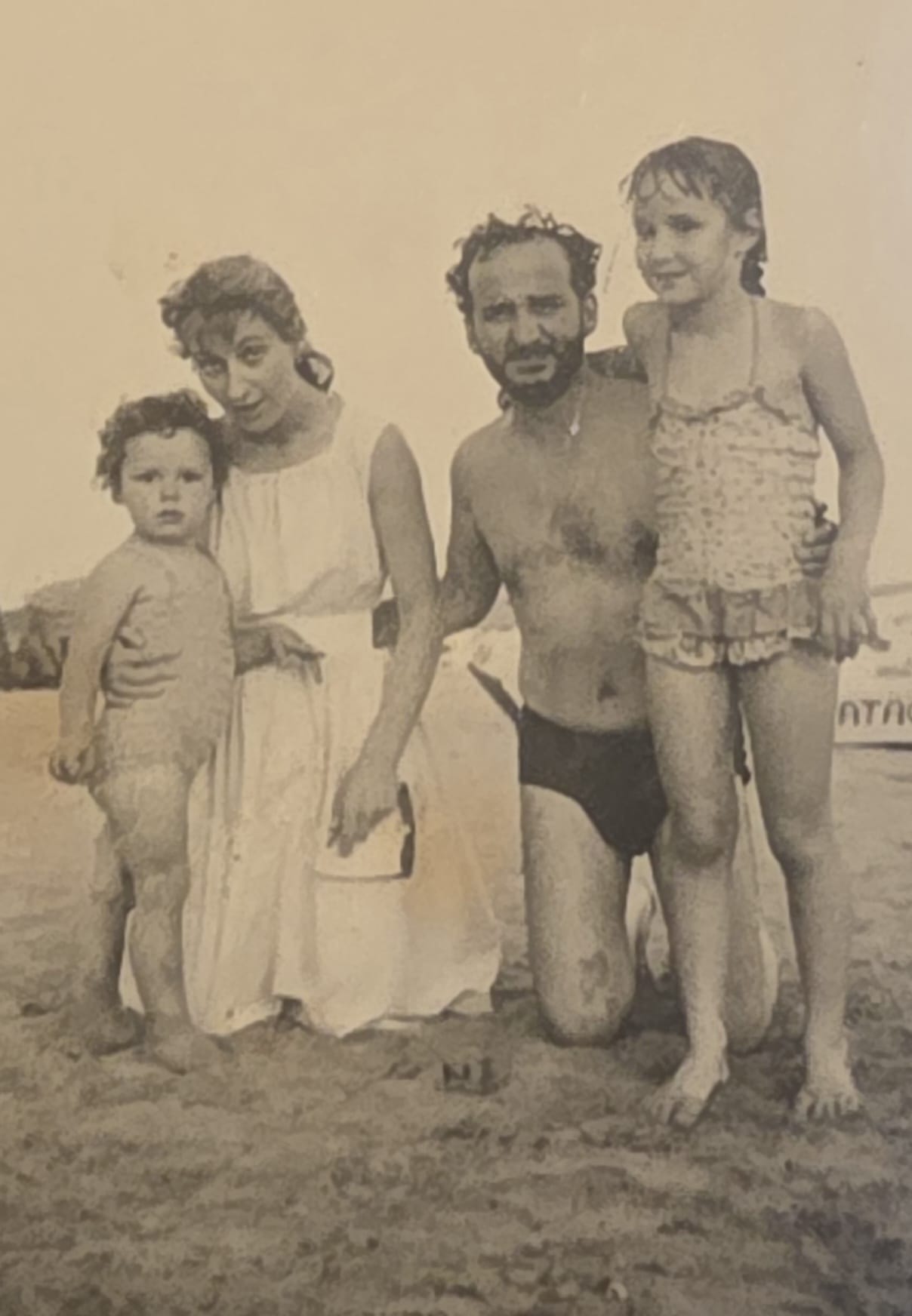
summer 1959.
Though she was very young at the time, the encounter planted a seed of curiosity that would stay with her for years.
“Why was there this distinction?” Miriam reflects. “Why was he one person at home and another in the world outside?”
It was only later, through studying art herself and engaging with the archive carefully preserved by their mother, Lorna Selim, that Miriam began to reconcile those two versions. Gradually, she came to understand him not only as a parent but also as a central figure in a wider artistic movement.
Sculpting Freedom
Both sisters’ perception of Jewad Selim expanded from private memories of a father to an appreciation of the public figure and the impact of his art. His small sculptures, often less publicly visible, allowed them to appreciate the core of his approach: a blending of modernist ideas with references drawn from Iraqi history and everyday life. Together, these works laid the foundation for what would become his most recognisable achievement, Baghdad’s Freedom Monument.
Commissioned during the leadership of Abd Al Karim Qasim, the monument was created at a politically charged moment just after the July 1958 revolution. Yet both sisters emphasise that its purpose was never to celebrate a single era.
“Our father was not a socialist or political activist,” Zaineb explains. “Qasim desired a monument celebrating the revolution, but Jewad chose a theme celebrating the people’s fight for freedom and the prosperity of Iraq. Jewad wanted a monument that was timeless and able to withstand changes of time.”
Miriam adds to this, highlighting her father’s insistence that the work should not celebrate any individual.
“Qasim wanted a representation of himself, but Jewad said, ‘No, I will depict the soldier, the people’s fighter – because if it represents Qasim, when the era changes, it’s going to go.'”
Hands, Clay, and Legacy
Although funded by the state, the monument remained true to Jewad Selim’s vision.
“That’s really the only way large works of art can be produced – by sponsorship,” Zaineb says. “Jewad’s aim was always to have sculptures in the public view, conveying a message understandable by everyone.”
While ambitious in scale, the Freedom Monument also raised questions of accessibility for its audience.

Zaineb recalls her father’s concern: “I think my father was a little worried that, because it was done in the form of modern art rather than traditional art, people might not understand it.”
Despite these concerns, the monument has proven resilient and open to interpretation.
“There have been lots of interpretations by various art experts,” Zaineb notes, “but I think it speaks for itself.”
Designed to be read from right to left in keeping with Arabic script, the monument reinforces a sense of openness and inclusivity, and has become over the decades a living part of Baghdad.
“I’ve noticed when people gather together, the people of Iraq gather under the monument as if it’s some kind of symbol of freedom and progress,” Zaineb observes.
Miriam adds: “It has become a very popular meeting place, hasn’t it? Even in earlier decades, public events were centred there.”
Its endurance through Iraq’s years of conflict, including the destruction of nearby buildings during the 2003 US invasion, has only heightened the monument’s significance, as cameras captured it still standing.
“That moment was seen as almost symbolic,” Miriam recalls. “Even amid all the destruction, the monument standing meant that the Iraqi people’s pursuit of freedom and progress would endure. From then on, its significance was magnified.”
Yet for the Selim sisters, the Freedom Monument is just one part of their father’s vision. He valued a more immediate, tactile relationship with art.
“He wanted sculptures on the ground – accessible, something children could climb on,” Miriam explains, noting that even unrealised works, such as The Unknown Political Prisoner, were designed with that philosophy in mind.
“Health and safety would never allow it now,” she adds with a wry smile.
Zaineb remembers the intimate, hands-on side of his approach at home, saying, “There was an ebony sculpture of a mother and child. That was my favourite; it sat on a shelf. I used to play with it.”
Miriam nods in agreement: “That tactile access – that’s exactly what Jewad wanted.”

photography asked his friend Ramzi to source a new camera, he supplied Jewad
with an Olympus S35 and guided Jewad through the controls. The film remained, un-
processed in the camera after Jewad’s death on 23rd January, it survived many
years before the images were printed. Miriam, then each of her three children in turn,
learnt the rudiments of photography on this camera, we still have it.
Dedication Across Decades
Today, their engagement with Jewad’s work has shifted from personal experience to preservation, with Zaineb taking the lead in archiving and translating the documents their mother meticulously collected.
“I started looking through all these documents my mother had beautifully archived. My Arabic is schoolgirl Arabic, but we now have the internet, Google Translate… so I was able to translate them,” she says.
Zaineb adds that what began as a personal project has since grown into in-depth research and the compilation of a catalogue raisonné. She plans to write a full biography and to develop a digital archive that can accommodate future additions.
Zaineb reflects on how technology has transformed the process, noting, “The internet helped enormously – Jewad talked about films he’d seen, places he’d been, and I was able to look these up, while social media also connected us with people who held previously unseen material.”
One particular discovery proved invaluable, as Miriam recalls: “We contacted someone whose father had been Jewad’s sculpture student… she sent scans of exhibition catalogues he had kept. That was a golden nugget.”
Reflecting on the catalogue raisonné that Zaineb developed in collaboration with Bonhams’ London Middle East department, Miriam highlights how beautifully the project came together: “Their role was really about making connections, but the core research and material all came from Zaineb. She left nothing unchecked – every reference, image, and permission was verified. Her dedication and persistence were truly admirable.”
A Longing for Baghdad
Turning from their father’s legacy to Iraq itself, the sisters reflect on how time and distance have shaped their perspective.
“I can only speak from what I’ve learned second-hand,” Miriam admits, acknowledging the limits of her experience.
Despite the distance, their bond with Iraq remains strong, guided by memory, research, and intention rather than daily presence. Still, both express a longing to reconnect in person.
“I’d love to go back to Baghdad and see the monument again,” Miriam says. “As a child, it felt like a place of sorrow and loss, but now I want to see it as it was intended: a celebration of the Iraqi people’s striving for freedom and prosperity.”
On reflection, both sisters emphasise that their connection to Jewad rests not only on his public monuments but also on intimate, hands-on memories.
Zaineb recalls a singular moment from childhood that captures this perfectly: “When we were in Italy, I visited the studio where the monument was being made. There were great piles of clay kept wet, and Jewad taught me how to cast a clay sculpture in gypsum. I was eight years old.”
It is a brief memory, but it carries the same weight as the works themselves: a process of shaping, assembling, and preserving something enduring.