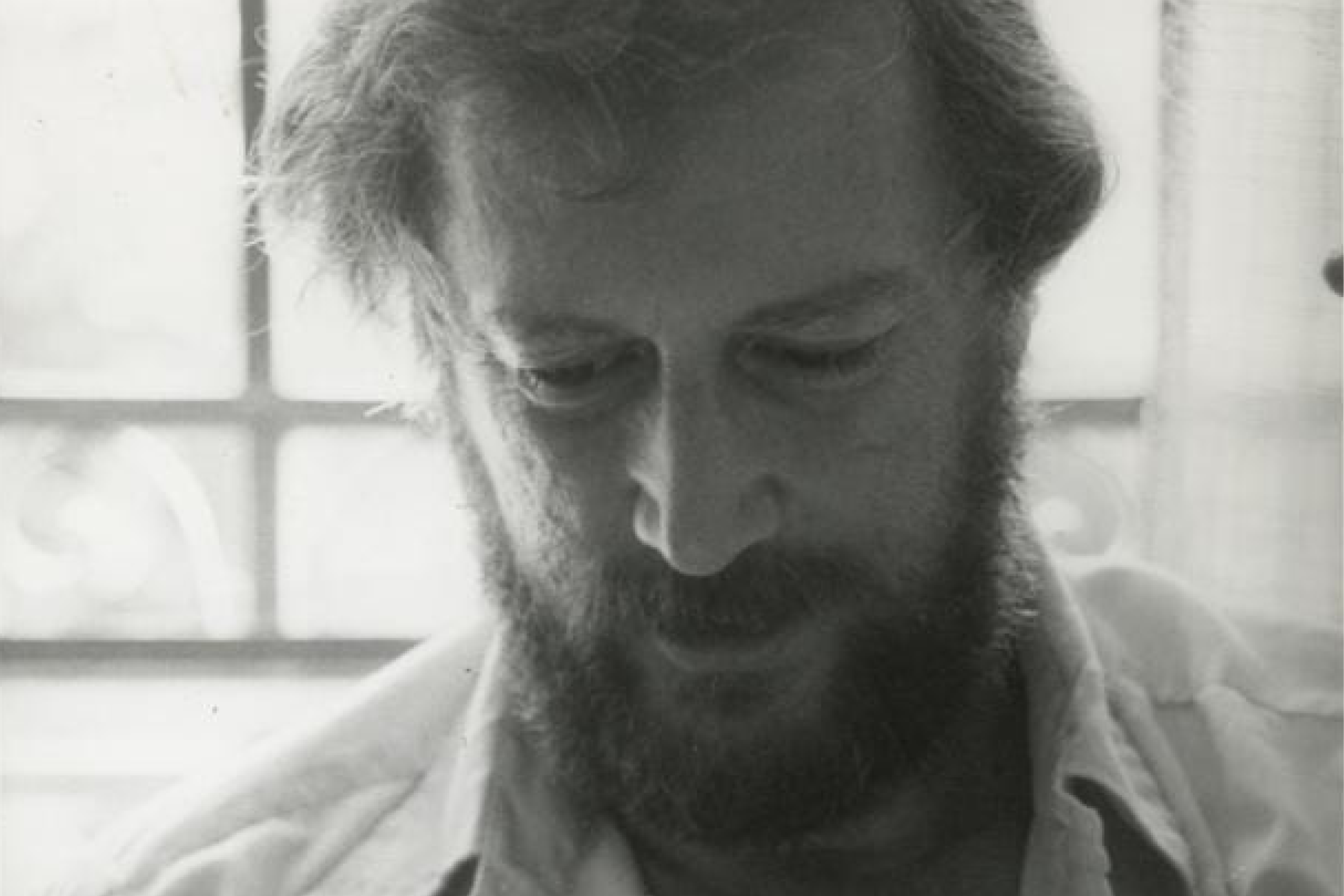
Sliman Mansour passed away yesterday at seventy-nine. I found out on Instagram. His family posted it on his story, a few hours after they had posted that he was in critical condition. “The final chapter has been written.” No cause given.
There is a version of this paragraph where I tell you how absurd that is, learning your favorite painter is gone from a square in a feed, wedged between an ad and somebody’s lunch. It is absurd. It was also the only way it was ever going to reach me. He was in Jerusalem and Ramallah and I am not, and the app is where he put his paintings up, one at a time, English title, then the Arabic in parentheses, oil on canvas, the year. Nothing else. For years, I would comment on his paintings and he would reply with a heart. I could reach him from here, and he could reach me, and neither of us had to be anywhere.
For Palestinians this is just life. We are scattered across enough time zones that there is no other room to be in. You learn a cousin got married from a video someone held up at the wrong angle. You learn a neighbor died from a story that expires in a day. The feed is a bad substitute for a village. It is also, for a lot of us, the only village there is.
I will call him Sliman from here, the way you would a grandfather. He was in the house before I was.
The last years were hard on him. A stroke in 2021 affected his left hand and made concentrating difficult, and he kept going to the studio anyway. “I try to work daily, to go to the studio, to do something there. Not painting all the time, but maybe reading or making sketches or something like that.”
Every Palestinian will mourn Sliman. He is one of the most famous artists Palestine has given us. But one painting has been doing the work of fifty years, and I want to spend some time with the rest of his work too.
I have two of his paintings in my home right now, a gift for my sister, both signed by him. One of them is Jamal Al Mahamil.
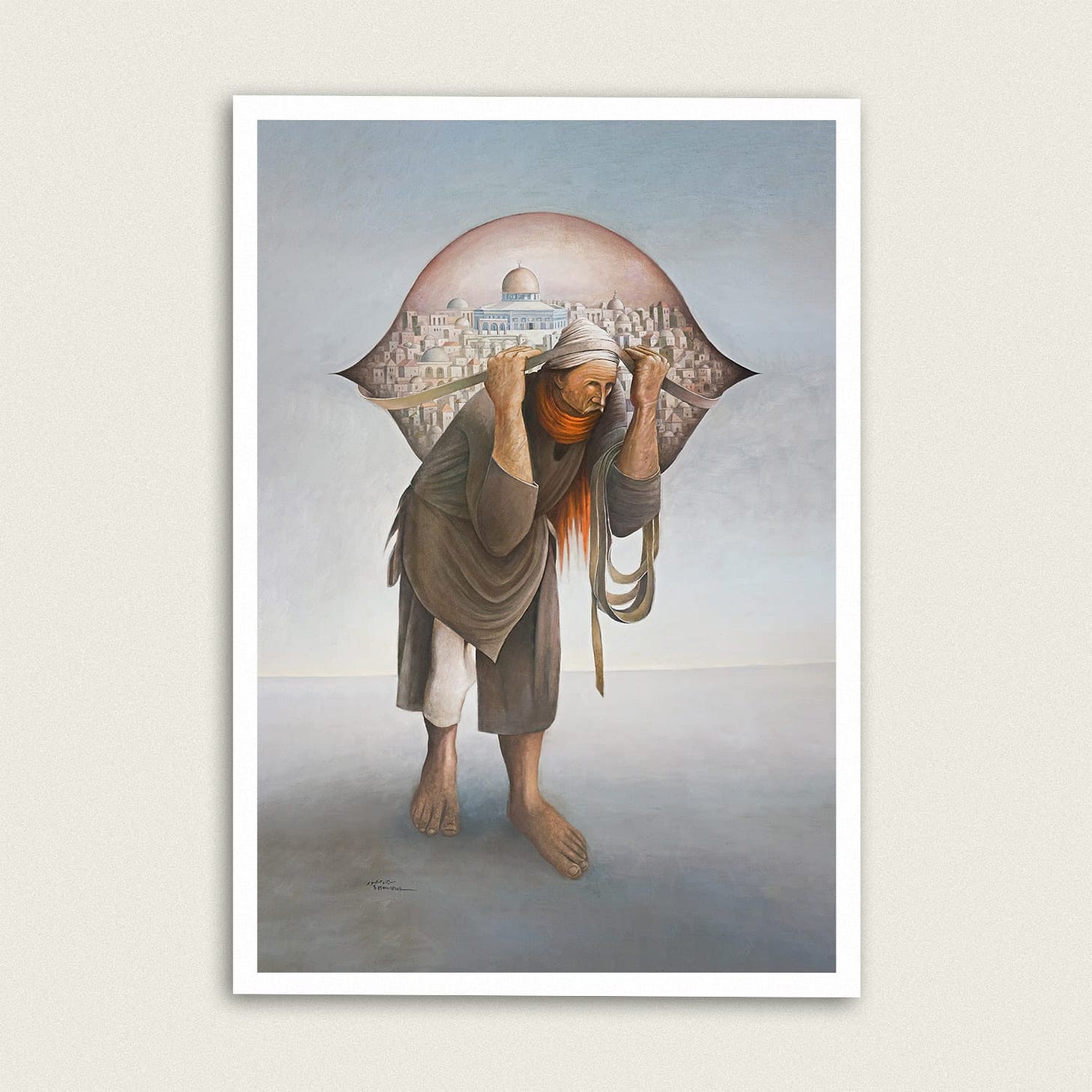
If you are Palestinian, you have seen this before. An old man, barefoot, bent forward at the waist, walking to the right. A rope runs from the load on his back up over his forehead, which is how porters in the Old City of Jerusalem carried things, with the neck and the spine taking the weight instead of the shoulders. The load is enormous and shaped like an eye. Inside the eye is Jerusalem, the Dome of the Rock sitting at the center of it, far too large for the buildings around it. His hands and feet are painted bigger than they should be. His face is barely resolved. There is no ground under him and no destination in front of him. He is walking through nothing.
The thing about this painting that most don’t know is that the eye was an accident.
Sliman had been sketching porters in the alleys for a while and getting nowhere. He tried loading the man with a refrigerator. He tried a wardrobe. Every time, he ended up with a competent picture of a porter, which is to say a picture of nothing. Then the idea came to give him the city. He drew Jerusalem inside a circle first, and the circle looked like it might roll off the man’s back at any moment, so he added a cone at each end to steady it. The shape that came out of that fix resembled an eye.
Fifty years of interpretation has been hung on that eye. People tie it to the Arabic idiom where the beloved is the pupil of your eye. Curators write that the porter has no eyes of his own because what he carries on his back is what his eyes really see. All of that is good and beautiful and some of it is true. But he was twenty-six, working in Birzeit, trying to keep a shape from looking like it was about to fall off a man’s back.
Sliman did not name it either. The painting was untitled for two years. It went up in 1975 at the YMCA in Jerusalem, in the first exhibition the League of Palestinian Artists ever mounted. He had helped bring the League into existence. Some men from a publishing office on Salah Al Din Street came to the show and offered to print it as a poster. Everyone stood around the office trying to think of a name. Emile Habibi happened to be in the room. Habibi, who wrote The Pessoptimist, suggested Jamal Al Mahamil, the camel that carries the mahamil, the ceremonial litters, the beast that takes the sacred load. Everyone agreed on the spot.
Then it went out into the world. The Communist Party carried it first. Their networks moved the poster into cities, villages and camps across the occupied territories, and by Sliman’s own account it spread very fast and reached the majority of homes. From there it crossed into Jordan. Then somebody working for Abu Jihad got in touch and asked for a good-quality image to run as the cover of Filastin al-Thawra, and Sliman handed one over, and so it reached Beirut and then everywhere else. The most famous Palestinian painting of the century traveled on communist infrastructure before Fatah ever touched it.
The original is where the story turns ugly. The printers on Salah Al Din Street kept the canvas. According to Khaled Hourani, who wrote an entire book trying to trace it, they stalled and stalled until Sliman agreed to sell, then paid him in checks. One cleared. The rest bounced. He lost the painting.
So he painted it again. That second version went to Amman in 1976 and then on to London, where the Libyan ambassador bought it as a birthday present for Muammar Gaddafi. The ambassador asked Sliman to write the dedication on the front of the canvas. He refused, and wrote it on the back. He never saw it again. Years later he called a Libyan embassy to ask what had happened to it and was told it had been lost or destroyed when the Americans bombed Gaddafi’s compound in 1986, but nobody would confirm anything, and he was always careful to say so. Every article that tells you flatly that the painting burned in an American airstrike is going further than the painter ever did.
He painted it a third time in 2005. He asked working porters in Jerusalem about the rope, and they told him he had drawn it wrong. The braided rope he had painted was not right for a load that heavy. It slips. You want something flat, closer to a strip of cloth. He had painted the wrong rope for thirty-two years, on the most reproduced image in Palestinian art, and when men who actually carry things for a living told him so, he changed it. He also added the Holy Sepulchre next to the Dome.
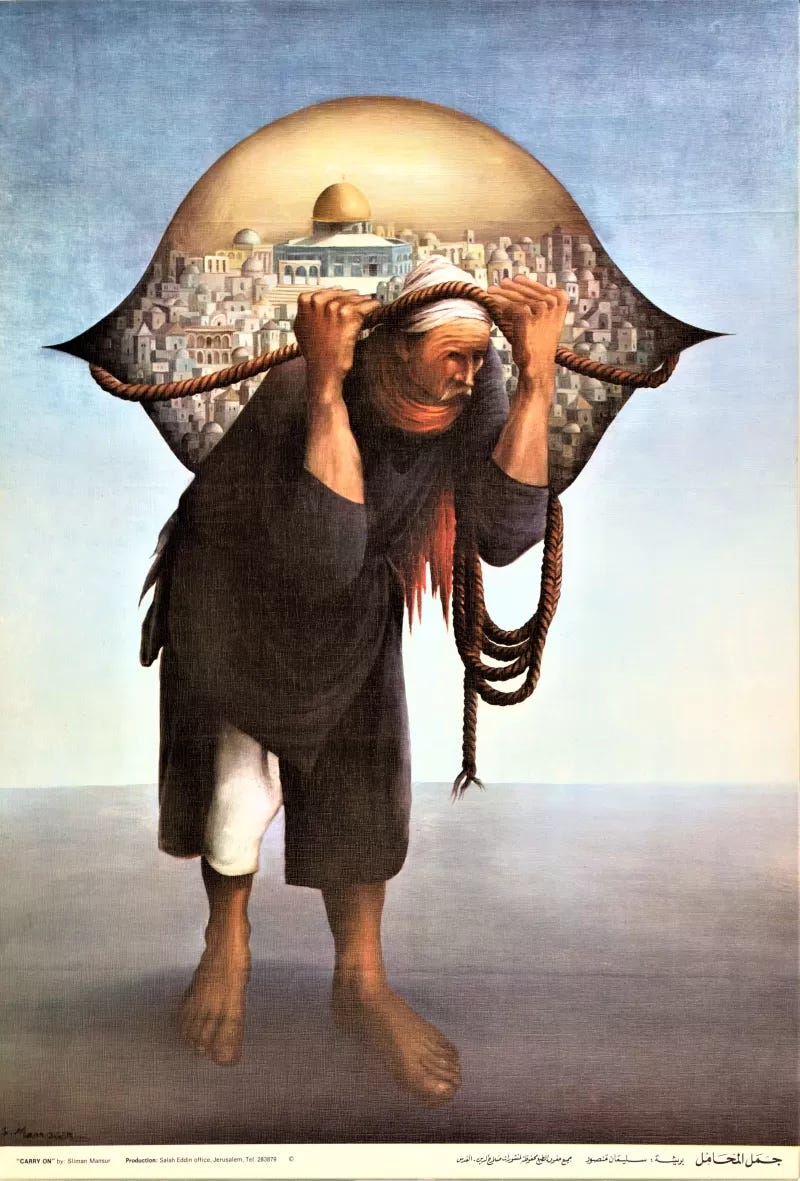
In 2015 Christie’s put that third version up for sale in Dubai and cataloged it as the second. A collector in London saw the online listing and told them he owned the 1973 original. It checked out. The painting that had been called lost for forty years had been hanging on a wall in London.
One more thing about this canvas, and it is the part I find hardest. It trapped him. He said so, plainly, in an interview in 2024:
“When Jamal Al Mahamil and paintings like it became known and famous, I remained afraid to step outside that atmosphere until 1987. Afraid of change in my art, afraid that people would reject my work. That was a very great constraint on my freedom.”
Fourteen years of not being allowed to be anyone else, by his audience and by himself. Al Modon put it more bluntly when Hourani’s book came out: the painting became so famous that its maker turned into its victim, because it covered over everything else he ever did.
Rituals under Occupation
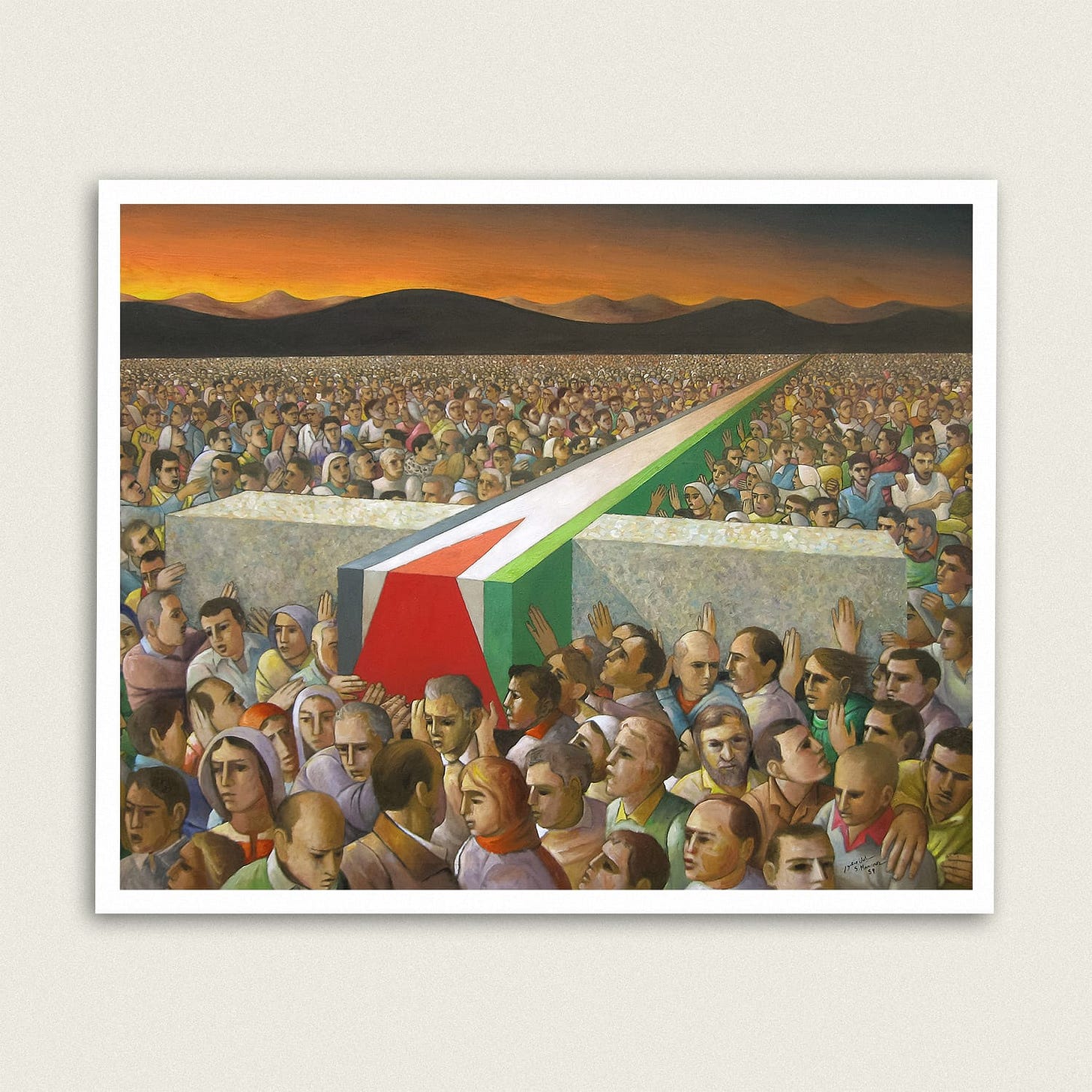
Men and women, packed shoulder to shoulder and filling the frame, carrying a coffin above their heads. The composition shapes the coffin as a cross, holds it above the crowd and drapes it with the Palestinian flag.
In 1989 that flag was illegal. Illegal under Israeli military orders governing flags and political symbols, the same set of orders that let the army close art exhibitions and take canvases off the walls. Palestinian artists had been told they could not paint in red, green, black and white together. Putting a flag over a coffin, in 1989, in the midst of the First Intifada, was the offense itself, committed on canvas.
Now look at the faces. When painting a crowd, the easy way would be to make it a mass, an anonymous wave of grief with the individual features dissolved. Sliman gave each face in that procession specific details and strong expressions, one at a time, all the way back. A refusal. Israel counts us. He painted us one by one.
One of those faces is his if you can spot it. He put himself in the procession, and he is the only figure in the painting looking out of it, straight at whoever is standing in front of it. Everyone else is looking at the coffin. He is looking at you.
The name itself: Rituals, plural. Not A Funeral. Not The Martyr. A practice, something that recurs on a schedule, like a wedding season or a harvest. Under occupation, burying the dead had become a civic ceremony with its own customs and choreography, its own frequency. He painted the funeral the way another painter would paint the olive harvest, because by 1989 it happened about as often.
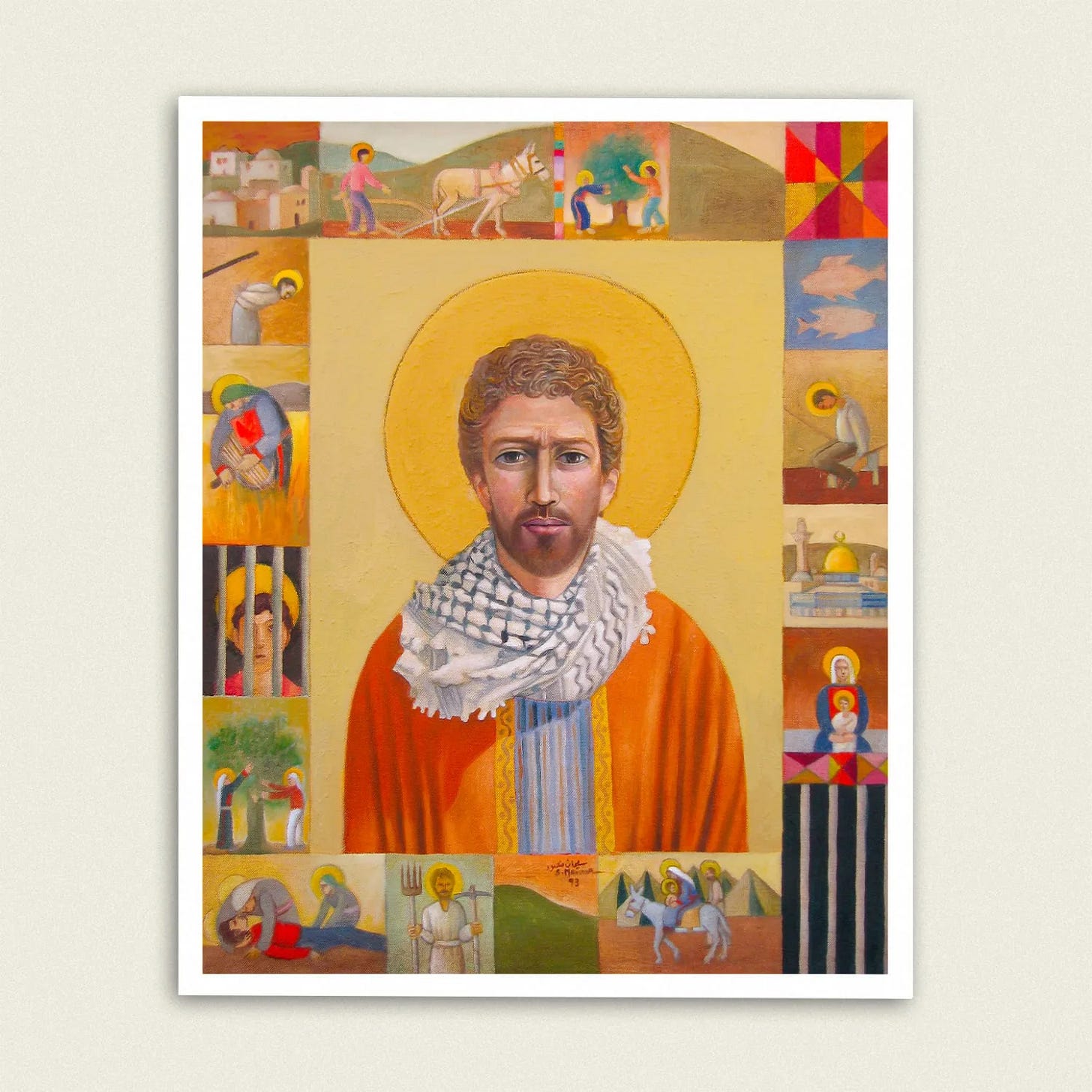
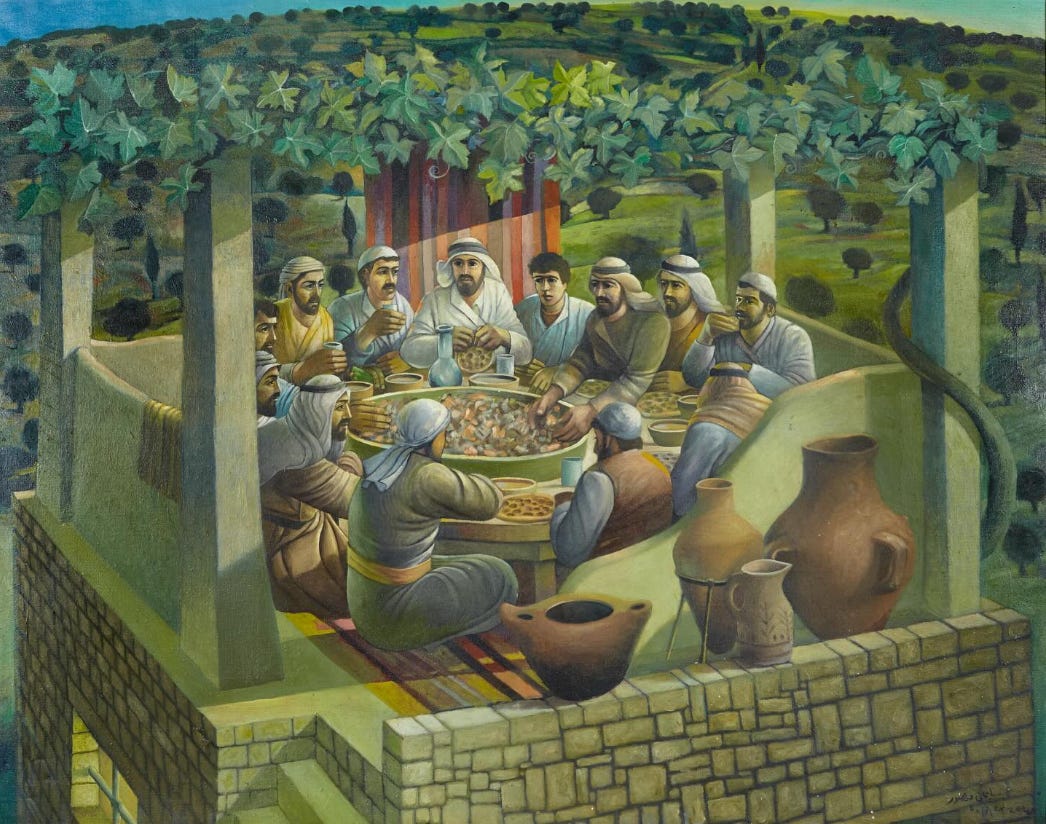
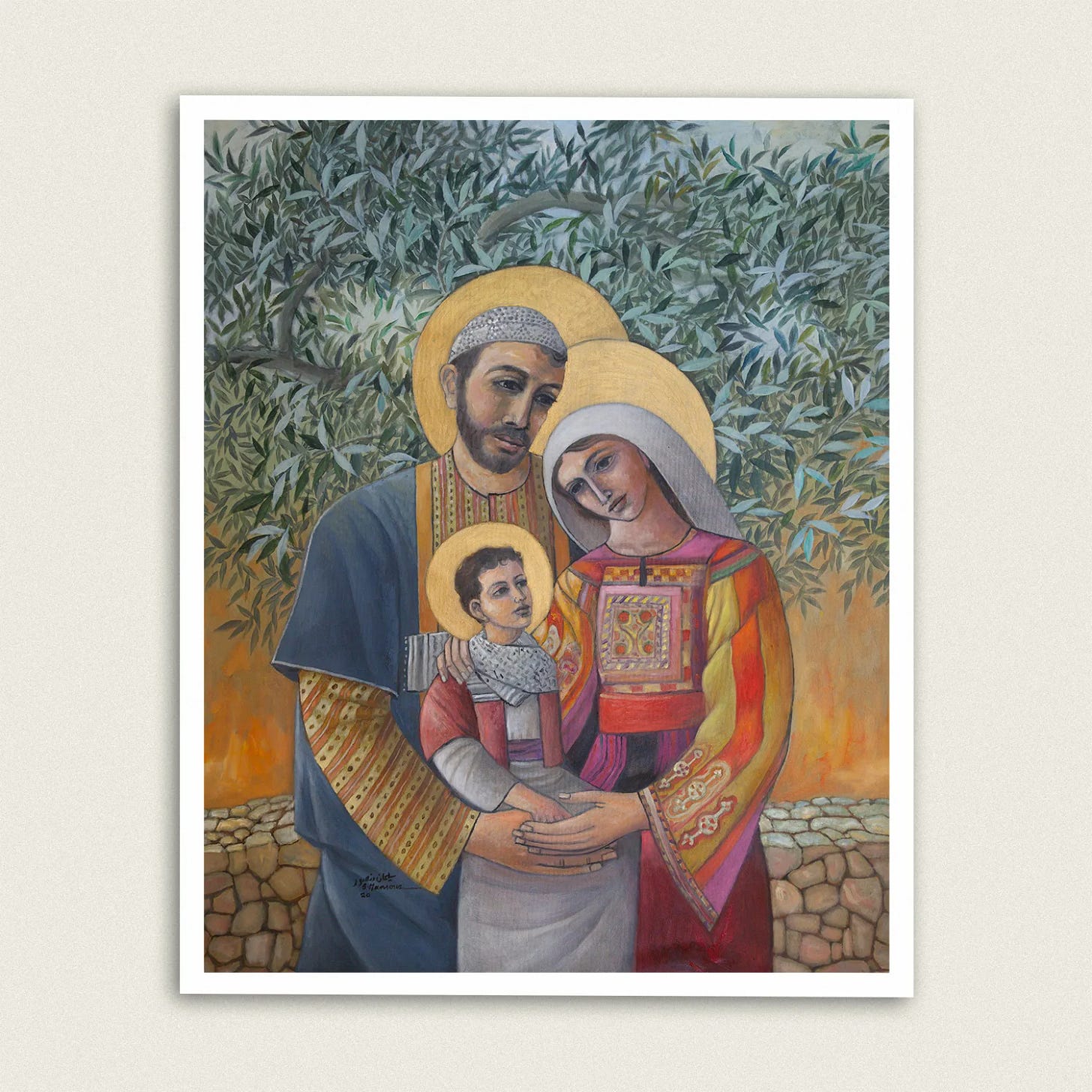
Sliman was from Birzeit and he used Christian composition constantly for Palestinian political subjects. The cross-shaped coffin here, The Nazarene in 1993, a Palestinian last supper, a holy family in an olive grove in 2020. Sliman painted his own history. The crucifixion is the one story the West already agrees is about an innocent man killed by an occupying empire, and Sliman kept putting Palestinians inside it. Jesus was Palestinian, born in Bethlehem.
Bride of the Homeland
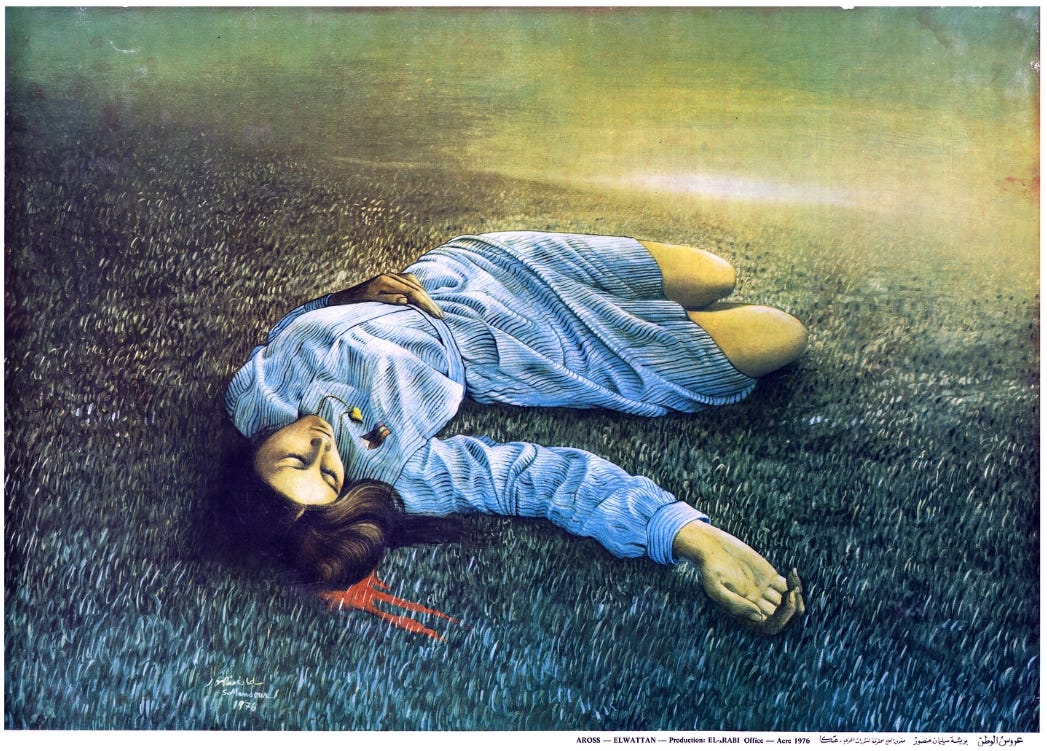
In 1976 a Palestinian schoolgirl named Lina Al Nabulsi was killed in Nablus. She was seventeen. It was the sixteenth of May, and she was walking home in her school uniform when she crossed a demonstration. Israeli soldiers chased her and her friends into an apartment building and shot her where she was hiding, in front of people, so everyone would understand the lesson. The Israeli army said a rifle went off and a stray bullet found her.
Israel confiscated the photograph of her.
So Sliman built the image himself. He painted her lying on the ground in her bloodstained school uniform, and he used his fiancée, Hanan Katu’a, as the model. He called it Aroos Al Watan, Bride of the Homeland.
That painting went up in every house. It got stuck on poles, in alleys, in camps. For a generation of Palestinians, Lina Al Nabulsi’s face is Hanan Katu’a’s face, and nobody minds, because the alternative was no face at all.
Prison
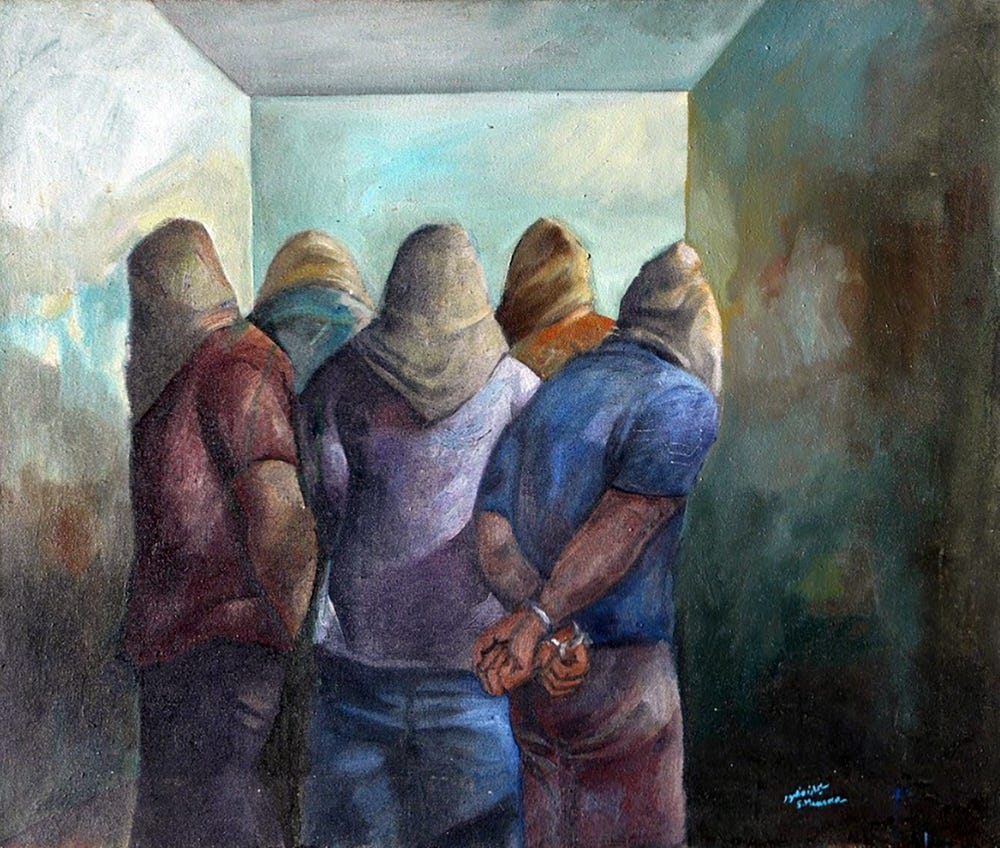
Five men, hands cuffed behind their backs, heads covered. Here the facelessness is the point, and it runs the other way from Rituals under Occupation. There, every mourner gets features. Here they are taken away, because that is what the cell room does.
Sliman had been in that room:
“They put a bag on my head. I was handcuffed behind my back. I was beaten, the same as what everyone else who is imprisoned goes through.”
They never told him he had been arrested for being an artist.
He painted his own hood and then hung it on a wall.
The watermelon
Two years before that, in 1980, he had a solo show at Gallery 79 in Ramallah, the first gallery the city had. By his own telling it opened at two in the afternoon, and at six that evening Israeli soldiers arrived, cleared the room, locked the door and took the keys with them.
A month later they called him in with two other artists and handed the keys back. They went to the gallery. Of the forty paintings that had been in the show, four were still there.
That summons is also where the Palestinian watermelon comes from, and since the watermelon is now on tote bags in cities where nobody can find Ramallah on a map, it is worth getting the story correct, because Sliman spent years trying to.
The Israeli officers told the artists to stop painting politics and paint flowers instead. The officers said the flag was forbidden, and so were its colors. Issam Badr asked the obvious question. What if I paint a flower that happens to be red, green, black and white? The Israeli officer told him it would be confiscated. Then he added the line:
even if you paint a watermelon, it will be confiscated.
The irony of the watermelon not even being a Palestinian idea. But an Israeli officer’s shit joke, a threat improvised on the spot to close a loophole. And Sliman, when asked about it decades later, was honest about the story. He did not remember Palestinian artists of that period actually painting watermelons. The symbol came much later, mostly through Khaled Hourani in 2007.
He could have let that one go. It flattered him and it flattered the cause. He kept correcting it instead. The rule he drew from the whole ordeal is better than the myth anyway: “Anything that made Israel angry later became a symbol.”
The mud
In 1987 the Intifada started and the strategy was to stop buying anything Israeli that you could live without. Sliman applied it to his own trade, which meant he could no longer buy paint.
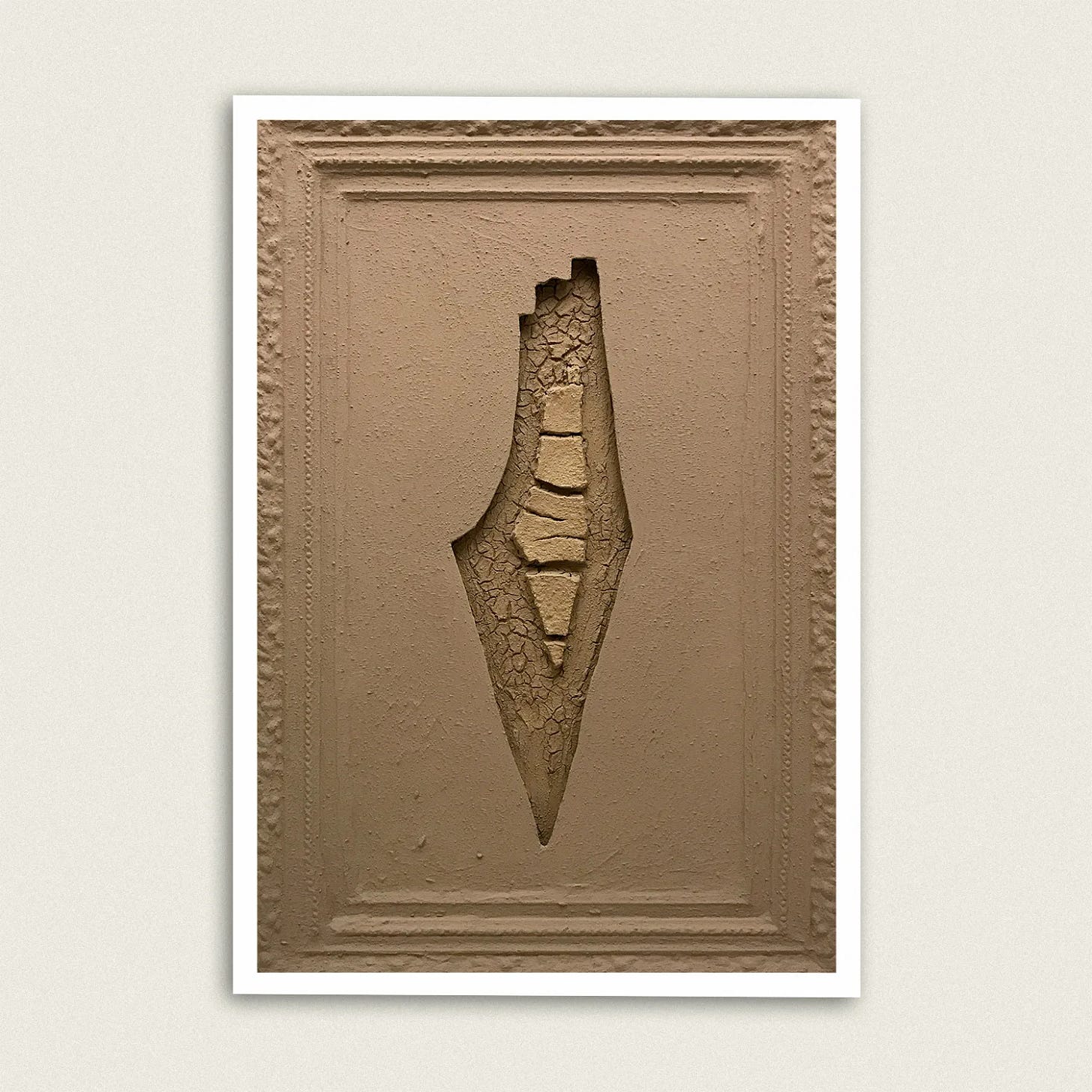
He and Nabil Anani, Vera Tamari and Tayseer Barakat formed a group. In Arabic they called it Nahwa Al Tajreeb wal Ibda, Toward Experimentation and Creativity, though the name that stuck in English is New Visions. They divided the materials of the country between them. Anani took sheep leather from a factory in Hebron. Barakat burned images into wood. Tamari took potter’s clay. Sliman took mud, mixed with hay, the same pale soil villagers used for oven walls and the walls of houses. For color they used henna, coffee and plant dye.
Mud came to him first because he had watched his grandmother build beehives out of mud and hay when he was small. He went and found an old woman in a nearby village and asked her about the soil, how you pick it and how you mix it, and she explained the whole process. That is how he learned.
Then the work started cracking as it dried, and he hated it. He filled the cracks in. He thought they were ugly. It took him about five years to stop.
He gave two different explanations for what the cracks meant, years apart. The first is political and geographic: “They reflected our political life here, the hundreds of checkpoints that fragment our landscape.” The second, he said, is that the mud also reflects human fate: “people waiting to disappear, fall down and go away.”
“I was molded by the Palestinian landscape. I said to myself, rather than drawing the land, I will draw with land. People would inhale my artwork at exhibitions. They would feel the Palestinian heritage, by touch, by scent, with the senses.”
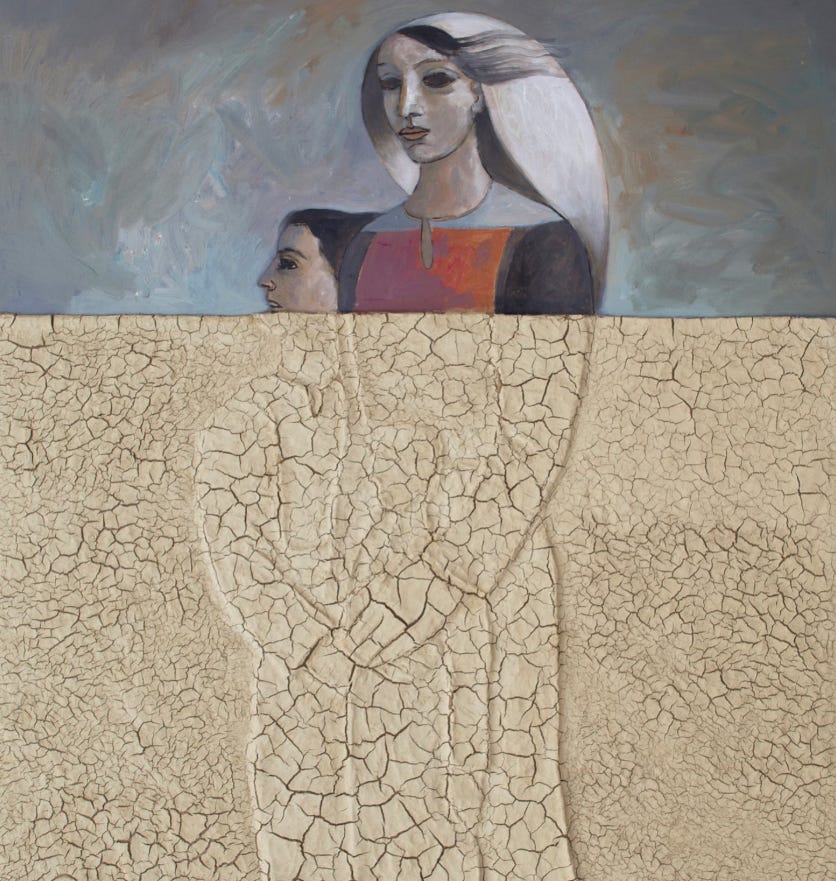
And then the Absent Presence paintings at the end of the 2010s, where he splits each picture between two materials. What is painted in acrylic is still there. What is made of dried mud is going back to dirt. In the 2019 one a woman and a boy stand holding hands, only their heads visible, the rest of them overlaid with cracked clay, their Palestinian clothes underneath it and obscured by it.
The symbols
Sliman painted the same handful of things his whole life, and each one is doing a specific job.
For him, the olive and the orange are dates. He said: “When I paint orange trees I am painting land that was occupied in 1948, and when I paint olive trees, I am painting about land that was occupied in 1967.”
Which means Yaffa from 1979, with its women harvesting oranges, and Salma from 1981, with her basket of them, are Nakba paintings.
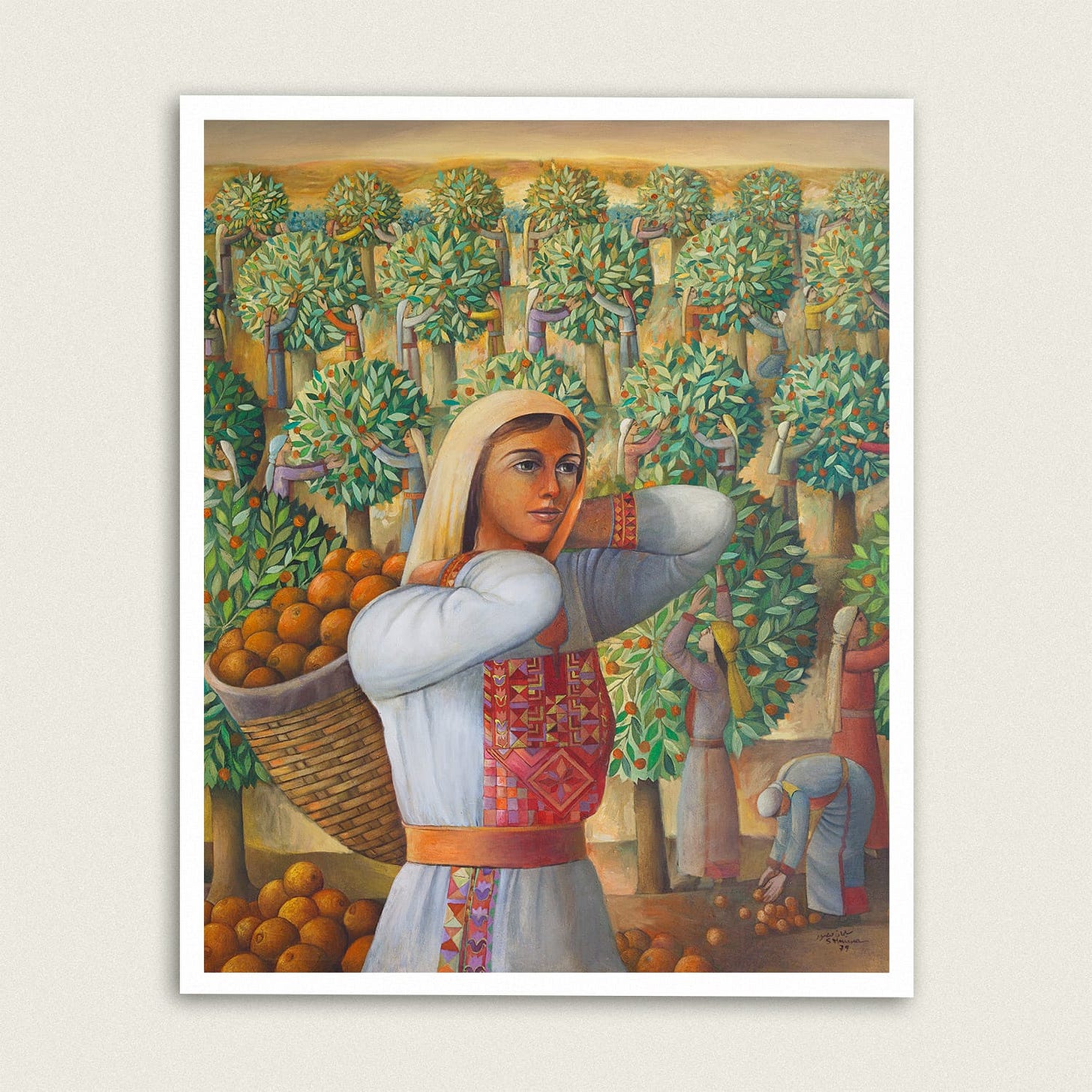
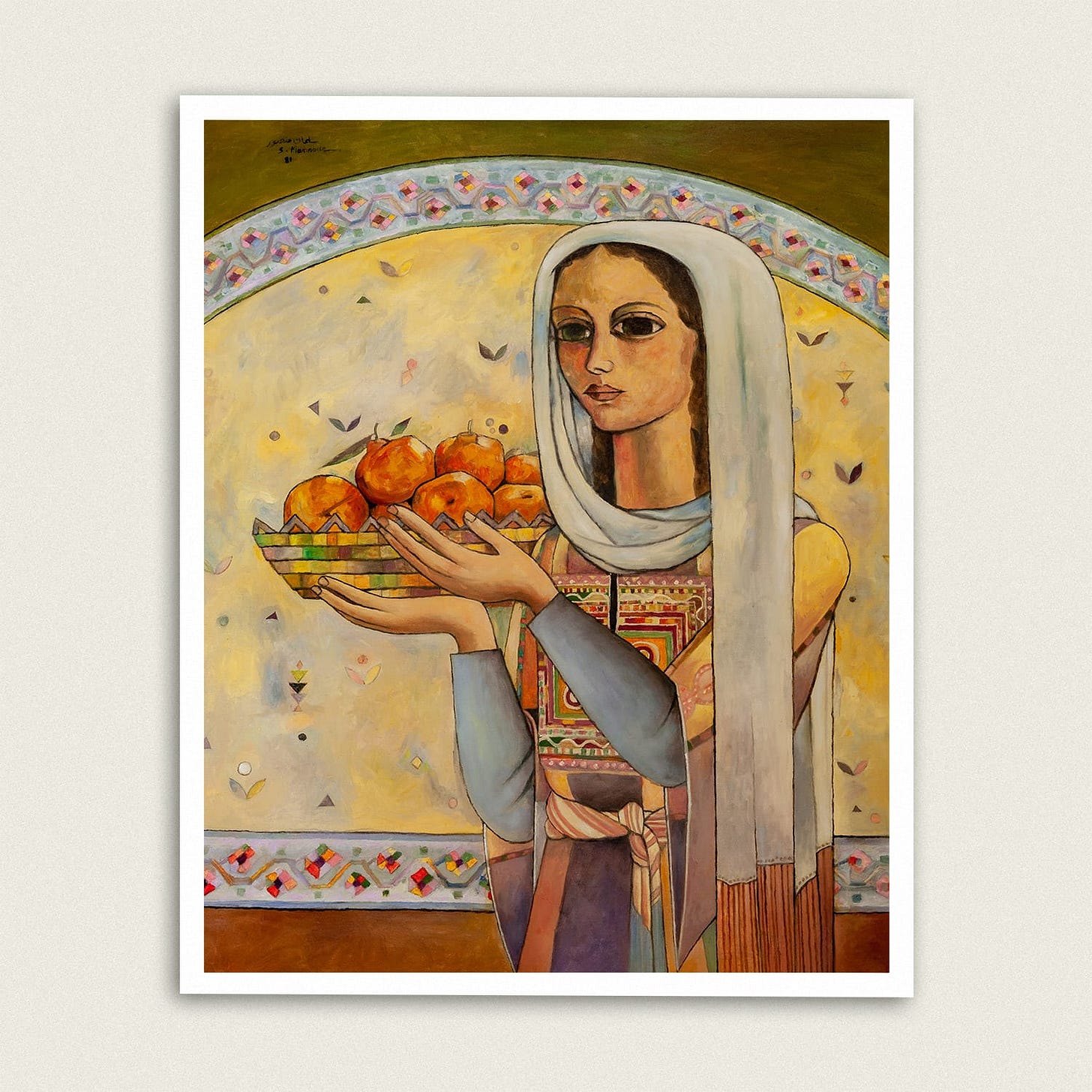
And the olive harvests are paintings about the occupation of the West Bank, in the present tense. Put both fruits on one canvas and Sliman is making a claim about the entirety of Palestine.
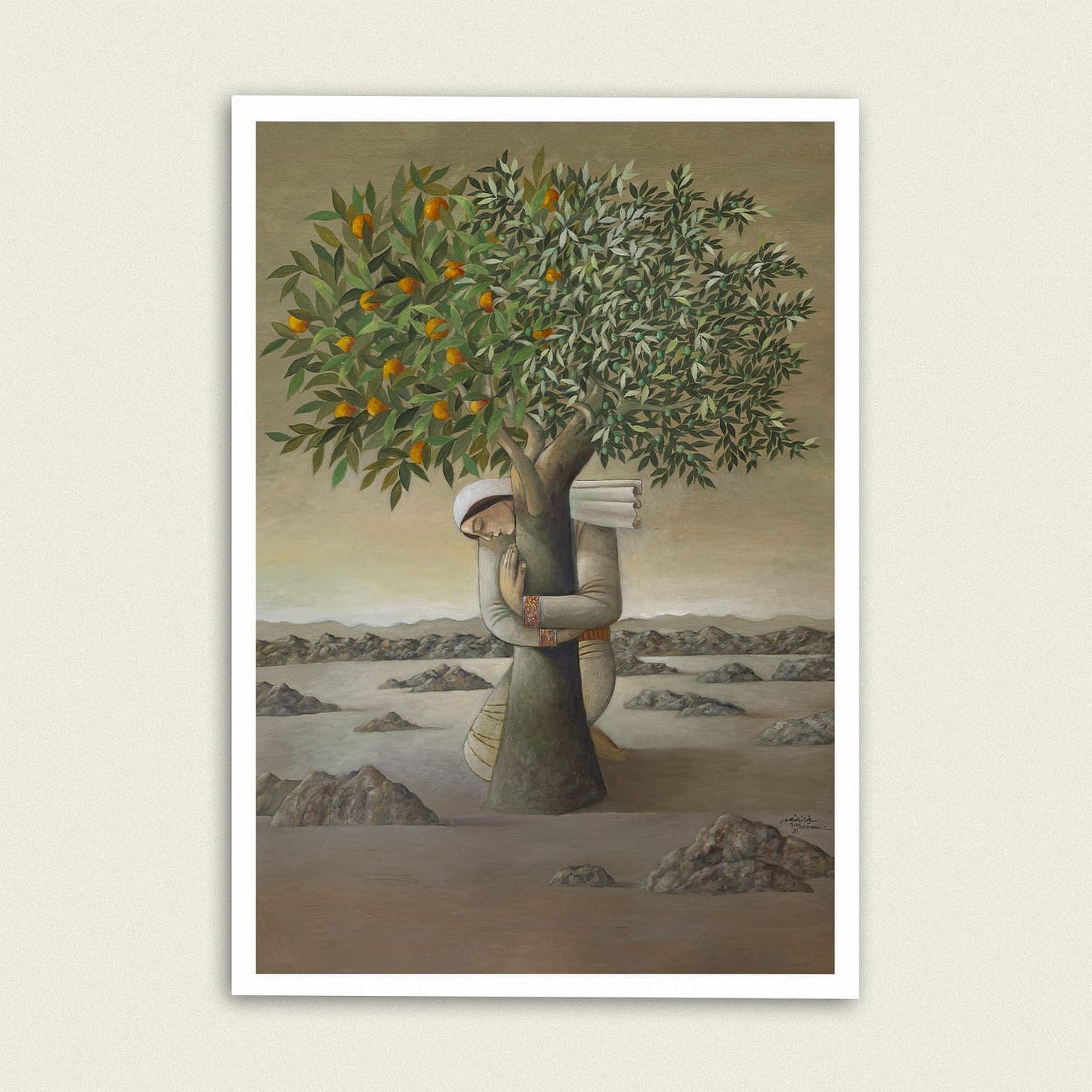
He chose the olive as the sign of the land because it is vulnerable: uprooted, burned and confiscated, constantly. And the Jaffa orange because it kept being sold abroad under the city’s name after the people who grew it were expelled and barred from their groves.
The cactus. In Arabic sabbar, from the same root as sabr, patience, and sitting right next to sumud, the steadfastness Palestinians talk about constantly and that translates badly into English every single time. Sliman’s own gloss was flatter and better than any of that: “If you wanted to know if there was once a village, you would look out for the cactus plants. They don’t die easily.”
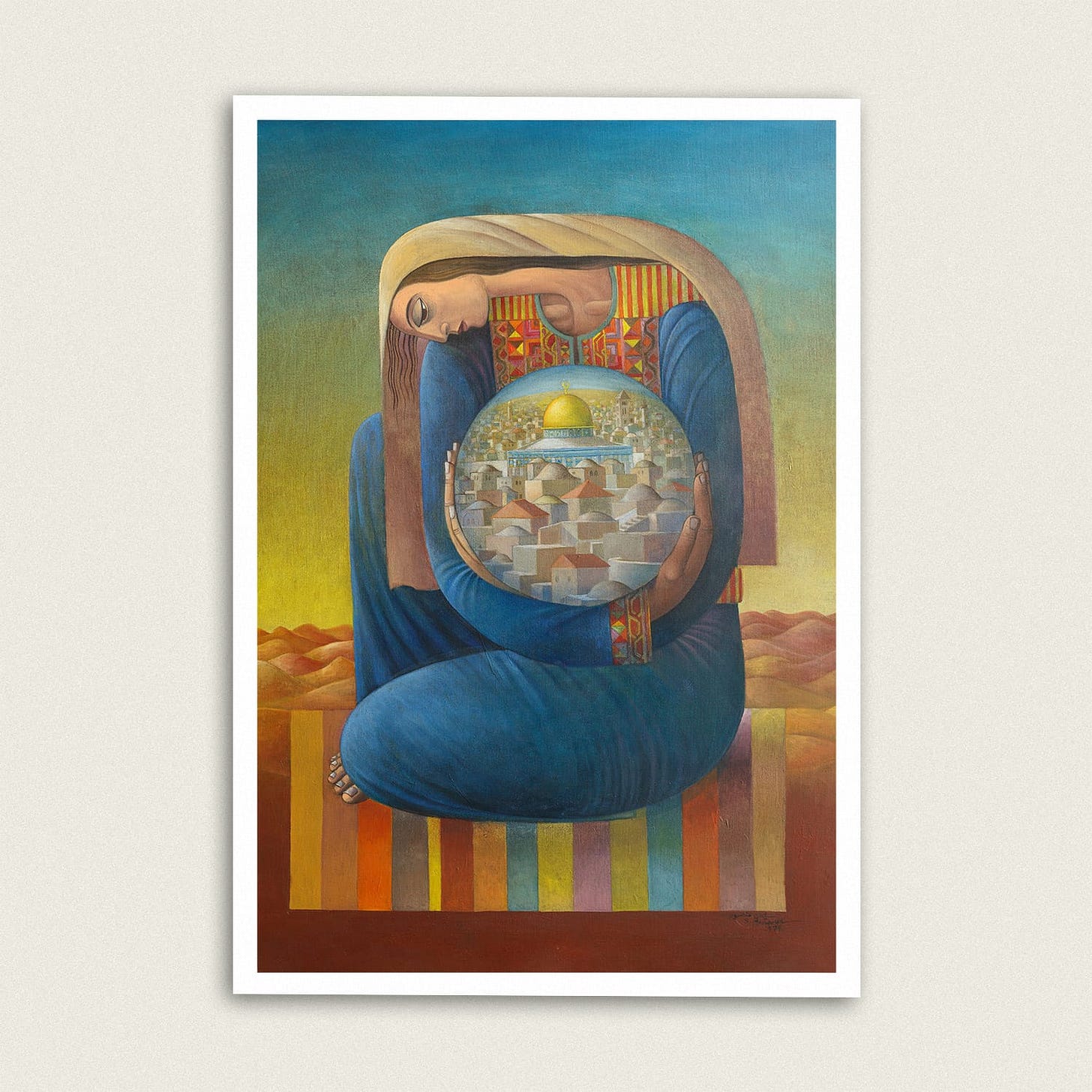
And Jerusalem. Across his entire life he almost never painted the city as a place anybody lives in. It is carried. The porter carries it on his back. A woman carries it in 1979 as a sphere in her arms.
A girl in 1978 balances it on her head.
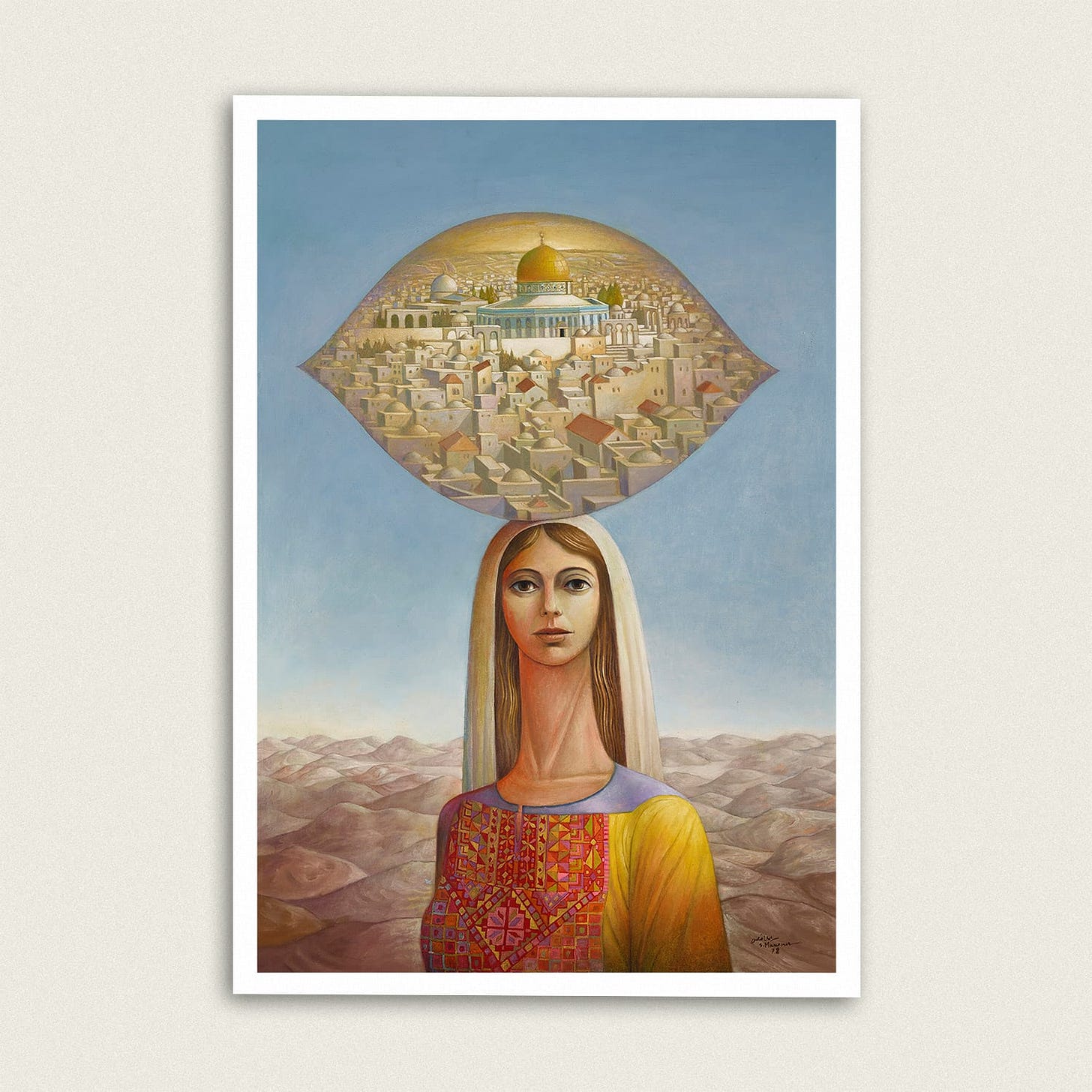
It is a thing held at a distance, never a street you walk down. That is exactly what Jerusalem has become for us. We are barred from entering it, from seeing it, from smelling it, from lying on the carpets of its holy site. Jerusalem to me is a memory from when I was a kid, carried in my arms, in my heart, and atop my head, and I haven’t seen it again since.
Eleven months before he passed he sat for an interview on Tarwida and said this:
“Our relationship with Palestine is a romantic one. Palestinian art, whether poetry, literature, visual art, or even music, carries a great sense of romance. This has pros and cons. One of the positives is that when I paint a Palestinian village, I paint it in the most beautiful way possible. If there is a broken tree, for example, I’ll make it sprout. If there is a donkey in the shade looking ragged, I’ll add something to romanticize the scene. That kind of painting goes straight to the heart. I’ve had many young people in America and Europe who have said to me, ‘We’ve never been to Palestine, but through your paintings, we come to love Palestine.’ For me, that feels like a great achievement. Something I truly accomplished. I sparked in them a love for Palestine. Without love, there is no belonging. And belonging is what will save Palestine, and the belonging of its Palestinian people.”
He was right about the achievement. I have not stood in Jerusalem since I was a kid, yet I have never lost the memory of it, because a man in Birzeit kept painting the city onto other people’s backs until it settled onto mine.
Rest your back, ya ustaz Sliman. There are enough of us to carry it now.