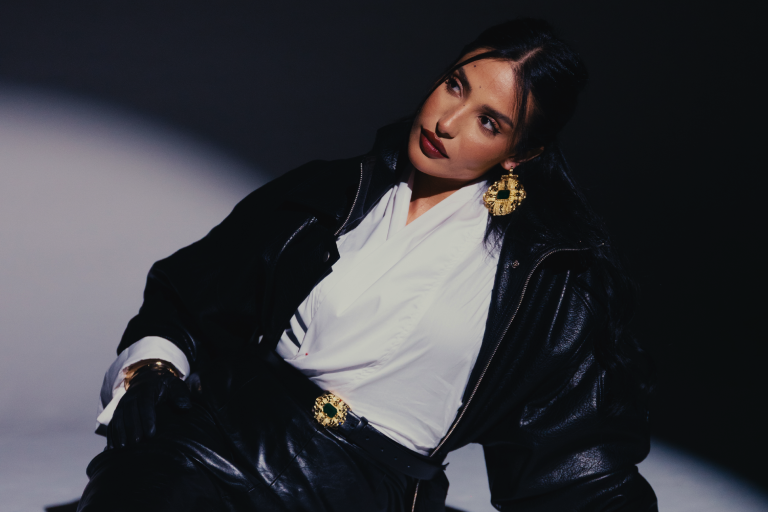
Coming of age as an avid fan of R&B, LA-based artist Michael Hakim tells me he felt a gap in the pop industry even at a young age. “I listened to Justin Bieber. I liked Cody Simpson, but I felt like all the pop boys at that time were White pop boys.”
His musical world, like many Arab kids living in the West, was soon split in two: “I would listen to Arabic music with my mom, she would listen to Nancy Ajram a lot, for example. But it always felt like a distinct separation – that was her music, this was mine.”
He adds, speaking of long-standing tokenism when it comes to Arab representation in the West: “There weren’t any American pop stars I could look at and be like, ‘oh, he’s Arab.’ We always felt so much pride when we would watch award shows and see someone who was Arab, it was like an event. Well, I don’t want it to be an event, I want it to be the norm.”
When Michael released his 2024 album Peaks and Valleys, an eight-track of R&B beats with Arabic-English lyrics, the reaction from Western audiences was understandable. “One of the reactions was, what language is he speaking? Why are there numbers in the words? It was fun seeing people in the comments explain things like, ‘we use the 3 for the ‘ah’ sound, or we use the 7 for the ‘ha’ sound’. We all do that.”
By “we,” I understand exactly what Michael is talking about; It’s my lived experience. Recent studies show that at least 5% or 20 million Arabs live outside their homeland, with significant populations in South America, Europe and of course, the United States.
These diaspora populations create a new kind of Arab-ish culture – something not quite Arab but not quite assimilated in their home bases. The adoption of third-culture hacks, like the use of numbers rather than letters, are quite common but never mainstream. That’s exactly what Michael Hakim hopes to change.
“A lot of people who are making this new wave of Arabic music, it stems from a place of seeking validation from the Arab world.”
His highly anticipated second album, set to release this summer on August 14th, finally has a name: AR&B – a label that can alone stir endless online debates around the legitimacy of Arab diasporic pop.
“A lot of people who are making this new wave of Arabic music, it stems from a place of seeking validation from the Arab world. Like, ‘guys, I know I grew up in the diaspora but I’m still Arab!’ and I feel like I’m taking a completely different approach,” he says, commenting on one of the most polarizing conversations in Arab music today.
“I think a lot of artists today are doing an amazing job blending Arabic and Western music,” Hakim tells me, “but for me, the goal wasn’t just to combine the two. I wanted to see what a sound could be if both influences were equally part of its DNA from the ground up,” hinting at a cultural hybridity that the Arab diaspora know, oh, so well.
Yet, he refuses to see this hybridity as weakness, or a dilution of a native culture: “[This new project] is owning who I am, and not seeing it as my achilles heel, but as my superpower. I’m not seeking validation from any world, I’m building an entirely new world of my own.”
At the time of our interview, the 27-year old artist is still in the process of selecting which songs make the final cut. “The theme of the project, it still resonates more with R&B. It’s still about love and romance,” Hakim tells me, “But it has much more Arab instrumentation. I would say, stereotypically, it sounds like Western music but with more Arabic percussion.”
He wants to explore hidden synergies between R&B and Arab pop, like the Arabic language’s capacity of tackling love, romance, and heartbreak with unparalleled emotional presence and surgical precision.
“The bigger vision is creating something people can eventually recognize as AR&B the same way they recognize Afrobeats or Reggaeton. Not because of the language, but because the sound itself has its own identity.”
“My music is an introduction to the Arab world for someone who doesn’t want to just go from zero to 100.”
It’s easy to see this evolution from the outside – Hakim’s Peaks and Valleys felt nostalgic in the best way, seemingly answering the question, what if Usher produced Arabic music? But with his most recent releases, he continues to carve out his own space at the crossroads between R&B and Arabic music.
“My music is an introduction to the Arab world for someone who doesn’t want to just go from zero to 100. [It] offers a sense of familiarity to people who don’t know anything about our music, and as they get deeper into it, then they [can] transition into fully Arabic music.”
His last release of 2025 was Yasmina, a yearning ballad with 2000s-inspired melodies. The music video is simple but effective, complete with mood lighting, an iPod and a Tawla set. His lyrics leaned more into his Eastern identities, with the hook of the song entirely in Arabic.
With Hakim’s May release, Bint El Shalabiya, he pushes his style even further, with more traditional percussion and strings to fill out the melodies and an entire opening verse in Arabic.
“I think there’s a difference between putting music out as a creative outlet and being an artist, being intentional with what you put out. I feel like I’ve transitioned into putting out more purpose-driven work,” Hakim says. “I’ve definitely become more intentional with what I’m doing. I want to get Arabic music and more specifically the Arabic language on a more globalized scale. Obviously a lot of people are trying to do that, and they’re doing it in different ways.”
As the child of both Palestinian and Lebanese immigrants, Hakim sees a continuity between what the region is going through politically, and the music it has recently started to export: “Arabic music and Arabic culture is definitely the next wave in mainstream culture. And I think a part of it is because of what’s going on in Palestine and Lebanon. People have more of an eye on our region.”
And he’s not wrong – the IFPI recently dubbed the Middle East and North Africa (MENA) is the world’s fastest-growing music market as of 2024–2025, with revenue growing 22.8% to exceed $144 million.
These numbers, driven by a streaming-dominated market, showcase the new breadth of Arabic music in the online age. And the impact is evident; with names like Elyanna announced on the official 2026 World Cup soundtrack, to pop stars like Zeyne and Saint Levant crossing over to Western audiences.
“I think there’s a difference between putting music out as a creative outlet and being an artist, being intentional with what you put out.”
He sees his place in this growing class of Arab popstars, cognizant of the fact that being Arab in the mainstream in this day and age comes with an added responsibility. “In a time where our identities are being erased, my two identities [being Palestinian and Lebanese] are both under attack of being erased, so I’m asking myself, ‘what is the best way to preserve it?’ And I think that’s through my music.”
The ongoing violence against Palestine and Lebanon isn’t an abstract concept to Hakim. “I was actually in Lebanon during the war in 2006,” he tells me. “I know – just a little bit – what it’s like to have bombs dropping and the sound of the explosions. And I know right now, it’s worse than it was in 2006. So it’s real for me.”
Growing up, Hakim visited his father’s family in Lebanon every summer, building a connection with the land, the people and the culture. His father’s family is still there. “My grandma, for example, has lived through so many different wars. She’s in her eighties now and nothing has changed, it’s just another war. It’s devastating.”
Hakim is quick to point out the freedom to come and go from Lebanon is a privilege he doesn’t take lightly. “I’m not going to pretend I know what it’s like to live in Southern Lebanon right now, or in Palestine right now. But I feel a sense of responsibility to continue to produce music that honors those sides of myself because my music and Arabic music as a whole is a reminder that we exist.”