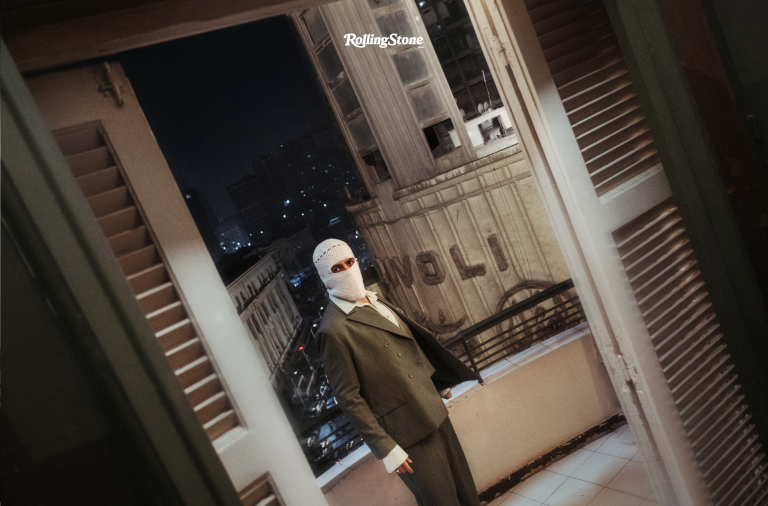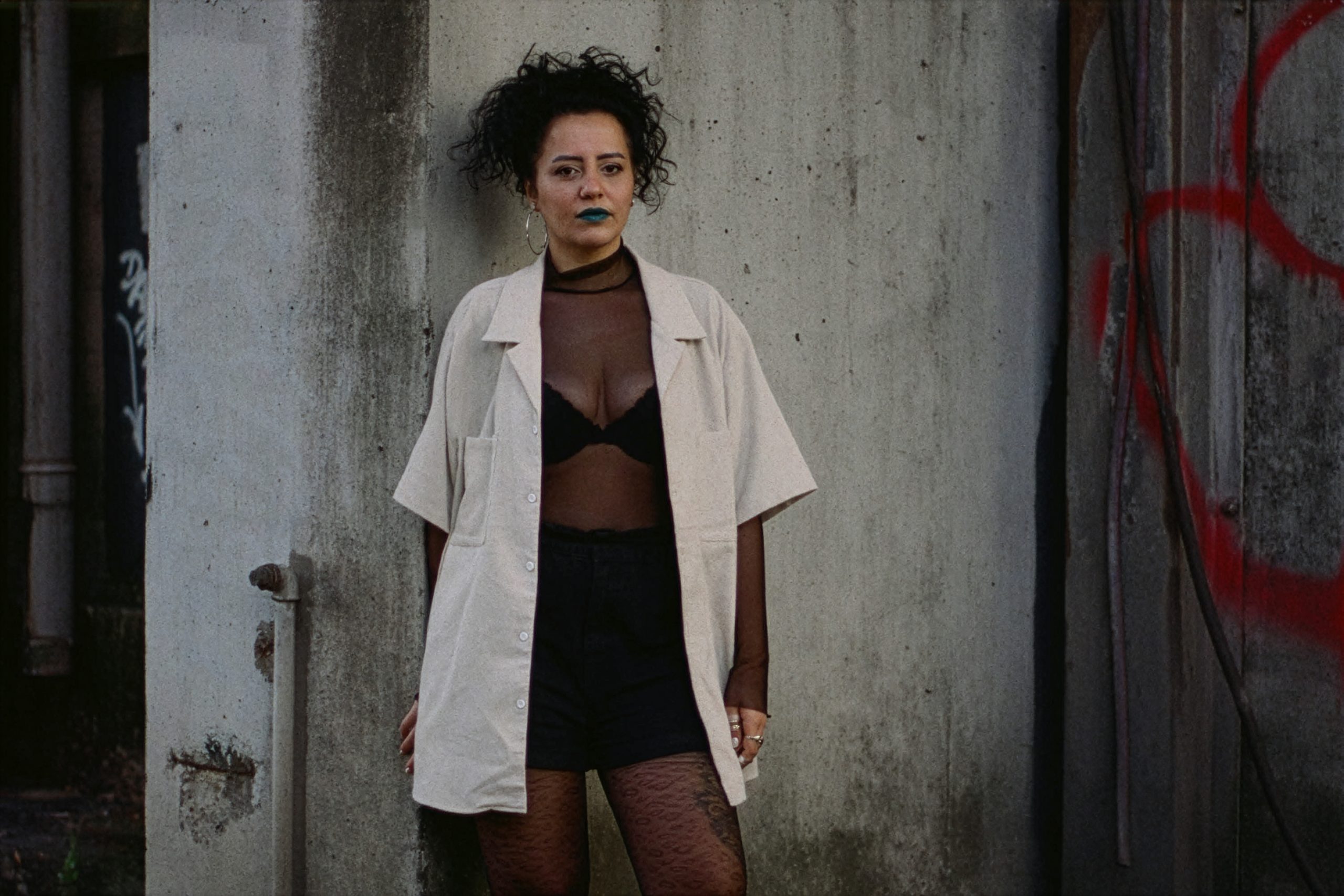
Cairo is a crowded city where everyone is chasing something, whether it’s the metro, the bus, the traffic light before it turns red, their daily bread, or, if there’s time, their dreams. Amid the constant honking and shouting of a bustling Cairo street, I sat with El Kontessa beside the balcony of her fourth-floor apartment.
The noise easily carried inside, making the space feel loud, a familiar motif in her music, which can be described as dense and abrasive, imbued with fragments of Cairo’s chaos. As the noise swelled, she smirked and pointed out the irony that when she records, everything has to be completely silent, as she pointed to her recording setup.
After years of experimenting in her bedroom, El Kontessa stepped into public spaces in 2018, DJing at underground Cairo parties where she blended electro-shaabi with gqom, pop, and jungle. Through these edits and hybrid DJ sets, she realized she wanted more control over the elements in her mixes, which pushed her toward producing her own music.
Deeply influenced by maqsoom rhythms, multidisciplinary artist El Kontessa approaches music in a radically personal way. She views maqsoom as a modular system, reshaping it through experimentation and blending it with other genres, sometimes pulling apart its patterns and bending them into polyrhythms, building entire compositions from its internal logic.
As an illustrator, producer, and DJ, El Kontessa visualizes sound by translating rhythms into a color palette. Having illustrated the artwork for her debut album, Nos Habet Caramel herself, the visuals are highly saturated, surrealistic patterns of neon yellow and purple colours.
Her sound sits somewhere between cinematic textures, shaabi instrumentation, and intense drum and bass. She avoids fixed rhythmic formulas, something evident in the frequent beat breaks, tempo changes, and sudden transitions packed into her productions. Each track sounds like a compressed DJ set, unfolding as a narrative with constant shifts in tempo and energy within a three- to five-minute timeframe.
She has previously performed globally at major festivals and venues, including Primavera, BRDCST Festival, Outernational, Nyege Nyege Festival in Uganda, Nykobop Festival in Paris, and Utrecht’s Le Guess Who?. Her work has also reached global radio platforms such as NTS, Rinse FM, Movement Radio, Noods, and, most recently, through her residency on Stegi Radio.
When I walked into her home studio, the first thing I noticed was a large painting of two cheetahs standing in a miniature jungle, fitting for someone whose space is filled with plants and color. Over a cup of coffee, she records a short demo, walking me through how she transforms a single sample into a full track. These are moments from our conversation.
When did you start making music? How different were your early DJ gigs from how you perform now?
When I first started in 2018, I based my sets heavily on electro-shaabi and stayed in that space for about the first three years. Then every year after that, I started experimenting with the genre, mixing it with different sounds like drum and bass, jungle, and more.
What pushed you from DJing into production? Was it about not finding enough music to play?
Yes, I couldn’t find enough music to mix. I always had ideas while listening to my own mixes, so I started editing them, and that’s how my production began. The structure of my tracks flows like a DJ set, where the intro, middle, and outro are all different.
I just found out today that you paint. What’s your background with visual art?
Before making music, I was a visual artist for years. I graduated from Fine Arts and worked with radical mural painting, mosaics, glass, graffiti and everything related to urban art. I used to do exhibitions and kept drawing.
The drawing process goes back and forth with my music. Sometimes I see melodies as shapes, so I stop and draw to reset myself while working on music.
Is drawing part of your creative process in making music?
(She points to different drawings and paintings hung across her apartment walls.)
I still draw, but I don’t release things publicly. I did the album illustration myself, while the art direction and typography were done by Yazan El Zubi. I work with digital illustration and painting, acrylic and oil, digital and analog. When I’m stuck musically, drawing helps my creativity, and vice versa.
What did you grow up listening to?
Mostly Arabic pop like Sherine Abdelwahab, Nancy Aghram, Myriam Fares, Angham, and the sexy era of the 2000s, like Ruby, Maria, and Sandy. It influences my music a lot.
How do you approach sampling?
Sometimes I record samples, sometimes I take them from tracks. Since I listen to a LOT of music, sometimes a tiny micro-sample inspires me, and I turn it into something very different. My work revolves around sampling, mostly acoustic sources, live and organic recordings. That’s why I go for tracks with acoustic elements. I like knowing where the sound comes from, which is why I prefer acoustic samples over software sounds.
Best crowd you’ve played for?
Cairo, without a doubt. Maybe I’m biased since I’m based here, but my favorite gig was Simasra’s showcase for 10 Years of Salute of the Parrot, where I played my album Nos Habet Caramel at Cairo Jazz Club 610. The audience came open-minded, ready to hear new and experimental music from each artist.

Which brings me to your remix collaboration with Maurice Louca. How did it come about?
Samsara first reached out to me. They wanted remixes for Salute of the Parrot. I’ve loved Maurice’s music for a long time, especially that album, so it was a special opportunity. Rapture was the track I always wanted to play with and edit, even before they asked me. When they sent the options, I picked it immediately. Being able to put my own music into it honestly felt like I’d made it.
You have tracks called ‘Mesh Marshmellow’, ‘Madrab Deban’, and ‘Mafish Mawdo3’, among other quirky titles. How do you name your tracks?
It’s purely random and funny. But I like my tracks to tell a complete story from intro to outro, so the track names and the sound effects, car noises, street sounds, help create a visual space and storyline for the listener.
Almost all your tracks shift tempo, often slowing down toward the end. How intentional is that?
Very intentional. I like tempo ups and downs. I get bored very easily, and those rhythmic shifts reflect my personality and mood swings, constantly going up and down.
Who are you listening to right now?
Lately, I’ve been listening to Nada El Shazly, Sandy Chamoun, Baraari, Koast, and Maryam Saleh, among many other female artists.
What’s next for you?
I’m working on a new album now. I can’t say anything about it, except that it’s full of collaborations, and hopefully it’ll be released next year.
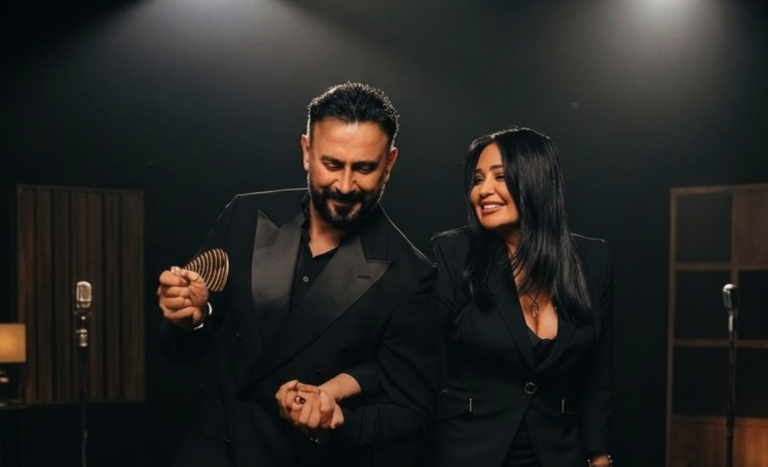
Having previously mashed up Haifa Wehbe’s ‘Ezzay Ansak,’ Elkontessa recorded a demo for us using a sample from Haifa Wehbe’s ‘Wahdi.’