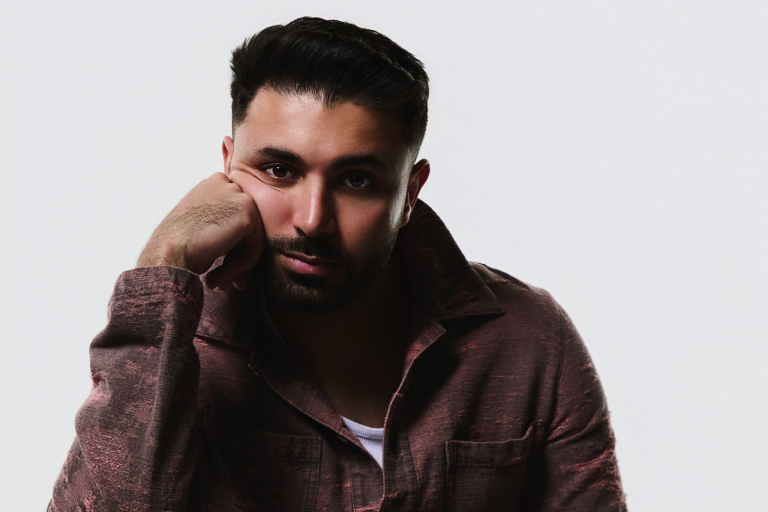
There’s a certain freedom that comes with being truthful. It’s exactly this kind of freedom that Syrian-Canadian artist Ram Sleibi, better known as BOUMPH, is pursuing as an Arab rapper in the diaspora. With a style that blends satire and “real talk,” and a mask that blurs theater and hip hop, Sleibi’s character BOUMPH adds a voice to the chorus of voices challenging the stereotypes the industry often reserves for Arab artists. And he has a lot to say.
“When I first started writing Arabic hip hop, [the topics all] had that same vibe of leaving a bitter taste in the mouth. So I just thought it’s a cool name. And then people started calling me boumph, for short, like BMF, [short for] ‘bitter mouth feel’.”
Born in Damascus to a household of actors, Sleibi was expected to become one himself. “The whole family knew ‘Ram is an actor’,” he recalls hearing while growing up, “he’s gonna grow up studying acting, and he’s going to follow in the footsteps [of his parents]. So music was just a hobby’.” But the Syrian civil war upended that path, and Sleibi and his family left Syria early in his teen years. With a lack of institutions that could set him up to have an actual career in acting, Sleibi turned to music which, by contrast, allowed him to express himself in more self-taught methods.
He started as a drummer before turning to guitar, bass and keys, instruments that he plays in his compositions today. His songs pull from childhood memories of listening to Fairouz and Ziad Rahbani, whose charisma and arrangements still inform his instincts: “What would Ziad do?” is a question he often asks himself when making music.
During his time in France and Dubai, teenage boredom turned into songwriting with friends. By the time he immigrated to Montreal in 2017, he had already played in a rock band as drummer and singer, and enrolled in Concordia University to study music – specifically jazz. “I never thought I’d be making hip hop, to be honest,” he admits. “I just started approaching the music as instrumental pieces, then rapped over them. That gave it a fresh taste in the Arabic hip hop industry.”
Then came BOUMPH, a character creation of Sleibi’s that was born after the events of October 7, 2023. While sitting in a cafe in Montreal, upon hearing the news of what had happened in Gaza, Sleibi felt inundated by bitter, shallow debates. “Whatever the opinions were, they were deaf. So I said, “I need to create a demon gorilla.”

In a sort-of antithesis to the “pretty boy” image pushed by Arab artists shooting their shot at superstardom, BOUMPH isn’t trying to keep anything “pretty” – his lyrics are confrontational and raw, hidden behind a mask that demands attention with no distractions. He’s allowing the music to speak for itself, no matter the discomfort.
Sleibi reached out to a friend who hand crocheted a green and white mask for him. “I put it on when I’m uncomfortable. I take it off when I want to say something real,” he says. When it’s on, Sleibi explains, “he’s like, Oh, I’m just a monkey. There’s no nationality, there’s no ego, it’s just me.”
That being said, Sleibi acknowledges, “just being born where I was born, and being from where I’m from, you can’t not be political. It’s just part of your DNA.” But BOUMPH was a theatrical response to egos and cliches of what’s expected of him. Sleibi believes that the music industry overlooks Arab artists until they start fitting the idea of what they think an Arab artist should look and sound like. This cookie-cutter package is a deal breaker for Sleibi and BOUMPH, by extension.
“I don’t chase global attention, because I know the package that comes with that. I know the compromises you have to make for that, and they don’t seem like compromises that I’m willing to take. And the people who are making these compromises? Those people are kind of the antagonists of BOUMPH’s storyline,” Sleibi says. “There’s a big wave of importing back to us what an Arab artist should look like, happening from the West.”
“A lot of Syrian rappers are super political and I think that it only did us harm. So I’m trying to kind of rewrite that. […] Whatever you write won’t be greater than what’s happening. So I express myself and my journey. If that makes my music Syrian, then great. But I’m not calling out my area code.”
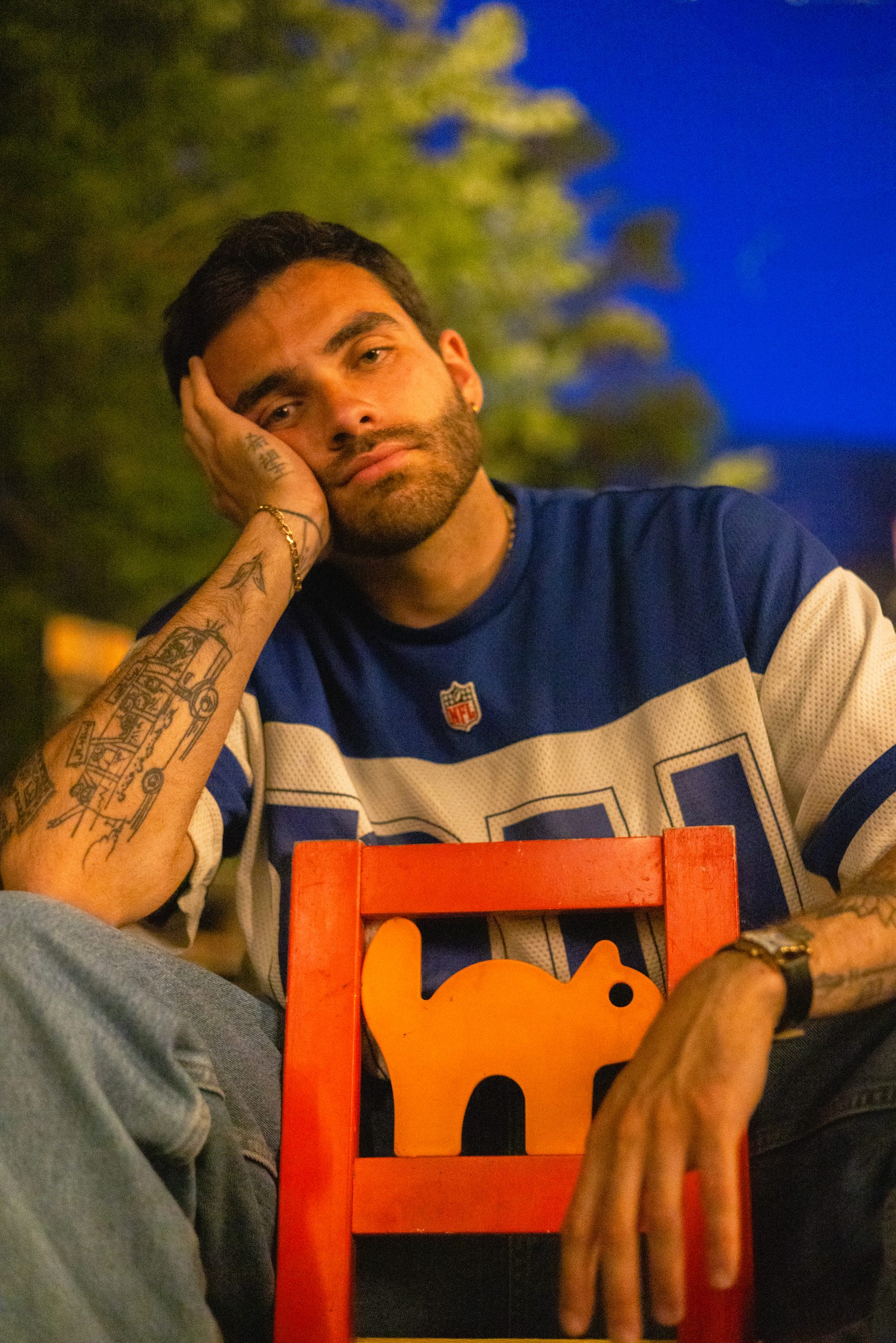
Sleibi currently shares a recording studio, where he pieces together his songs bit by bit in what he calls a “Frankenstein stage.” Once the music is done, he takes “obnoxiously long walks,” where he writes his thoughts on his phone’s notes app
The first track Sleibi wrote, Ouwet El Tarkeez, samples Carlos Puebla’s revolutionary ode Comandante Che Guevara, and was poured out in one sitting. That track sparked 4 more, quickly producing his first EP.
The music is just half the story. Sleibi’s acting roots work in partnership with the visuals he’s created to tell us a broader part of BOUMPH’s story. Cinematic scenes and morose colours that tell us more about what he’s dealing with. His latest video, A9ANSOR, filmed in an industrial elevator, depicts a battle with his alter ego. “At the end, I come victorious, and he’s left in the elevator. It’s announcing that the mask is going away for a little bit,” he explains.
But don’t expect the theatrics to vanish. “New masks will appear,” he says with a grin. “It’s not about that specific mask. It’s about when I feel like putting one on.”
Sleibi lauds his independent label Milq Records who approached him to work with him. “As a newcomer to this industry, the hardest part was imagining taking the journey completely alone.”
“I keep seeing big labels to wait for artists to work so hard and build an audience by themselves, and they approach you when you’re already big and they start sucking on your blood. I would like to send the message out that they should be investing in young, fresh artists in their early stages.”
Sleibi’s cutting words may leave a bitter taste in the industry’s mouth, but as BOUMPH reminds us, some aftertastes are meant to linger.