
There is something quietly defiant in the way 25-year-old Amira Jazeera is making pop music.
She calls herself a Palestinian Pop Princess but works inside a genre long shaped and guarded by Western industry norms.
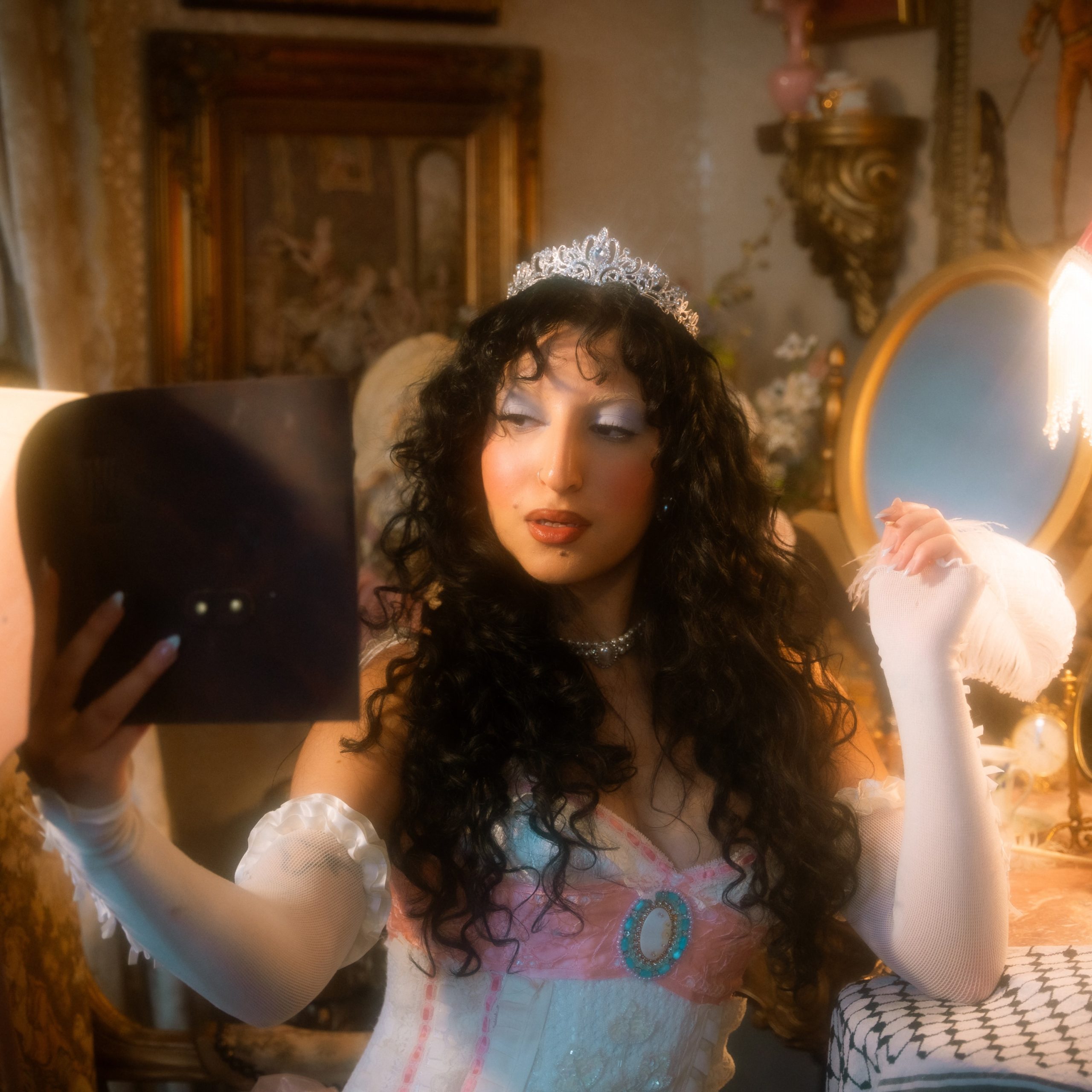
Her face catches the eye immediately, recognizable without being standard, carrying a confidence that recalls early Madonna, self-possessed and unbothered.
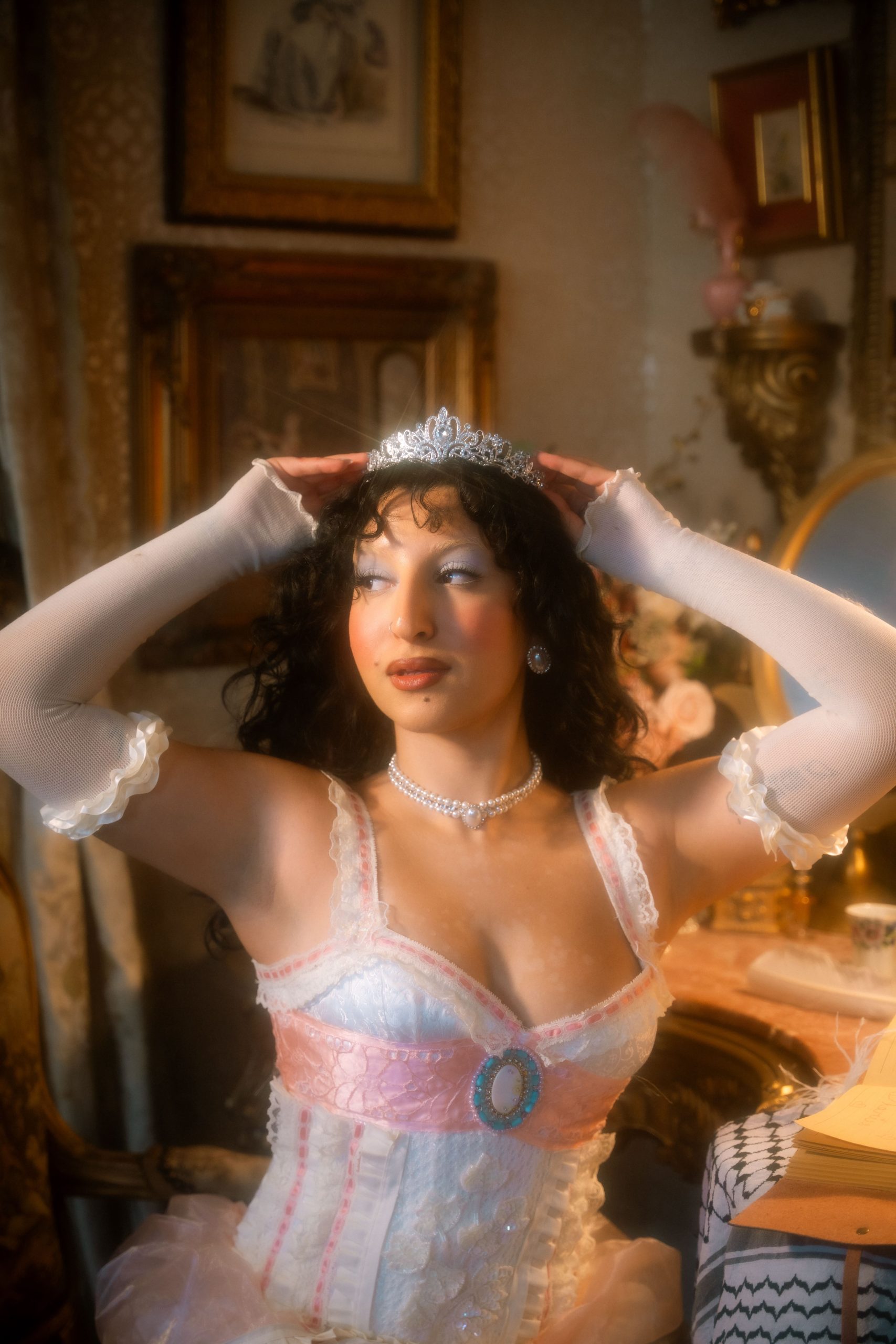
She mixes eras and textures freely. The looks shift but never feel accidental, corsetry to lace, leather to metal, always anchored by her tight Arab curls: a material Arab girl in a material Western world. The contradiction is there, but she doesn’t stop to resolve it.
She writes about attraction, hesitation, heat, fallout, wanting someone to stay, wanting them gone. The lyrics are catchy and physical in the way pop is meant to be. In a cultural landscape that repeatedly reduces Palestinian life to loss, her refusal to carry that burden into her music feels necessary.
Working from inside pop like this is deceptively difficult, especially when it isn’t a choice or an aesthetic. “No one is bankrolling my lifestyle,” she says. “I’m doing this from scratch. It’s just me and the music.”
Amira was able to receive a modest stipend from a small, independent label to distribute her first album, enough to make the work but not enough to necessarily shape it.
That freedom shows in her music. With full creative control, she makes decisions, trusting instinct over permission: “I learned pretty early what it means to be different,” she says.
Growing up as one of the only Arab girls in predominantly white towns inside Ohio sharpened her awareness early. After 9/11, that difference hardened into something more constant. School came with questions she didn’t ask for, often surfacing unkindly.
“I was called all kinds of names,” she added, brushing it off.
She turned to a piano, a laptop, GarageBand, and YouTube, without formal training or a long-term plan, just practice. “Music gave me comfort,” she said. “It was where I could escape and get away from all the drama.”
Her first performances came early. She was 17 when she stepped onto an open mic stage for the first time. The response surprised her.
“I felt loved, heard, seen,” she said. The moment stayed with her, and shaped how she thinks about performance now, as something she holds and directs.
Her walls are lined with women she grew up admiring, Ariana Grande, SZA, Lady Gaga, Britney Spears. But her most formative influence has always been closer to home.
Khalid, 33, her eldest sibling of four and now her manager, recognized her seriousness before anyone else did. Before stepping into that role, they had been building a creative life in stand-up and music, learning the mechanics of performance. That momentum was later redirected toward Amira, pushing her early recordings and inspiring the work to be treated as real, long before outside validation arrived. “I really don’t know where I’d be without them,” Amira said.
As a teenager, she recorded wherever she could. When Khalid moved out, she took over their bedroom, slowly turning it into a makeshift studio, her first space to work without interruption.
The bond between them is clear and functional. Khalid handles the logistics around the work so Amira can stay focused on making the music. She protects the creative core; Khalid clears the path in front of it.
Amira’s first release came in 2019 with the single “Whoever,” a self-assured declaration that now reads like a thesis statement.
“I’m not what you expected me to be. I’m something you never saw coming,” she sings, staking out independence long before there was an audience waiting for it.
A steady run of singles followed, building toward her first EP, “Werk It Bitch,” released in 2023. The project marked a shift from instinct to intention, sharpening her sound and clarifying her direction.
That clarity reached a wider audience with “Still Thinkin’ Bout Me,” released in May 2024, becoming her biggest breakthrough to date, passing 270,000 streams on Spotify.
On YouTube, Amira posted a short video breaking down how she made the track. She titled it simply, “here’s how I produced,” and walked through the song in three steps, less a tutorial than a glimpse into her instincts.
“I love 80s drums,” she says in the video. “I wanted it to have a lot of movement.” A touch of Arabic percussion follows naturally, treated as part of the groove.
That sensibility runs through her work. Amira produces and edits her music herself, shaping each layer deliberately. It isn’t studied. It’s intuitive.
The music video extends that presence further. Amira appears in ornate, empire-era dress, lace and pearls framing a steady, unsentimental gaze. She plays with decadence without yielding to it. In a world where empire has left real scars, the choice to inhabit its costume without deference carries weight. She is not reenacting power. She is handling it.
In April 2025, just around her birthday, Amira released her first full-length album, The Amira Diaries.
The record moves with intimacy and structure, personal without tipping into confession. One of its tracks, “Teardrops,” became an unexpected boundary marker. When invited to perform at a show and encouraged to play only that song, Amira declined. “I’m not going to be tokenized,” she said. “I’m not going to be reduced to one feeling.” Her refusal is quiet and firm. When attention arrives with conditions, she’s willing to push back.
What complicates that picture is where she sits in between. Her identity can be read first through Palestinian suffering, even as she remains aware of the risk of not being considered Arab enough by many Arabs.
“We didn’t grow up listening to Fairuz,” Khalid said, pushing back gently against assumptions about inherited culture. They speak Arabic and have spent time in Palestine. Amira’s connection is different. She does not speak Arabic, and she does not pretend otherwise. Their dynamic holds both realities without forcing them into a single story.
“What matters is how that reality translates once the music begins,” Khalid says.
While America gives her the freedom to create, at the same time it asks her to carry what that freedom costs.
Since October 2023, the weight and the visibility of being Palestinian in America have intensified at once.
Khalid describes feeling hopeful and worn down in equal measure. Visibility, they say, rarely arrives without expectation. The pressure to explain, to narrow, to make oneself legible sets in quickly. “I’m not Edward Said,” they say. “I’m Kal Jazeera.”
That tension unfolded alongside personal loss. In mid-June, Khalid posted on social media that their cousin Adnan was killed in Gaza while waiting in line for aid.
“A single sniper shot my cousin Adnan while he was trying to bring food back to his family,” Khalid wrote. “He was murdered by the IOF.” Adnan was 25. His family home had been destroyed in an Israeli airstrike weeks earlier, leaving him to care for his sick father, his sister, and her children.
Amira and her family raised funds to support those left behind. The grief doesn’t surface directly in her lyrics, but it sits beside the work, present, unresolved, and impossible to separate from the moment it was made.
Amira continues to work. In December, she released a cover of “Last Christmas,” timed for the holidays, another reminder that her ambitions are straightforward even as the context around her is not. She wants to make pop music. She wants it to be fun, precise, and hers, and she’s not going to wait around for things to start making sense.
Instead, she keeps working, releasing songs, shaping them herself, and trusting the listener to meet the music where it is. In a world that keeps demanding Palestinians explain themselves, her work makes a quieter plea: Listen first. Stay with the rhythm. Let the rest remain unsaid.



Arab Films Are Reaching The Oscars, But The Industry Is Still Lagging
Four Arab films make the Oscars shortlist this year, marking a historic moment for an Arab cinema still struggling for sovereignty.