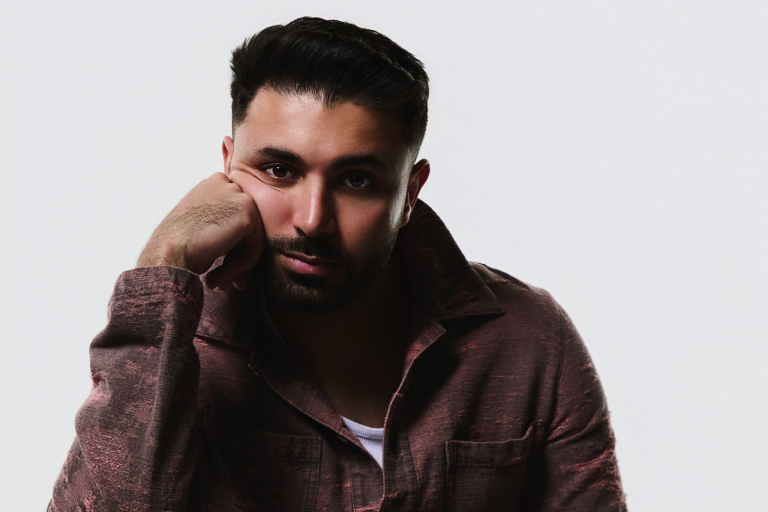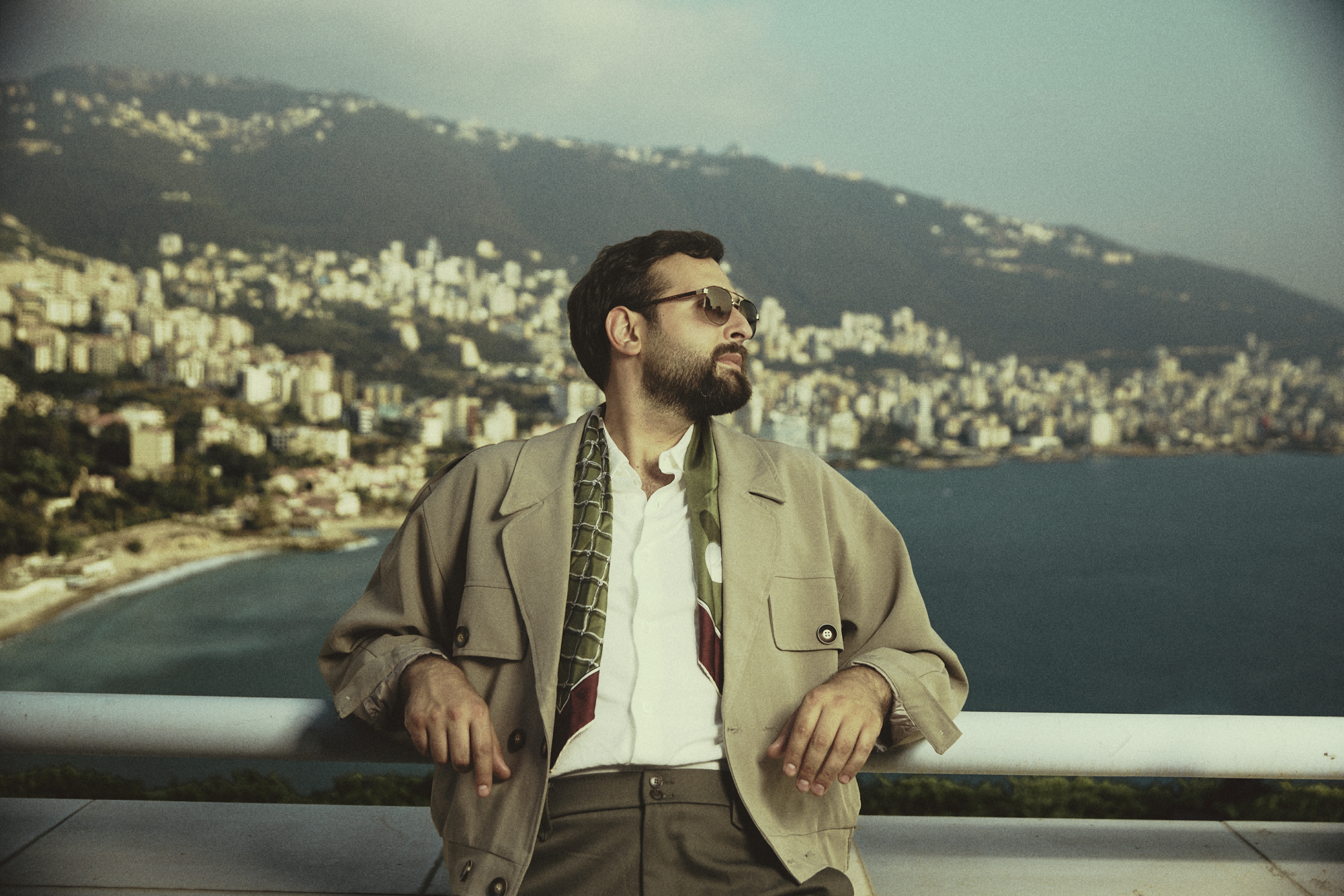
From the comfort of his Beirut home, George Nehme appeared relaxed and deeply present, speaking with the kind of quiet conviction that comes from knowing exactly who he is as an artist. He spoke with a calm, grounded clarity.
In truth, he’s the sort of artist whose words linger long after the call ends, the kind that quietly stirs something in you.
“If I’m not aware of where I come from, how can I know where I’m going?” the Lebanese artist says firmly. “Our music heritage only stays alive when we reinvent it, not by copying what was done decades ago, but by breathing new life into it.”
True to his word, George has made it his mission to carry the Lebanese song forward, and it’s safe to say it couldn’t be in better hands.
George Nehme is one of Lebanon’s most striking contemporary voices. Grounded in the tender lyricism of old-school Lebanese song but driven by a modern sound, he has carved a niche of his own in today’s Arabic soundscape. From his 2016 breakthrough “Ya Tafida” to his latest release “Weqef El Machroue,” he moves between nostalgia and modernity with a rare, sincere ease, captivating millions and selling out venues across the Arab world and its far-flung diaspora.
But what truly sets him apart is his charisma in live performance. He trades vocal lines with his band and audience, slips into mawwal improvisation and melisma, and bends phrasing into something that feels like an intimate conversation. Few performers today command stage presence like George Nehme; fewer still do it with such unmistakable grace, punctuating moments with his signature cry of “rouh!” (go).
While plenty of artists chase trends and algorithms, Nehme stays locked into something deeper: musical truth. He knows exactly what he’s doing, and more importantly, why.
“If I just follow trends, then I’m no longer saying what’s truly inside me,” he says.
That awareness runs through everything he creates. He gets the responsibility that comes with shaping how people, especially younger listeners, experience music, and he carries that weight with real care.
“Frequencies can move your body and emotions without you even noticing,” he says. “That’s why music is powerful.”
It’s no surprise he’s remained fully independent from the start, despite receiving offers from music labels. “I’m free to make my own artistic choices, to experiment and create,” he says. “Sometimes it works and sometimes it doesn’t, but owning that is part of what makes it so rewarding.”
Neither George nor his surname is anything but new to the music scene. A true wunderkind, he began his musical journey early, working with Wadi’ Al Safi at the age of eleven and later with Fairuz at just fourteen. He stepped into the spotlight before most children had even found their passions, landing a role as the youngest cast member in a rerun of the 1971 musical Sah el Noum alongside Fairuz.
“The energy she gives anyone who works with her is indescribable. Her precision, her attention to every detail. Those things don’t leave you,” he recalls. Long hours of studio recording and rehearsal, followed by the thrill of performing live, left a deep imprint on him. “I was watching how real work happens on stage,” says Nehme.
It was during that time that his artistic outlook began to take shape, guided by mentors like Fairuz, Wadie El-Safi, and Ziad Rahbani — figures he credits with teaching him discipline, musical integrity, and a deep sense of artistic responsibility.
“He told me, ‘One day you’ll compose, you’ll create,’” Nehme recalls a conversation with Wadie El-Safi. “I was too young to understand the full meaning, but it was like he planted a point inside me.”
One of nine siblings, including renowned singer Abeer Nehme, he comes from a profoundly musical household where rehearsals filled the days, cassette tapes played constantly, and the belief that love is the most important thing guided their lives. His family has always been central to his artistic journey, and it’s no surprise he is often seen performing alongside his siblings.
“We are very close as siblings,” says Nehme. “If one of us succeeds, it’s as if we all succeed… that’s a huge source of strength for us,” he adds. Whether singing hopeful songs during the pandemic or Christmas carols throughout the years, always insisting that music must be sincere in its words, meaning, and melody.
One of Nehme’s proudest moments was pioneering the concept of a Lebanese Band back in 2008 — a true first of its kind. “I always travel with my band because for me, bands are everything,” Nehme says.
Later, he took another significant step by founding an American band that performs Lebanese music blended with classical and jazz, turning what began as a musical experiment into a cultural bridge: “Each instrument comes from a different country and background. That’s how the ‘voice of Lebanon’ reaches people who don’t even speak Arabic,” he adds.
Though Nehme has built his career around singles, allowing each release to shine on its own, his heart is set on releasing a full body of work. “When you release one track at a time, you can give it the spotlight it deserves instead of letting it get lost among ten others. But an album, for me, is a complete story that carries the listener from the first note to the last,” he says. He believes such a project will deepen his artistic identity and forge a more meaningful bond with audiences, and it’s a creative challenge he hopes to take on soon.

Capturing something deeply Lebanese, his latest single “Weqef El Machroue” tells the story of the emotional push-and-pull of a reality that somehow keeps going despite everything stacked against it. The song came together almost by chance, during a casual catch-up between Nehme and composer Ziad Boutros, with whom he shares a long-standing artistic and personal connection. As they sat listening to new material in Boutros’ car, one track in particular stopped Nehme in his tracks.
“The subject matter speaks to everyone, especially in our region and the situation we live in. We go through a thousand hardships, but thank God, we’re still alive in the end,” says Nehme.
Nehme has been involved in countless projects, composing, arranging, directing, and producing with a quiet fluency. But because he’s not always front-facing, his role often slips under the radar, the public unaware of just how many works carry his imprint. He actually prefers it that way: he’s happy to remain anonymous if it means the work reaches people authentically. In 2016, he directed the second season of Ethnopholia, a 20-part documentary series that taps into the ancestral roots of global music cultures, from Sardinia to India, tracing how geography, ritual, and memory shape sound.
Behind the scenes, Nehme spends hours in his new home-studio, catching ideas as they come and recording them instantly.
“I treat it like a small playground,” he says. “Usually, the spontaneous ideas are the most honest.”
Before allowing a song to leave the studio, he runs it through a circle of trusted ears, from mixers and producers to his family, but perhaps most tellingly, his nieces and nephews.
“Kids don’t know how to lie. You can see everything on their faces,” he laughs.
The passing of Ziad Rahbani hit Nehme on both a personal and artistic level. It wasn’t only the farewell to a towering composer, but to the mentor who had once slipped him handwritten scores and ushered him into Fairuz’s ensemble while still a teenager.
“He taught me that music must have a conscience,” says Nehme. “That you can’t separate the art from the truth of the people. He never believed the artist was above the public. He always lifted others,” Nehme reminisces.
While Nehme wears many hats as a composer, performer, arranger, and director, above all, he is a visionary. With a passion for sight, sound, and thought, he approaches every project as its self-contained universe, created to captivate both the ear and the eye. He is already nurturing ideas for a full-concept album, a film, even a modern Lebanese musical — projects “written in drawers” waiting for the right moment.
When our conversation drifts back to his earliest days, the kid standing next to Fairuz on stage, I ask what he would tell that boy now, after all these years.
Nehme pauses, smiles softly, and says, “I’d tell him, ‘You’re more than enough. Keep going.’”