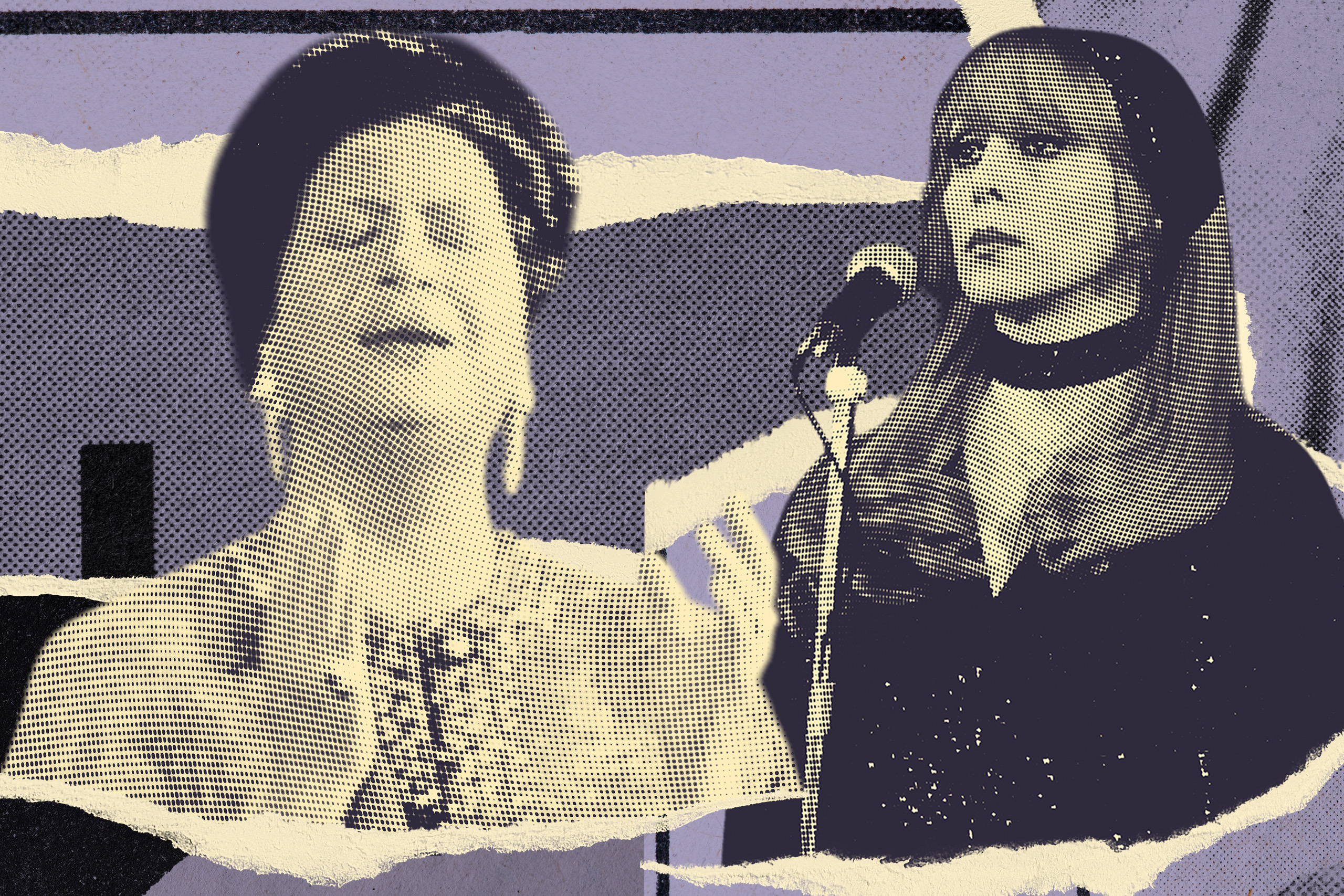
In the spring of 1967, a shimmering moment of cultural reconciliation took place onstage at Cairo University. Sabah, the Lebanese star whose Egyptian citizenship had been revoked during Gamal Abdel Nasser’s presidency, returned from exile under the leadership of Anwar Sadat. Once banned from the airwaves and erased from cinemas amid what was widely believed to be a political fallout, she now stood before a cheering crowd, her sequined dress catching the lights, her high ponytail swaying, as she sang through tears of joy.
“But how could just one hour pass, and we forget you, Egypt?” sings Sabah in a Lebanese-mountain style mawwal that opens “Walla Wetgama’na,” later dubbed the “song of return.” The song speaks of reunion, fate, and a love for Egypt that endures across distance and time. The grainy black-and-white footage that survived from that night feels almost mythic. Sabah waves her handkerchief, beaming, her energy both regal and electric. It is this version of the Lebanese legend that remains etched in the public imagination: radiant, spirited, and unmistakably alive.
Today, fragments of performances by Sabah, Umm Kulthum, Abdel Halim Hafez, Fairuz, and Warda circulate widely on social media. Sometimes it’s just a couplet, a mawwal, or the opening introduction of an ughniya. Out of context, they risk appearing as mere relics. But when paired with the right visual, whether a performance or even an AI-generated clip, the music comes alive again. A track buried deep in a streaming catalog can suddenly evoke a time when music felt more certain, more sincere, and built to last. For instance, Fairuz’s “Wahdon” saw a 63.97% increase in Spotify streams over the past three months—an additional 2.5 million plays—according to music analytics company Chartmetric.
The streams from Arabic music’s golden age still hold steady, even after artists have passed or retired. Tribute concerts sell out. And their voices are still heard in coffee shops, car radios, and balconies across the region. The continued presence of legacy artists reflects a deeper shift in how talent is defined, performed, and sustained. Both Fairuz and Warda are now at their highest streaming peaks, reaching 1.52 million and 391 thousand Spotify monthly listeners, respectively.
For much of the 20th century, achieving stardom in the Arab world required more than charisma or luck. It required technical skill, a profound familiarity with Qur’anic recitation, and a nuanced understanding of the maqam system—a complex set of tonal modes that form the foundation of Arabic music.
But in the 1970s, Egypt’s cassette revolution disrupted the gatekeeping structures of the music industry and redefined stardom for Arab artists. Wedding singers and shaabi artists found mass appeal through bootlegged tapes and informal distribution networks. By the 90s and the 00s, the rise of music videos brought a new priority: image. The visual began to matter as much as the voice. Televised talent shows, like Studio El Fan and Star Academy, launched careers not just by judging vocal ability, but also by weighing charm, appearance, and on-screen presence. Artists such as Majida El Roumi, Wael Kfoury, and Elissa emerged not just as singers, but as complete public figures.
Those barriers are virtually nonexistent today. Anyone with a phone and a beat can release a track. The tools of production have been democratized, but visibility has not. With platforms like TikTok and Instagram delivering highly personalized content, one user may be served dabke remixes, while another is directed straight to Moroccan trap. This hyper-fragmentation has made it harder than ever for a single voice to resonate across the region.
The result is a paradox. Amid this volatility, the careers of legacy artists, built slowly and deliberately over the years, feel more like the exception than the norm.
As technology shifts the way music is created and consumed, it has also blurred the boundaries of genre. Many of today’s Arabic pop tracks rely heavily on Western harmonic progressions. Producers may add a few regional flourishes, such as an oud taqsim or a tabla rhythm, to evoke an “Arabic” sound. However, beneath the lyrics, the structure is often indistinguishable from a Western hit.
Arabic classical music is particularly vulnerable to algorithm-driven platforms. Rich traditions such as muwashshah, qasida, and taqtuqa are collapsed under the broad and vague label of tarab. Algorithms trained on Western listening habits struggle to make sense of hour-long tracks with extended intros and multiple tonal shifts. Tarab was never intended for passive consumption, but rather for moments of exchange between the artist and the audience.
This is where live experiences bring back what algorithms filter out. The arc of a performance, be it at a majlis or onstage with an orchestra, bends to the mood of the room. That spirit survives in sold-out tribute concerts from the Cairo Opera House to Riyadh Season, where crowds of all ages sing along to songs released long before they were born. For many, this music was once dismissed as slow or outdated, something their parents played in the background. But with time, distance gives way to depth. Suddenly, each musical modulation in “Alf Leila We Leila” reveals the brilliance of Baligh Hamdi. On YouTube, the original version of “Alf Leila We Leila” has 89 million views, with the National Arab Orchestra version not far behind at 69 million.
Change has opened the door for more diverse voices, but not all progress is created equal. The current attention economy serves us well in some ways. But for artists, a brief surge of momentum can feel like a promise of lasting success, only to collapse under the pressure to keep up. Many find themselves burning out before they’ve even had the chance to build something real.
In the middle of all this, some of us retreat to the tarabs, to the voices that don’t chase trends but create space. And some retreat to the superstars of the past decades, such as Sherine, Amr Diab, and Nancy Ajram. Of the top ten artists in the region by Spotify monthly listeners, nine have careers that span more than three decades. This landscape, after all, still rewards artists who came up through older paths, such as radio, music videos, and televised concerts. Maybe that’s something worth holding on to.
One thing we should take pride in is our instinct to honor the voices that have shaped our culture. We do this not by dwelling on the past, but by appreciating the beauty of our musical archive. Our music wasn’t made for endless scrolling. It was meant to be heard with intention, to be shared, and to be felt deeply. Not all Arabic music needs to be tarab, but the existence of this music gives us something real to hold onto. It helps us make sense of the noise, offering a space that feels familiar even if the world around us keeps shifting. We might not wake up to a “Fairuzyat” mix on YouTube every morning, but it’s enough to know it’s there, quietly waiting, with open arms, for whenever we choose to return.